
The Pythagorean theorem is the one piece of school geometry that most adults still use, often without noticing. Every time a builder checks a corner with a tape measure, a decorator works out how far a ladder will reach or a shop lists a television by its diagonal, the same rule is doing the work: in a right-angled triangle, a² + b² = c². This guide explains what the theorem says, why it is true and how it solves real measuring problems, with numbers you can check in the free Pythagorean theorem calculator as you read.
Quick answer: The Pythagorean theorem says that in any right triangle the square of the longest side equals the sum of the squares of the other two: a² + b² = c². Real-life uses include squaring a corner with the 3-4-5 rule, working out how high a ladder reaches, finding a screen's width from its diagonal and measuring straight-line distance on a map.
What Does the Pythagorean Theorem Say?
The theorem says that if a triangle has a right angle, the area of the square drawn on its longest side equals the combined area of the squares on the two shorter sides. The longest side, opposite the right angle, is the hypotenuse, usually labelled c. The two sides that form the right angle are the legs, a and b.
c = √(a² + b²) and a = √(c² − b²)
The simplest whole-number case is the 3-4-5 triangle: 3² + 4² = 9 + 16 = 25, and √25 = 5. Sets like this are called Pythagorean triples, and 5-12-13 and 8-15-17 are the next most useful. The theorem is named after the Greek mathematician Pythagoras, although Babylonian clay tablets show the relationship was being used more than a thousand years earlier. Today it is taught in Key Stage 3 in England and in grade 8 in the United States, where the Common Core geometry standards ask students to explain a proof and apply the theorem to real-world problems in two and three dimensions.
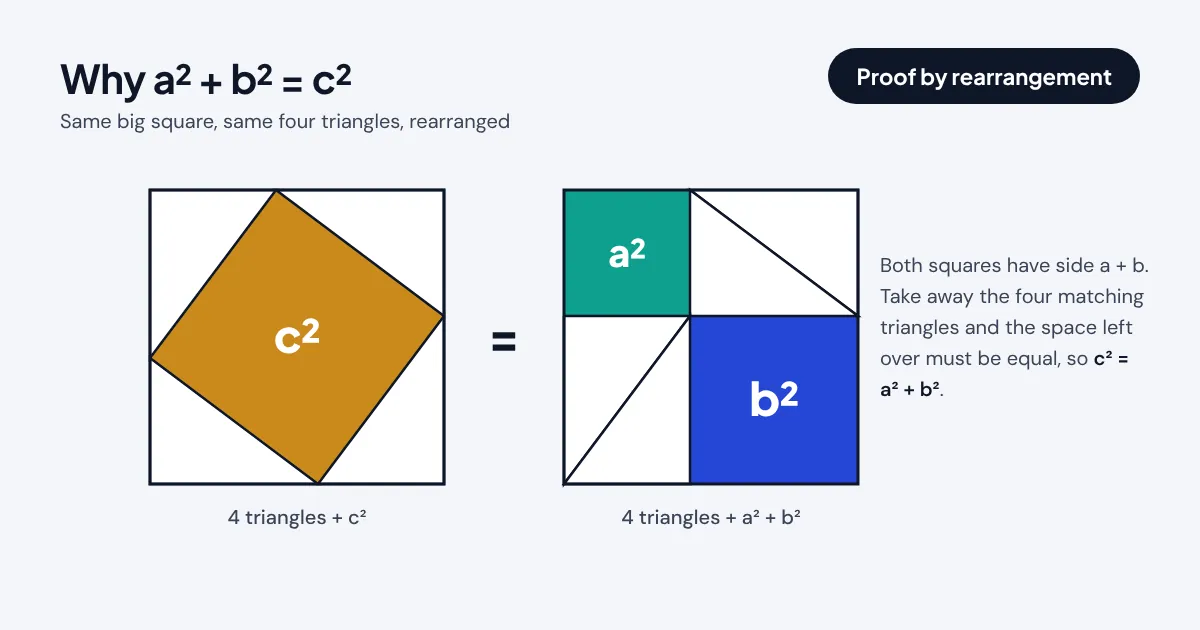
The neatest proof needs no algebra. Draw a large square with side a + b and place four copies of the triangle inside it. Arranged one way, they leave a tilted square of area c² in the middle. Rearranged, they leave two squares of area a² and b². The empty space has to be the same both times, so a² + b² must equal c².
How Do Builders Use the 3-4-5 Rule to Get a Square Corner?
Builders measure 3 units along one side of a corner, 4 units along the other and check that the diagonal between the two marks is exactly 5 units. If it is, the corner is a true 90°. Because the theorem works in both directions, a triangle with sides 3, 4 and 5 must contain a right angle, so the check needs nothing more than a tape measure.
Scale the numbers to suit the job. For a shed base, 0.9 m, 1.2 m and 1.5 m works well; for a house extension, 3 m, 4 m and 5 m or even 6 m, 8 m and 10 m gives a more accurate result, because a small measuring error matters less over a longer distance. Landscapers sometimes use a loop of rope with 12 equally spaced knots instead. To mark the knots on a 7.5 m rope, divide 7.5 by 12 to get 0.625 m between knots; if you want to see that sum worked through on paper, the long division calculator shows each step. Pegging the rope into a 3-4-5 shape then gives a right angle on open ground.
How High Will a Ladder Reach?
A ladder leaning against a wall makes a right triangle: the ladder is the hypotenuse, the wall is one leg and the ground between the wall and the foot of the ladder is the other. To find the height, square the ladder length, subtract the square of the ground distance and take the square root.
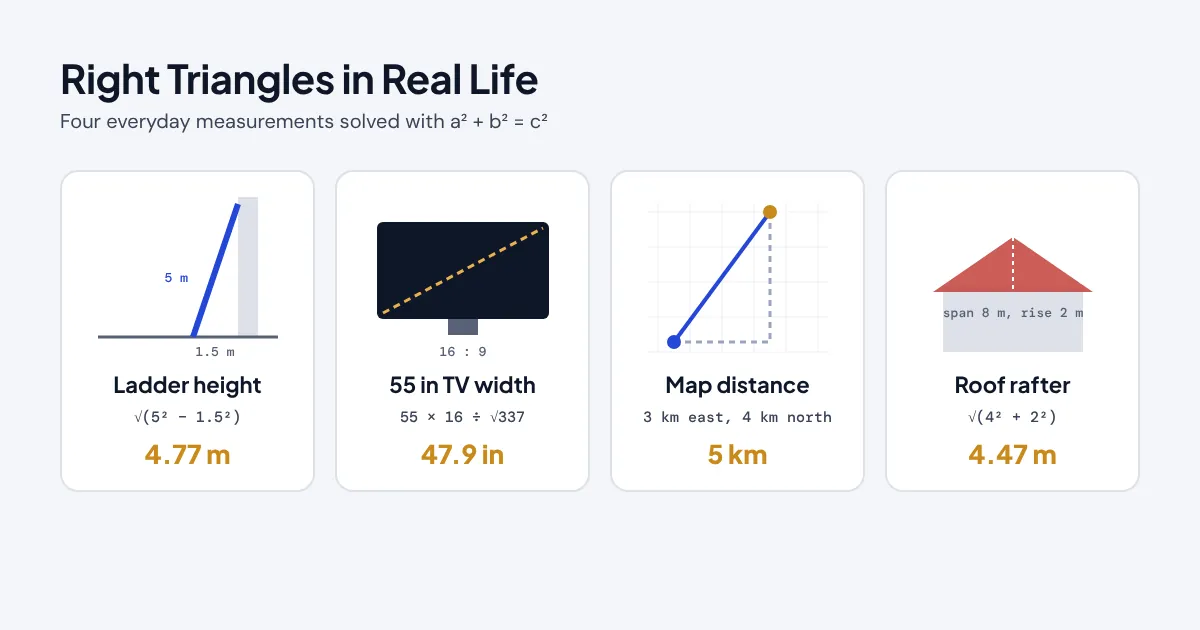
Take a 5 m ladder with its foot 1.5 m from the wall. The height reached is √(5² − 1.5²) = √(25 − 2.25) = √22.75 ≈ 4.77 m. The usual safety rule is "1 in 4": one unit out from the wall for every four units up, which gives an angle of about 76°. For a 5 m ladder that puts the foot about 1.21 m out and the top about 4.85 m up. The theorem tells you the geometry; for the full safety checklist, including footing and securing the ladder, read the HSE guidance on using ladders.
How Are TV and Phone Screens Measured?
Screens are sold by their diagonal, which is the hypotenuse of a right triangle formed by the width and height. For a 16:9 screen, the diagonal of the ratio triangle is √(16² + 9²) = √337 ≈ 18.36. Divide the advertised size by 18.36 and multiply by 16 for the width and by 9 for the height.
| Advertised size (16:9) | Width | Height |
|---|---|---|
| 32 in | 27.9 in (70.8 cm) | 15.7 in (39.8 cm) |
| 43 in | 37.5 in (95.2 cm) | 21.1 in (53.5 cm) |
| 55 in | 47.9 in (121.8 cm) | 27.0 in (68.5 cm) |
| 65 in | 56.7 in (143.9 cm) | 31.9 in (80.9 cm) |
| 75 in | 65.4 in (166.0 cm) | 36.8 in (93.4 cm) |
These figures are for the visible picture; the frame adds a little more, so always check the stand or wall space against the maker's dimensions. The same method works for phones. A 6.1 in phone with a 19.5:9 screen is about 2.56 in wide and 5.54 in tall, which explains why a tall, narrow phone can have a bigger headline size than a wider one but less screen area.
How Do You Find Straight-Line Distance on a Map?
On a grid map, the east-west gap and the north-south gap between two places are the legs of a right triangle, and the straight-line distance is the hypotenuse. If a walk ends 3 km east and 4 km north of where it started, you are 5 km from the start as the crow flies, even though you walked 7 km along the paths.
With coordinates this becomes the distance formula, d = √((x₂ − x₁)² + (y₂ − y₁)²). The midpoint calculator applies it to any two points and also finds the halfway point between them, which is handy for choosing a fair meeting place or the centre of a straight path. Over long distances the curve of the Earth matters and navigation software uses spherical formulas instead, but for a town map, a garden plan or a game board the flat version is accurate enough.
Where Else Does the Theorem Turn Up?
Once you start looking, right triangles are everywhere:
- Roofs. A roof with an 8 m span and a 2 m rise needs rafters of at least √(4² + 2²) = √20 ≈ 4.47 m, before the overhang is added.
- Stairs and ramps. The going and the rise form the legs, and the length of the stringer or ramp surface is the hypotenuse.
- Box fitting. The longest pole that fits flat in a 60 cm by 80 cm drawer is √(60² + 80²) = 100 cm. In three dimensions, add the depth as a third square under the root.
- Video games and graphics. Games check whether two objects are within range with the same distance formula, usually comparing squared distances to skip the slow square root.
- Probability. If you pick a random point in a 1 by 1 square, it lands within a distance of 1 of a corner when x² + y² ≤ 1. That happens with a probability of π/4, about 78.5%. The probability calculator turns any count of hits and trials into a percentage, which is how simulations use this fact to estimate π.
What Mistakes Should You Avoid?
Most wrong answers come from a handful of slips, and all of them are easy to catch:
- Using the wrong side as c. The hypotenuse is always opposite the right angle and always the longest side. If your "c" comes out shorter than a leg, the sides are in the wrong places.
- Adding instead of subtracting. To find a leg, subtract: a² = c² − b². Adding gives a value longer than the hypotenuse, which is impossible.
- Mixing units. Convert everything to the same unit first. Adding 150 cm² to 2 m² gives nonsense.
- Forgetting the square root. a² + b² gives c², not c. For legs of 6 and 8, c² is 100 but c is 10.
- Using it on the wrong triangle. The theorem only works with a right angle. For any other triangle, use the cosine rule.
A quick sense check helps too: the hypotenuse is always longer than either leg but shorter than the two legs added together. A 3-4 triangle must have a hypotenuse between 4 and 7, and 5 sits comfortably in that range.
Frequently asked questions
What is the Pythagorean theorem in simple words?
In a triangle with a right angle, square the two shorter sides and add them together. The total equals the square of the longest side. So if the short sides are 3 and 4, the long side is 5.
Why is the 3-4-5 rule used in building?
Because 3² + 4² = 5², any triangle with sides in the ratio 3:4:5 has a right angle. Measuring those three lengths with a tape is a fast, accurate way to set out a square corner without a large set square.
Does the Pythagorean theorem work in 3D?
Yes. The diagonal of a box with sides a, b and c is √(a² + b² + c²). It is the theorem applied twice: once across the base and once up to the opposite corner.
Who discovered the Pythagorean theorem?
It is named after Pythagoras, who lived around 570 to 495 BC, but Babylonian and Indian mathematicians used the relationship much earlier. Pythagoras or his followers are usually credited with an early general proof.
How do I find a missing side quickly?
Enter the two sides you know into a Pythagorean theorem calculator. It squares, adds or subtracts, takes the root and shows each step, so you can copy the working into homework or a site notebook.