Quick answer: The nth term is a rule that gives any term of a sequence from its position n. For a linear sequence, nth term = difference × n + (first term − difference), so 5, 8, 11, 14 has nth term 3n + 2 and the 20th term is 62. This nth term calculator also solves quadratic, cubic and geometric sequences.

What Does an Nth Term Calculator Do?
An nth term calculator reads the terms you type, works out what kind of sequence they form, and writes the general rule in terms of n. Enter a few terms such as 5, 8, 11, 14, 17 and it returns the nth term (3n + 2), any term you ask for, the next three terms, the 100th term, and whether a particular number belongs to the sequence. The difference table and every step of the method are printed underneath, set out the way GCSE mark schemes expect.
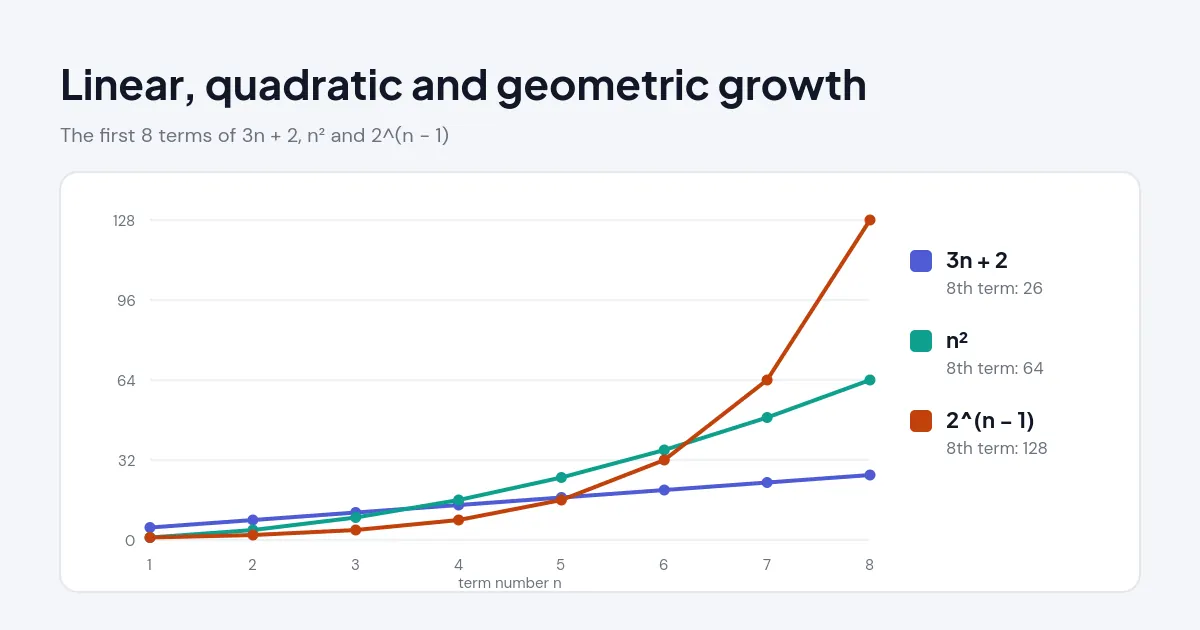
It recognises five kinds of pattern: linear (arithmetic), quadratic, cubic, geometric and Fibonacci-type, as well as constant sequences. Fractions, decimals and negative numbers are handled exactly, with no rounding, so a rule such as ½n² + ½n for the triangle numbers comes out precisely. To add up the terms rather than find them, the series calculator gives arithmetic and geometric sums.
How Do You Use the Nth Term Calculator?

- Type the sequence, separating the terms with commas or spaces. Give at least 3 terms, and 4 or 5 for quadratic or cubic patterns.
- Enter the term number you want, for example 20 for the 20th term.
- Optionally, type a number to test whether it appears in the sequence.
- Read the nth term rule and the sequence type at the top of the result.
- Check the difference table and the numbered steps, which show how the rule was found.
The more terms you give, the safer the answer. Three terms always fit a quadratic, so the calculator tells you when a rule has been assumed from too few terms.
How Do You Find the Nth Term of a Linear Sequence?
For a linear sequence, find the common difference d and the first term a, then the nth term is dn + (a − d). The difference tells you which times table the sequence follows, and the adjustment lines it up with the first term.
Quadratic: nth term = an² + bn + c, where a = second difference ÷ 2
Cubic: the n³ coefficient = third difference ÷ 6
Worked example (linear): 5, 8, 11, 14, 17 goes up by 3 each time, so the rule starts with 3n. When n = 1, 3n gives 3, but the first term is 5, so add 2: the nth term is 3n + 2. The 20th term is 3 × 20 + 2 = 62. To test whether 100 is in the sequence, solve 3n + 2 = 100, giving n = 32.67; that is not a whole number, so 100 is not a term.
Worked example (decreasing): 10, 7, 4, 1 goes down by 3, so the rule starts with −3n. When n = 1 that gives −3, and the first term is 10, so add 13: the nth term is 13 − 3n, and the 5th term is −2.
How Do You Find the Nth Term of a Quadratic Sequence?
A sequence is quadratic when the first differences change but the second differences are constant. Halve the second difference to get the n² coefficient, subtract that n² pattern from the sequence, and find the nth term of the linear sequence that is left.
Worked example: take 2, 9, 20, 35, 54. The first differences are 7, 11, 15, 19 and the second differences are all 4, so a = 4 ÷ 2 = 2 and the rule starts with 2n². The values of 2n² are 2, 8, 18, 32, 50. Subtracting gives 0, 1, 2, 3, 4, which has nth term n − 1. So the nth term is 2n² + n − 1, and the 20th term is 2 × 400 + 20 − 1 = 819.
Quadratic nth terms are part of the higher tier in the Department for Education GCSE mathematics subject content, while linear rules are expected at foundation tier. For a fuller treatment of arithmetic and geometric sequences with exercises, OpenStax (Rice University) has a free chapter on arithmetic sequences.
Which Type of Sequence Is It?
Look at the differences first, then the ratios. The table shows the test for each type and an example you can paste into the calculator.
| Type | Test | Example | Nth term |
|---|---|---|---|
| Linear (arithmetic) | Constant first difference | 5, 8, 11, 14 | 3n + 2 |
| Quadratic | Constant second difference | 2, 3, 6, 11, 18 | n² − 2n + 3 |
| Triangle numbers | Second difference 1 | 1, 3, 6, 10, 15 | ½n² + ½n |
| Cubic | Constant third difference | 1, 8, 27, 64, 125 | n³ |
| Geometric | Constant ratio | 3, 6, 12, 24 | 3 × 2n − 1 |
| Fibonacci-type | Each term = sum of the two before | 1, 1, 2, 3, 5, 8 | No simple nth term; rule Tn = Tn−1 + Tn−2 |
A common slip is to call 3, 6, 12, 24 linear because it starts by going up in threes. Check every gap: they are 3, 6, 12, so the differences are not constant, but each term is double the one before, which makes it geometric. The exponent calculator is handy for working out large powers such as 219 when you need a far-off geometric term.
Related Tools
- Series Calculator
- Linear Equation Calculator
- Quadratic Formula Calculator
- Exponent Calculator
- Fraction Calculator
- Interpolation Calculator
Frequently asked questions
How do you find the nth term of a sequence?
Find the difference between terms. If it is constant, multiply it by n and add the first term minus the difference. For 5, 8, 11, 14 that gives 3n + 2.
What does n stand for in the nth term?
n is the position of a term: 1 for the first term, 2 for the second and so on. Substituting n = 20 into the rule gives the 20th term.
How do you know if a sequence is quadratic?
The first differences change, but the differences between them (the second differences) stay the same. For 2, 9, 20, 35, 54 the second difference is always 4.
How do you check if a number is in a sequence?
Set the nth term equal to the number and solve for n. If n is a positive whole number, the number is a term. For 3n + 2 = 62, n = 20, so 62 is the 20th term.
What is the nth term of a geometric sequence?
a × rn − 1, where a is the first term and r is the common ratio. For 3, 6, 12, 24 the nth term is 3 × 2n − 1, so the 10th term is 1,536.
How many terms do I need to enter?
At least 3. Use 4 or more to confirm a quadratic and 5 or more to confirm a cubic, because any 3 numbers can be fitted by some quadratic.