Quick answer: A trigonometry calculator finds sin, cos and tan, plus csc, sec and cot, for any angle in degrees or radians, and turns a value back into an angle with arcsin, arccos or arctan. For 30°, sin = 1/2, cos = √3/2 ≈ 0.8660 and tan = √3/3 ≈ 0.5774. Special angles are shown as exact surds.

Which Trig Functions and Angle Units Are Covered?
A trigonometry calculator evaluates the six trigonometric functions of an angle and solves the reverse problem of finding an angle from a ratio. Type an angle in degrees, radians or gradians and it returns sin, cos, tan, cosec, sec and cot together, states the quadrant and the reference angle, and draws the angle on a unit circle so you can see why each sign is positive or negative.
For the angles you meet most often, multiples of 15°, the answers appear as exact values such as √3/2 or 2 − √3 next to the decimal, which is what exam mark schemes expect on non-calculator papers. Radians can be typed with pi, for example 3pi/4 or π/6. If you are working with the sides of a right-angled triangle rather than a bare angle, the right triangle calculator applies SOH CAH TOA to the whole triangle in one go.
How Do You Find Sin, Cos and Tan of an Angle?
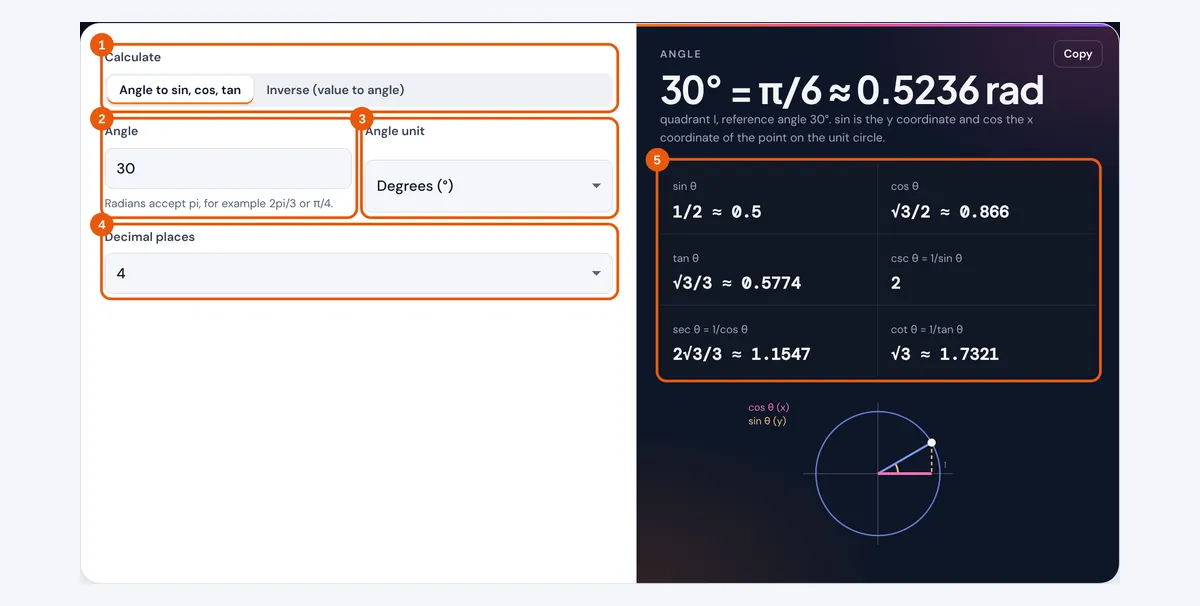
- Choose Angle to sin, cos, tan, or Inverse to turn a value into an angle.
- Type the angle, for example 135, −60 or pi/3, or type the value for the inverse function, such as 0.5 or sqrt3/2.
- Pick the unit: degrees, radians or gradians. For inverse mode, pick arcsin, arccos, arctan, arccsc, arcsec or arccot.
- Choose the number of decimal places.
- Read all six ratios, the exact form where one exists, the quadrant and the unit circle. In inverse mode you also get every solution between 0° and 360°.
Tan and sec show as undefined at 90° and 270°, and cosec and cot at 0° and 180°, because the calculation would divide by zero there.
What Are the Trigonometric Formulas?
In a right-angled triangle, sine, cosine and tangent are ratios of two sides measured from the angle θ. On the unit circle the same ratios become coordinates, which extends them to any angle.
cosec θ = 1 ÷ sin θ sec θ = 1 ÷ cos θ cot θ = 1 ÷ tan θ
radians = degrees × π ÷ 180 sin² θ + cos² θ = 1
Worked example: find sin, cos and tan of 210°. The angle is in quadrant III, 30° past 180°, so the reference angle is 30°. In quadrant III both x and y are negative, so sin 210° = −1/2 and cos 210° = −√3/2 ≈ −0.8660. Tan is the ratio of two negatives, so tan 210° = √3/3 ≈ 0.5774, which is positive. In radians, 210° is 7π/6 ≈ 3.6652.
The NIST Digital Library of Mathematical Functions section on the trigonometric functions sets out the formal definitions, and its neighbouring sections list the identities and the principal ranges this calculator uses.
What Are the Exact Values of Sin, Cos and Tan?
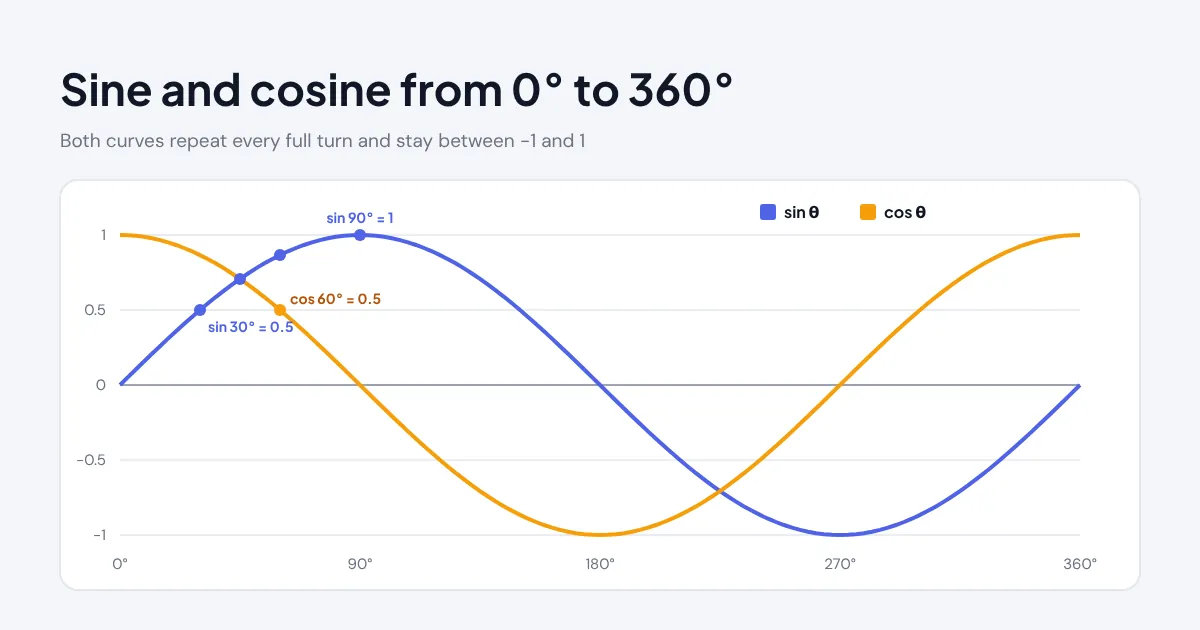
The exact values below come from two triangles: the half square with angles 45°, 45°, 90° and the half equilateral triangle with angles 30°, 60°, 90°. Learning these five rows covers most exam questions.
| Angle | Radians | sin θ | cos θ | tan θ |
|---|---|---|---|---|
| 0° | 0 | 0 | 1 | 0 |
| 30° | π/6 | 1/2 | √3/2 ≈ 0.8660 | √3/3 ≈ 0.5774 |
| 45° | π/4 | √2/2 ≈ 0.7071 | √2/2 ≈ 0.7071 | 1 |
| 60° | π/3 | √3/2 ≈ 0.8660 | 1/2 | √3 ≈ 1.7321 |
| 90° | π/2 | 1 | 0 | undefined |
Exact trigonometric values for 0°, 30°, 45°, 60° and 90° are listed in the Department for Education GCSE mathematics subject content among the facts GCSE students are expected to know. For other quadrants, use the reference angle and the sign rule: all positive in quadrant I, only sine in II, only tangent in III and only cosine in IV.
How Do Inverse Trig Functions Work?
An inverse trig function gives the angle whose ratio equals your value, but it can only return one answer, called the principal value. Arcsin and arctan return angles from −90° to 90°, and arccos returns angles from 0° to 180°.
Because sine and cosine repeat, an equation such as sin θ = 0.5 has two solutions in every full turn: 30° and 180° − 30° = 150°. The calculator lists both, gives them in radians, and writes the general solution with 360°k so you can find answers in any range. To find a missing angle in a triangle that is not right-angled, use the sine rule or cosine rule in the triangle calculator.
Related Tools
- Right Triangle Calculator
- Triangle Calculator
- Hypotenuse Calculator
- Pythagorean Theorem Calculator
- Area of a Triangle Calculator
- Circumference Calculator
Frequently asked questions
How do you calculate sin, cos and tan?
In a right-angled triangle, sin is opposite over hypotenuse, cos is adjacent over hypotenuse and tan is opposite over adjacent. For any other angle, read them from the unit circle using the reference angle and the quadrant signs.
How do I switch between degrees and radians?
Multiply degrees by π and divide by 180 to get radians. 60° is 60 × π ÷ 180 = π/3 ≈ 1.0472 radians. Multiply by 180 and divide by π to go back.
Why is tan 90° undefined?
tan θ = sin θ ÷ cos θ, and cos 90° = 0. Dividing by zero has no value, so tan 90° is undefined rather than a very large number.
What is the difference between sin⁻¹ and 1/sin?
sin⁻¹ is arcsin, the inverse function that turns a ratio into an angle. 1/sin is cosec, a ratio. sin⁻¹(0.5) = 30°, while 1/sin 30° = 2.
How do you find all solutions of sin x = 0.5 between 0° and 360°?
Find the principal value, arcsin 0.5 = 30°, then use the symmetry of sine: the second answer is 180° − 30° = 150°. For cosine, the second answer is 360° minus the principal value.
What are cosec, sec and cot?
They are the reciprocal ratios: cosec is 1 ÷ sin, sec is 1 ÷ cos and cot is 1 ÷ tan. The calculator shows them alongside sin, cos and tan.