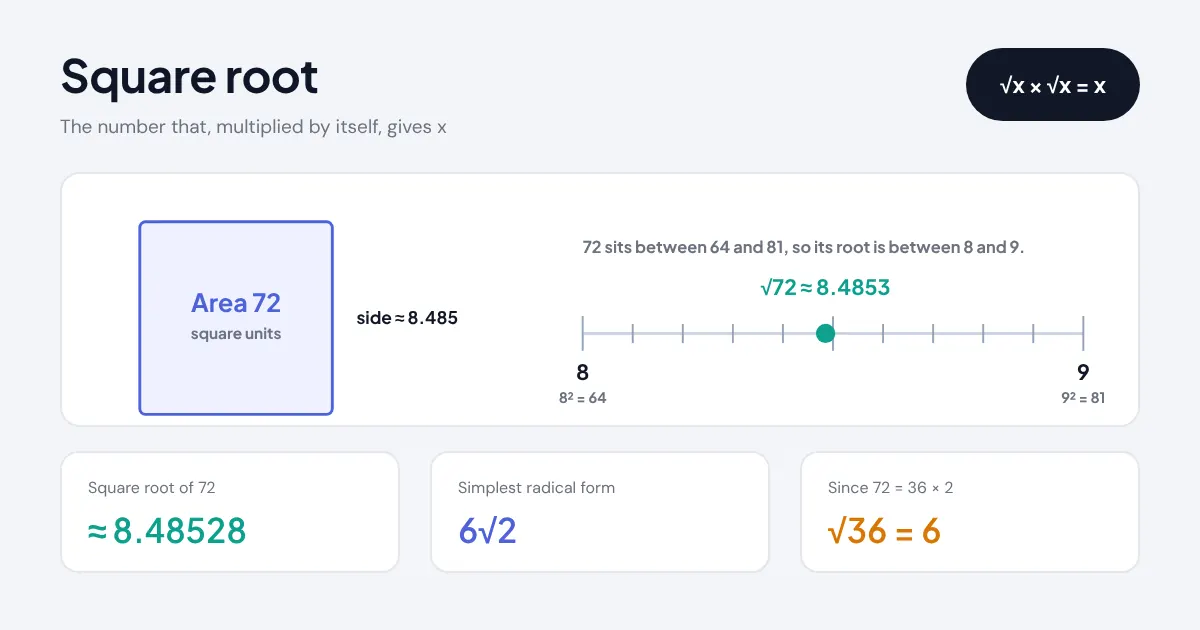
Quick answer: The square root of x is the number that gives x when multiplied by itself, so √64 = 8 because 8 × 8 = 64. Numbers that are not perfect squares have irrational roots: √72 ≈ 8.4852813742, which simplifies to 6√2. This square root calculator gives up to 100 exact decimal places, the simplest radical form and the method.
What Does the Square Root Calculator Show?
This square root calculator gives the principal (positive) square root of any number you type, rounded to the number of decimal places you choose, from 2 up to 100. Every digit is computed with exact whole-number arithmetic rather than ordinary floating point, so √2 to 50 places is correct to the last digit. Perfect squares such as 144 or 2.25 come back as exact answers with no rounding.
Alongside the decimal you get the simplest radical form (√72 = 6√2), a yes or no for perfect squares, the two perfect squares the number sits between, and the Babylonian method worked step by step. Type a negative number and it gives the imaginary root, for example √−9 = 3i. If you need cube roots, fourth roots or to add and multiply surds, use the radical calculator.
How Do You Use the Square Root Calculator?
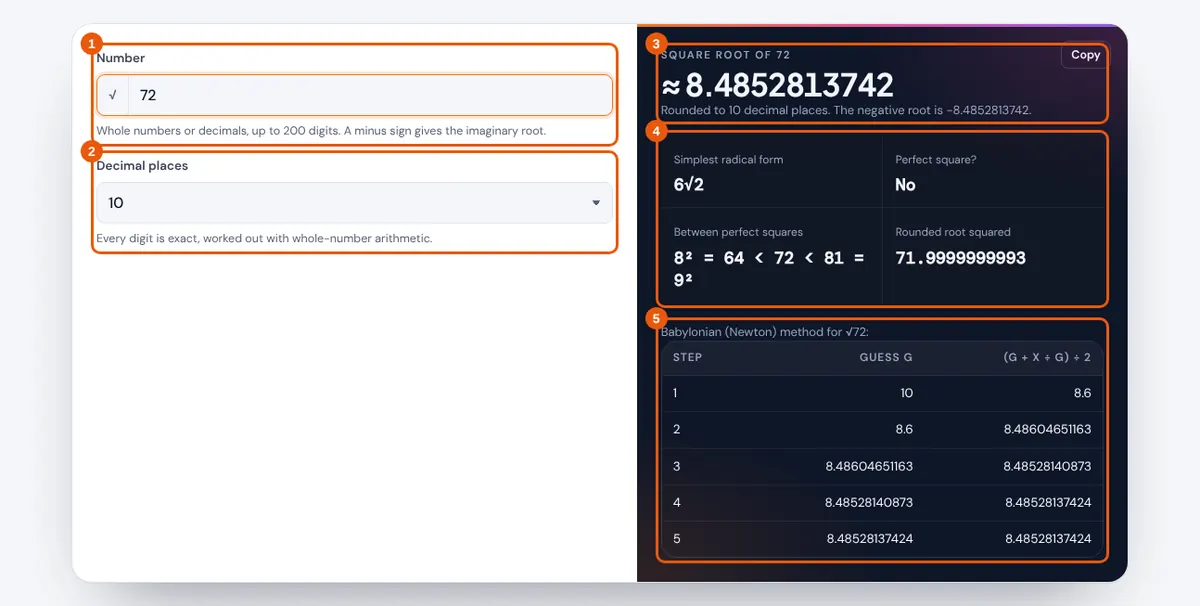
- Type the number under the √ sign. Whole numbers and decimals both work, and commas are ignored.
- Choose how many decimal places you want: 10 is plenty for schoolwork, while 50 or 100 suit checking code or exploring irrational numbers.
- Read the square root in the result box. An ≈ sign means the root is irrational and has been rounded.
- Check the simplest radical form if your teacher wants an exact answer.
- Use the Babylonian method table to see how the answer is reached by repeated averaging, then press Copy.
The calculator handles inputs of up to 200 digits, far beyond what a phone calculator can show.
How Do You Find a Square Root by Hand?
The fastest hand method is the Babylonian method, also called Newton's method for square roots. Start with any sensible guess, divide the number by the guess, and average the two. Each round roughly doubles the number of correct digits.
Babylonian method: gnext = (g + x ÷ g) ÷ 2
Worked example: find √72. Since 82 = 64 and 92 = 81, start with g = 8.5. Then 72 ÷ 8.5 ≈ 8.470588, and the average is (8.5 + 8.470588) ÷ 2 ≈ 8.485294. One more round gives 72 ÷ 8.485294 ≈ 8.485269, and the average is 8.4852814, which is already correct to seven decimal places.
Simplest radical form: look for the largest perfect square that divides the number. 72 = 36 × 2, so √72 = √36 × √2 = 6√2. The same idea gives √50 = 5√2 and √48 = 4√3. The Common Core grade 8 expressions and equations standards expect students to evaluate square roots of small perfect squares and to know that √2 is irrational.
What Are the Square Roots of Common Numbers?
These are the square roots people look up most often, rounded to six decimal places where they are irrational.
| Number | Square root | Simplest radical form | Perfect square? |
|---|---|---|---|
| 2 | 1.414214 | √2 | No |
| 3 | 1.732051 | √3 | No |
| 5 | 2.236068 | √5 | No |
| 8 | 2.828427 | 2√2 | No |
| 12 | 3.464102 | 2√3 | No |
| 16 | 4 | 4 | Yes |
| 20 | 4.472136 | 2√5 | No |
| 50 | 7.071068 | 5√2 | No |
| 72 | 8.485281 | 6√2 | No |
| 100 | 10 | 10 | Yes |
| 144 | 12 | 12 | Yes |
| 200 | 14.142136 | 10√2 | No |
Square roots are everywhere in geometry. The diagonal of a square with side s is s√2, and the Pythagorean theorem calculator takes a square root every time it finds a missing side. In statistics, the standard deviation is the square root of the variance, which the standard deviation calculator shows step by step.
What About Negative Numbers and Decimals?
A negative number has no real square root, because any real number times itself is zero or positive. In the complex numbers, √−x = i√x, where i2 = −1, so √−25 = 5i and √−8 = 2i√2.
Decimals work by pairing digits after the decimal point. √0.25 = 0.5 because 0.5 × 0.5 = 0.25, and √0.5 = √2 ÷ 2 ≈ 0.707107. Notice that the square root of a number between 0 and 1 is larger than the number itself. To write very large or very small roots compactly, pass the answer to the scientific notation calculator.
Related Tools
- Radical Calculator
- Exponent Calculator
- Pythagorean Theorem Calculator
- Hypotenuse Calculator
- Standard Deviation Calculator
- Rounding Calculator
Frequently asked questions
What is the square root of 2?
The square root of 2 is about 1.41421356237, and its decimals never end or repeat because it is irrational. Set the calculator to 50 or 100 places to see more of its digits.
Does a square root have two answers?
Every positive number has two square roots, one positive and one negative, since 8 × 8 and (−8) × (−8) both equal 64. The √ symbol means the positive one, called the principal square root, which is what this calculator shows first.
How do I know if a number is a perfect square?
Its square root is a whole number. Perfect squares end in 0, 1, 4, 5, 6 or 9, never in 2, 3, 7 or 8, which rules many numbers out quickly. The calculator says Yes or No for any input.
How do I simplify a square root?
Split the number into a perfect square times another factor, then take the root of the square. √180 = √36 × √5 = 6√5. Always use the largest perfect square factor so no further simplifying is needed.
Is the answer exact to 100 decimal places?
Yes. The calculator works with whole-number arithmetic on the digits you type, so every decimal place shown is correct, and the last one is rounded half up.
Can I find the square root of a negative number?
Not in the real numbers. Enter a negative value and the calculator gives the imaginary answer instead, for example √−72 = 6i√2 ≈ 8.4852813742i.