Quick answer: To work out a percentage decrease, subtract the new value from the original, divide by the original and multiply by 100. A price that falls from £250 to £185 has dropped by (250 − 185) ÷ 250 × 100 = 26%. This percentage decrease calculator also reduces a number by a percentage and finds the original value.

How Much Smaller Has a Value Become?
A percentage decrease calculator tells you how much smaller a value has become, expressed as a share of where it started. You enter the original value and the new value, and it returns the percentage decrease, the actual amount lost, the new value as a percentage of the old one and the multiplier that links them. It works for prices, wages, test marks, weights, website visits or anything else that has gone down.
It answers the other two common questions as well. Decrease by % takes a number and knocks a percentage off it, which is how a 15% discount or a 20% pay cut is worked out. Original value runs the sum backwards, so a coat reduced by 15% to £68 must have cost £80 before the sale. If the value has gone up instead, the calculator says so and shows the rise; the percentage increase calculator covers growth in more detail.
How Do You Work Out a Drop, Step by Step?

- Choose what you need: the percentage decrease between two values, a number decreased by a percentage, or the original value before a decrease.
- Type the original value and the new value, or the number and the percentage, depending on the mode.
- Pick how many decimal places you want in the answer.
- Read the result, the working with your numbers filled in, the amount of the drop and the multiplier.
- Press Copy to paste the answer into a spreadsheet, email or homework.
Commas and currency signs are ignored, so £1,250 works as well as 1250. Results update as you type.
What Is the Percentage Decrease Formula?
The percentage decrease formula divides the size of the drop by the original value and multiplies by 100. Always divide by the starting value, because that is the amount the change is measured against.
Decrease a number by p%: new = original × (1 − p ÷ 100)
Original before a p% decrease: original = new ÷ (1 − p ÷ 100)
Worked example: a car bought for £18,500 is worth £12,950 two years later. The drop is 18,500 − 12,950 = £5,550. Dividing by the original gives 5,550 ÷ 18,500 = 0.30, so the car has lost 30% of its value. The multiplier is 0.70, meaning it is now worth 70% of the purchase price.
Reverse example: after a 12% cut, a monthly bill is £44. The multiplier is 1 − 0.12 = 0.88, so the bill used to be 44 ÷ 0.88 = £50. Taking 12% off £44 instead would give the wrong answer, which is the most common slip with these questions. The reverse percentage calculator handles the same problem for increases too, such as removing VAT.
Why Does a Decrease Need a Bigger Increase to Recover?
A fall and the rise needed to undo it are different percentages because they are measured from different starting points. After a 50% drop, a value has halved, so it must double, a 100% increase, to get back to where it was.
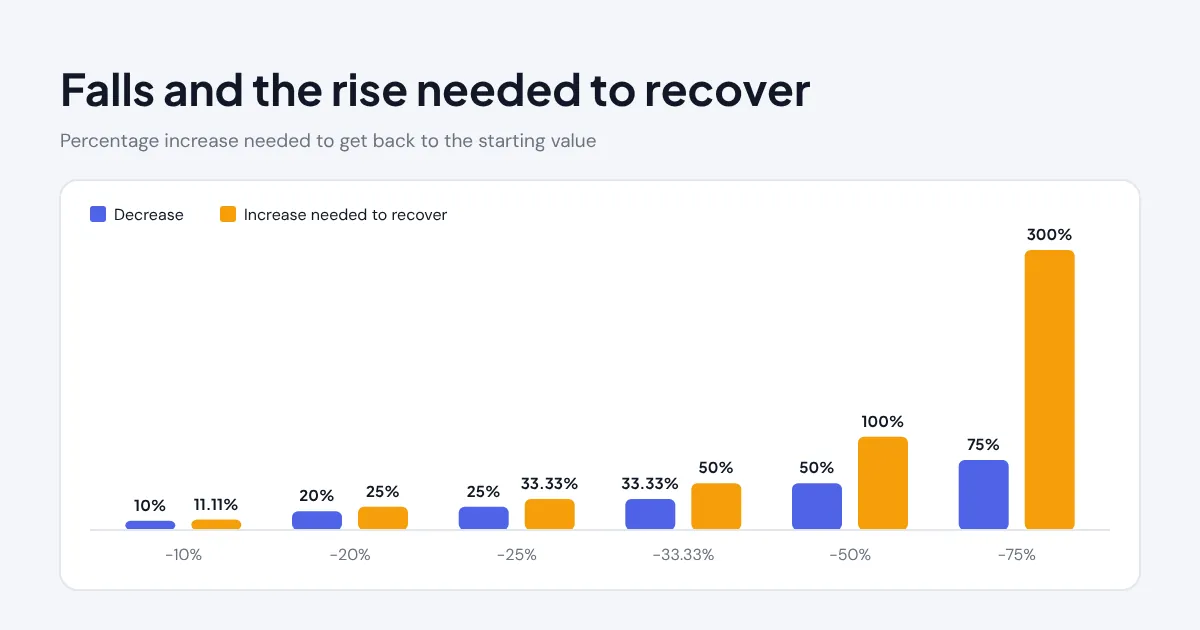
| Percentage decrease | Multiplier | £100 becomes | Increase needed to get back |
|---|---|---|---|
| 5% | 0.95 | £95.00 | 5.26% |
| 10% | 0.90 | £90.00 | 11.11% |
| 20% | 0.80 | £80.00 | 25.00% |
| 25% | 0.75 | £75.00 | 33.33% |
| 33.33% | 0.6667 | £66.67 | 50.00% |
| 50% | 0.50 | £50.00 | 100.00% |
| 75% | 0.25 | £25.00 | 300.00% |
The same idea explains successive discounts. Two reductions of 20% do not make 40%: the multiplier is 0.8 × 0.8 = 0.64, so the total decrease is 36%. When a figure rises and falls several times, the percentage change calculator keeps track of the sign for you.
Where Is Percentage Decrease Used?
Percentage decrease turns up in everyday maths and in GCSE papers alike. Shoppers use it to compare sale prices, drivers to measure depreciation, and businesses to report falls in costs, sales or staff absence. Official statistics use the same calculation: when the Office for National Statistics publishes its inflation and price indices, a fall in a price index from one period to the next is reported as a percentage decrease on the earlier figure.
In science, a falling reading such as a drop in temperature, mass or concentration is often quoted as a percentage of the starting value. If you are comparing a measured result with an expected one rather than an old value with a new value, use the percent error calculator instead, because it divides by the true value.
Related Tools
- Percentage Increase Calculator
- Percentage Change Calculator
- Reverse Percentage Calculator
- Average Percentage Calculator
- Fraction to Percent Calculator
- Percent Error Calculator
Frequently asked questions
How do you calculate a percentage decrease?
Subtract the new value from the original, divide the answer by the original and multiply by 100. From 80 to 60 the drop is 20, and 20 ÷ 80 × 100 = 25%.
How do I decrease a number by a percentage?
Multiply it by 1 minus the percentage as a decimal. To take 15% off £80, work out 80 × 0.85 = £68.
How do you find the original price after a percentage decrease?
Divide the reduced price by the multiplier. A price of £68 after a 15% reduction was 68 ÷ 0.85 = £80.
Can a percentage decrease be more than 100%?
Only if the value goes below zero, for example a profit turning into a loss. A quantity that cannot be negative, such as a price or a weight, can fall by 100% at most.
Is a percentage decrease the same as a negative percentage change?
Yes. A change of −26% and a decrease of 26% mean the same thing. This calculator shows decreases as positive numbers and flags any increase.
Why is a 50% decrease not undone by a 50% increase?
The increase is worked out on the smaller value. £100 down 50% is £50, and 50% of £50 is only £25, which brings it back to £75, not £100.