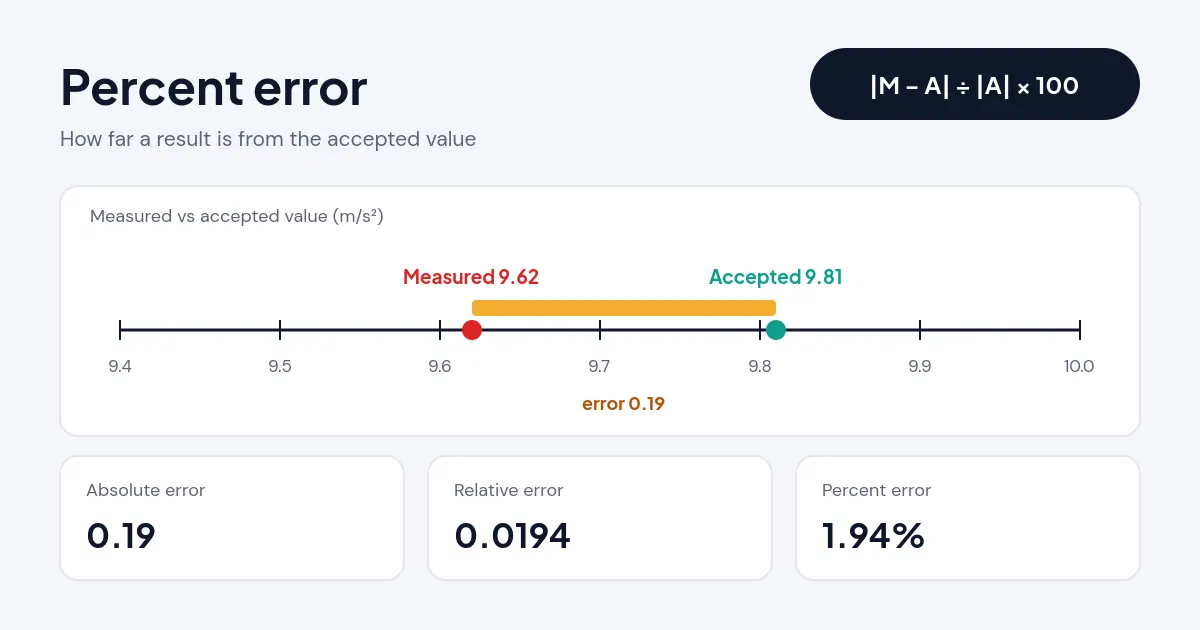
Quick answer: Percent error = |measured value − accepted value| ÷ |accepted value| × 100. If a pendulum experiment gives g = 9.62 m/s² and the accepted value is 9.81 m/s², the percent error calculator works out |9.62 − 9.81| ÷ 9.81 × 100 = 1.94%. Keep the sign to show whether you measured high or low.
How Far Is Your Result from the Accepted Value?
A percent error calculator measures how far an experimental or estimated result is from the true or accepted value, expressed as a percentage of that accepted value. It is the standard accuracy check in high school and college science labs: you measure the acceleration due to gravity, the density of aluminum or the boiling point of water, then compare your number with the textbook value. A small percent error means your method was accurate; a large one points to a mistake, a faulty instrument or an effect you did not control.
This calculator handles a single result or a whole set of trials. Paste several measurements and it averages them, finds the percent error of the mean and lists the error of each trial, so you can spot the one reading that pulled your result off. It also shows the absolute error, the relative error as a decimal and whether you measured above or below the accepted value.
How Do You Check a Lab Result's Accuracy?

- Type your measured value, the number you got from the experiment or estimate.
- Type the accepted value, the true, theoretical or reference figure you are comparing against.
- If you ran several trials, paste them in the trials box instead. The calculator uses their mean as the measured value.
- Choose Absolute for the usual positive percent error, or Signed to keep a minus sign when your result is below the accepted value.
- Read the percent error and the working line, then copy the result into your lab report.
Scientific notation such as 6.02e23 is accepted, which helps with very large or very small constants.
What Is the Percent Error Formula?
The percent error formula divides the absolute error by the size of the accepted value and multiplies by 100.
Signed percent error = (measured − accepted) ÷ |accepted| × 100
Absolute error = |measured − accepted| Relative error = absolute error ÷ |accepted|
Worked example: three pendulum trials give 9.58, 9.70 and 9.61 m/s². Their mean is (9.58 + 9.70 + 9.61) ÷ 3 = 9.63 m/s². The absolute error is |9.63 − 9.81| = 0.18, so the percent error is 0.18 ÷ 9.81 × 100 = 1.83%. The signed percent error is −1.83%, which tells you the measurements ran low, perhaps because the string stretched or the swing angle was too large.
The accepted value goes in the denominator, never your measurement. That is why percent error is undefined when the accepted value is zero: you cannot divide by zero, so report the absolute error instead. The standard acceleration due to gravity is defined as exactly 9.80665 m/s² in the NIST reference on fundamental constants, while 9.81 is the rounded value most textbooks use.
Percent Error Examples from Real Labs

| Experiment | Measured | Accepted | Percent error |
|---|---|---|---|
| Acceleration due to gravity | 9.62 m/s² | 9.81 m/s² | 1.94% |
| Density of aluminum | 2.61 g/cm³ | 2.70 g/cm³ | 3.33% |
| Boiling point of water at sea level | 98.6 °C | 100 °C | 1.40% |
| Speed of sound at 20 °C | 351 m/s | 343 m/s | 2.33% |
| Molar mass of CO₂ | 45.2 g/mol | 44.01 g/mol | 2.70% |
What counts as acceptable depends on the equipment. In most school labs a result under 5% is considered good and under 10% acceptable, while precision work with calibrated instruments aims well below 1%. Temperature readings need care: percent error on a Celsius or Fahrenheit value depends on where the zero sits, so for physics work it is better to convert both values to kelvin by adding 273.15 before comparing.
Percent error describes accuracy, how close you are to the true value. It does not describe precision, how close repeated trials are to each other. For that, find the spread of your trials with the standard deviation calculator. The NIST guide on evaluating measurement uncertainty explains how professional labs report both.
How Is Percent Error Different from Percent Difference?
Percent error compares a measurement with a known correct value, so the accepted value is always the reference. Percent difference compares two measurements when neither is known to be correct, and divides by their average instead. Percent change compares an old and a new value of the same quantity over time. If you are tracking how a value moved rather than how accurate it is, use the percentage change calculator.
Related Tools
- Percentage Change Calculator
- Standard Deviation Calculator
- Average Calculator (mean, median, mode)
- Percentage Increase Calculator
- Average Percentage Calculator
Frequently asked questions
How do you calculate percent error?
Subtract the accepted value from your measured value, take the absolute value, divide by the accepted value and multiply by 100. For 9.62 against 9.81, that is 0.19 ÷ 9.81 × 100 = 1.94%.
Can percent error be negative?
The usual percent error uses an absolute value, so it is always positive. A signed percent error is negative when your measurement is below the accepted value, which some teachers ask for to show the direction.
What is a good percent error?
In most school labs, under 5% is good and under 10% is acceptable. Professional measurements with calibrated equipment often aim for well under 1%.
Can percent error be more than 100%?
Yes. If your measured value is more than double the accepted value, or the opposite sign, the percent error goes above 100%.
Why do you divide by the accepted value?
Because percent error asks how big your mistake was relative to the correct answer. Dividing by your own measurement would make the result depend on how wrong you were.
Is percent error the same as relative error?
Relative error is the same comparison written as a decimal. Percent error is relative error multiplied by 100, so a relative error of 0.0194 is a percent error of 1.94%.