Surface area is the total area of every face of a 3D shape, measured in square units. For flat-faced solids you add up rectangles and triangles; for curved solids you use a formula that comes from unrolling the surface, such as 2πrh for the side of a cylinder. A 3 in by 10 in can, for example, has 2π(3)² + 2π(3)(10) ≈ 245.04 in² of metal. You can check any of the examples below with the surface area calculator, which shows the working for 8 shapes. This guide gives every formula you are likely to need, explains where each one comes from, and works through an example for each shape so the numbers make sense.
What Is Surface Area?
Surface area is the amount of material it would take to cover the outside of a solid once, with no overlap. Think of wrapping paper on a gift, paint on a water tank or sheet metal on a duct. Because it measures area, the answer is always in square units: square inches, square feet, square centimeters or square meters.
Two related terms come up often. Lateral surface area counts only the sides, leaving out the top and bottom. Total surface area includes every face. A label on a soup can covers the lateral area; the whole can, lids included, has the total surface area.
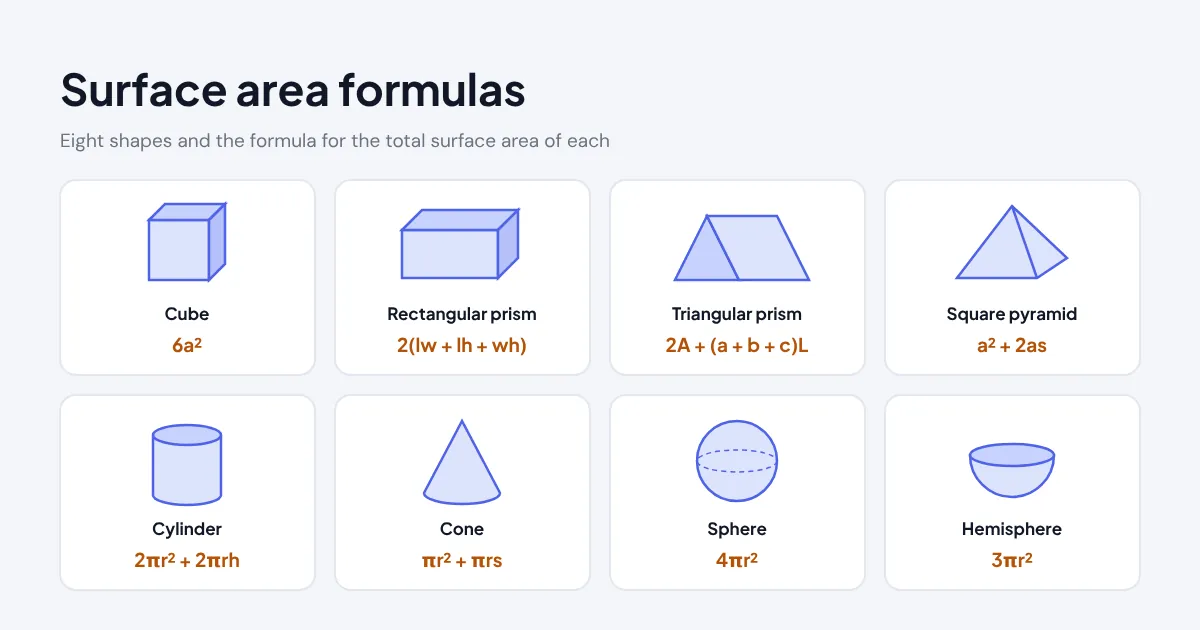
Surface Area Formulas at a Glance
Use this table as a quick reference. In it, a is an edge, l, w and h are length, width and height, r is a radius and s is a slant height.
| Shape | Total surface area | Lateral area |
|---|---|---|
| Cube | 6a² | 4a² |
| Rectangular prism | 2(lw + lh + wh) | 2h(l + w) |
| Triangular prism | 2 × triangle area + (a + b + c)L | (a + b + c)L |
| Square pyramid | a² + 2as | 2as |
| Cylinder | 2πr² + 2πrh | 2πrh |
| Cone | πr² + πrs | πrs |
| Sphere | 4πr² | 4πr² (all curved) |
| Hemisphere (closed) | 3πr² | 2πr² |
Surface area of prisms built from rectangles and triangles is part of the Common Core grade 7 geometry standards, so these first rows are the ones middle school students meet first. Cylinders, cones and spheres follow in high school.
Prisms: Cubes, Boxes and Triangular Prisms
A prism has two identical ends joined by flat rectangular sides, so its surface area is always the two ends plus the rectangles around them.
Cube
A cube has 6 identical square faces, each with area a², so SA = 6a². A dice-shaped box with 5 cm edges has 6 × 25 = 150 cm² of surface.
Rectangular prism
A box has three pairs of matching faces: top and bottom (lw), front and back (lh) and two ends (wh). Add one of each and double it: SA = 2(lw + lh + wh). A shipping box 8 in long, 5 in wide and 3 in tall needs 2(40 + 24 + 15) = 158 in² of cardboard before flaps.
Triangular prism
The two triangular ends have the same area, and the three rectangles have widths equal to the triangle's sides. For a 3-4-5 right triangle the end area is ½ × 3 × 4 = 6, so with a length of 10 the total is 2 × 6 + (3 + 4 + 5) × 10 = 132 square units. When the triangle has no right angle, find its area from the three sides with Heron's formula, which the calculator does automatically.
Curved Shapes: Cylinders, Cones, Spheres and Hemispheres
Curved surfaces look harder, but each formula comes from a simple picture of the surface laid flat.
Cylinder
Peel the label off a can and it becomes a rectangle. Its height is h and its width is the distance around the can, the circumference 2πr, so the curved side is 2πrh. Add two circular ends of πr² each: SA = 2πr² + 2πrh. A can with radius 3 in and height 10 in has 56.55 in² of lids and 188.50 in² of side, 245.04 in² in total.
Cone
Unrolled, the curved surface of a cone is a sector of a circle whose radius is the slant height s, and its area works out to πrs. The base adds πr², so SA = πr² + πrs. If you know the vertical height h instead of s, use Pythagoras: s = √(r² + h²). For r = 3 and h = 4, s = 5 and SA = 9π + 15π = 24π ≈ 75.40.
Sometimes a problem gives the angle of the cone's side instead of a height. If the side makes an angle θ with the base, then s = r ÷ cos θ. For a radius of 3 and a side angle of 60°, cos 60° = 0.5, so s = 6. The trigonometry calculator gives cos, sin and tan for any angle when the value is not one you know by heart.
Sphere and hemisphere
A sphere has no flat faces, and its surface area is exactly four times the area of its widest circle: SA = 4πr². A ball with radius 4 in has 4π(16) ≈ 201.06 in². A closed hemisphere is half of that curved surface, 2πr², plus the flat circle across the cut, πr², for 3πr² in total. An open bowl leaves out the flat circle.
Pyramids
A square pyramid is a square base plus four identical triangles. Each triangle has base a and height s, the slant height measured up the middle of the face, so the four together give 2as. With base edge 6 and vertical height 4, the slant height is s = √(4² + 3²) = 5, and SA = 36 + 2 × 6 × 5 = 96 square units. The 3 in that calculation is half the base edge, a step that is easy to forget.
How Does Surface Area Change When You Scale a Shape?
Surface area grows with the square of the scale factor. Double every length and the surface becomes 2² = 4 times larger; triple it and it becomes 9 times larger. Volume grows with the cube, so it rises even faster.
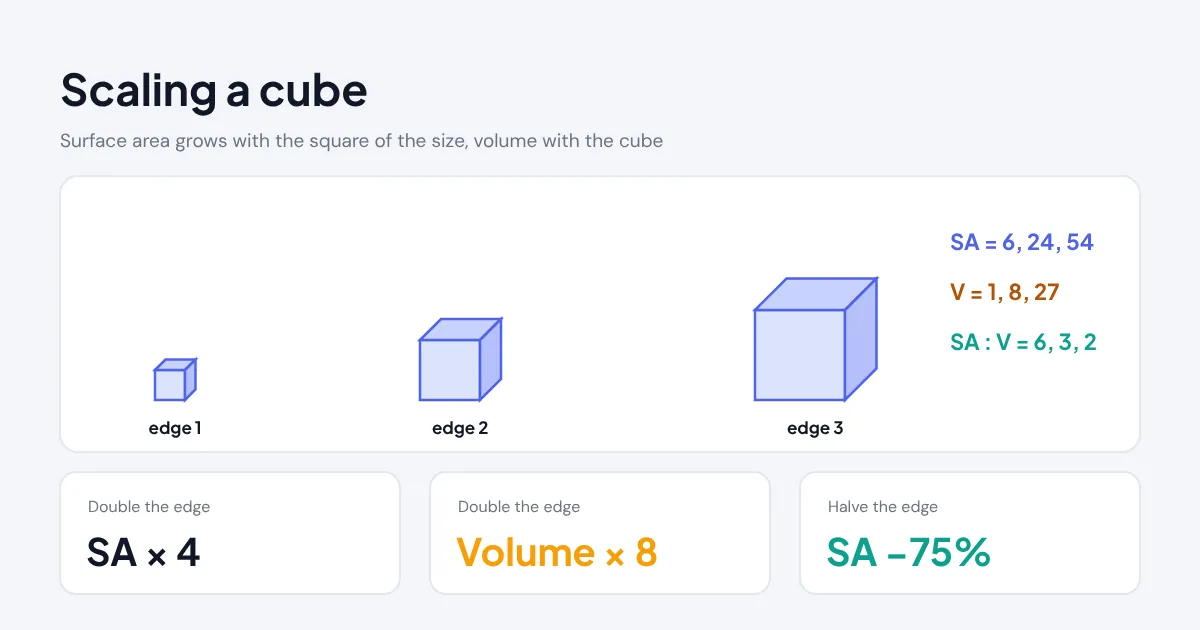
The same rule works in reverse. Halve every dimension of a box and its surface area falls to ¼ of the original, a 75% reduction, while its volume falls by 87.5%. If you want to confirm a change like that from real measurements, the percentage decrease calculator turns the old and new areas into a percentage drop and also shows how much bigger the shape would need to get to return to its original size.
Why Surface Area to Volume Ratio Matters
The surface area to volume ratio explains a lot of the physical world. Small objects have a lot of surface for their size, so they heat up, cool down and dissolve quickly. That is why crushed ice melts faster than a block, why a sliced potato cooks faster than a whole one, and why cells stay small. The OpenStax Biology textbook from Rice University uses exactly this sphere argument to explain why bacteria are tiny: as a cell grows, its volume outpaces its surface, and the membrane can no longer move nutrients in fast enough.
A classic class experiment tests this with agar cubes of different sizes soaked in dye or vinegar. Students measure how much of each cube changes color and compare the groups. If the averages differ, a t test decides whether the gap is real or just noise, and the p value calculator turns the t statistic and its degrees of freedom into a p-value so you can report the result properly.
Common Surface Area Mistakes to Avoid
- Using the vertical height instead of the slant height for a cone or pyramid. The curved or sloping faces always need s.
- Forgetting a face, usually the bottom of a box or the second end of a cylinder. Count faces before you calculate.
- Mixing units. Convert every length to the same unit first, and remember that 1 ft² is 144 in², not 12.
- Writing cubic units. Surface area is always in square units.
- Including a face that is not there, such as the top of an open tank or the base of a bowl.
Frequently asked questions
What is the general formula for surface area?
There is no single formula. For any solid, add the areas of all its faces. Prisms use 2 × base area + perimeter × length, and curved shapes use their own formulas such as 4πr² for a sphere.
Is surface area the same as area?
Area usually means a flat 2D region. Surface area is the total area of the outside of a 3D object, which is the sum of several flat or curved areas.
Which shape has the smallest surface area for its volume?
The sphere. For a fixed volume it needs less surface than any other shape, which is why bubbles and raindrops are round.
How do you find the surface area of a shape made of two solids?
Add the surface areas of both parts, then subtract twice the area where they join, because that face is hidden inside and is no longer on the outside.