How to Use the Paint Calculator
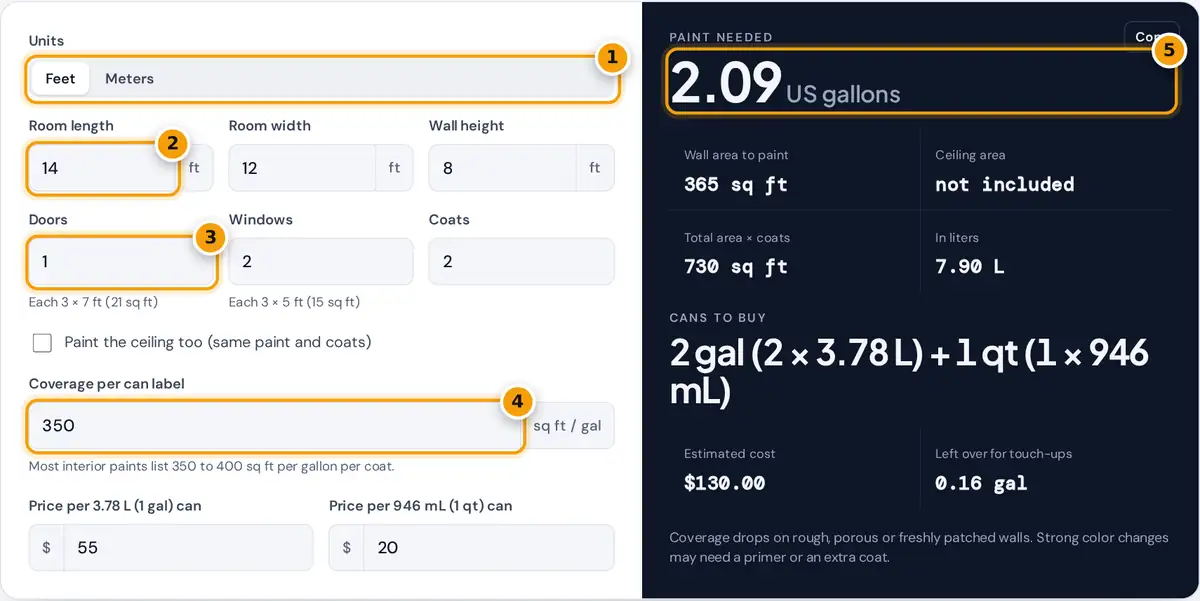
- Choose feet or meters for the room measurements.
- Enter the room length, width and wall height.
- Count the doors and windows and set the number of coats.
- Enter the coverage from the can label and the prices of gallons and quarts.
- Read the paint needed, then the cheapest mix of cans and the cost.
Choose feet or meters and enter the room's length, width and wall height. Count the doors and windows: the calculator subtracts a standard 3 × 7 ft door and a 3 × 5 ft window for each one. Set the number of coats (two is normal for a color change) and tick the ceiling box if you are painting it with the same product.
Enter the coverage printed on the can, in square feet per gallon or square meters per liter, and the prices of a 3.78 L (1 gallon) can and a 946 mL (1 quart) can. In Canada and the US, paint is sold in these same sizes, so the calculator works out the cheapest mix of cans that covers the job and shows how much will be left for touch-ups.
Paint Quantity Formula
paint area = (wall area + ceiling area) × coats
gallons = paint area ÷ coverage per gallon
liters = gallons × 3.785
350 sq ft per gallon ≈ 8.6 m² per liter
To choose cans, the calculator takes whole gallons first, then covers the remainder with quarts. If a full extra gallon costs the same or less than the quarts it would replace, it buys the gallon instead. Four quarts always become one gallon.
Worked Example: A 14 by 12 Bedroom
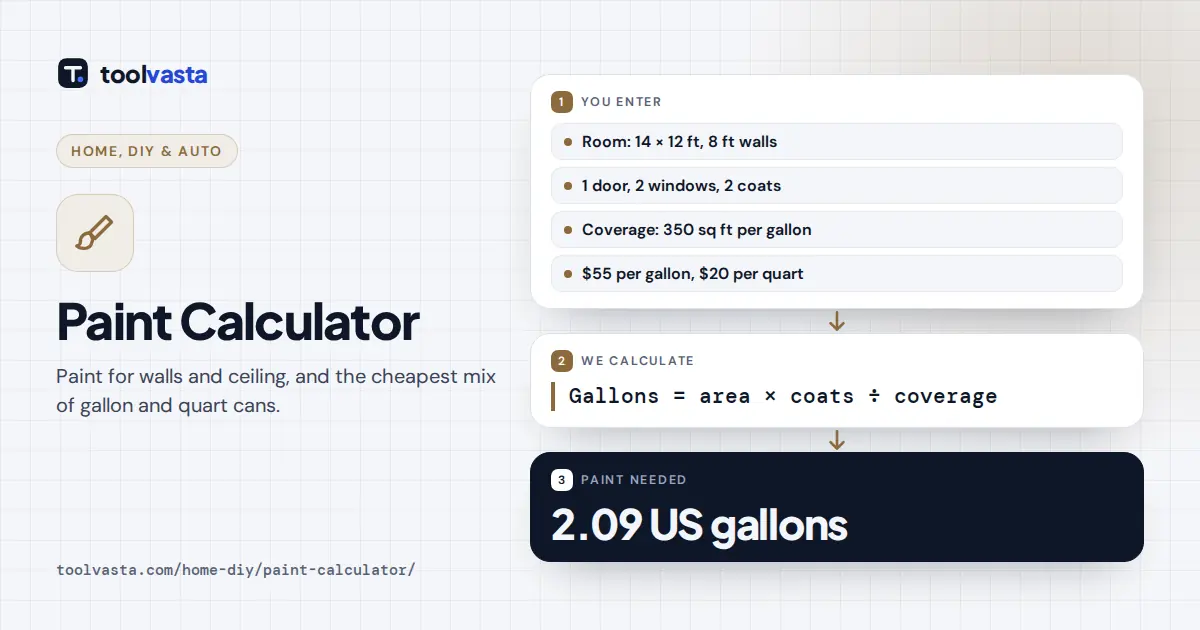
A bedroom is 14 by 12 ft with 8 ft walls, one door and two windows. The walls measure 2 × (14 + 12) × 8 = 416 sq ft. Removing 21 + 2 × 15 = 51 sq ft for openings leaves 365 sq ft. Two coats make 730 sq ft of painting, and at 350 sq ft per gallon that is 2.09 gallons, or 7.90 liters.
Two gallons leave 0.09 gallons to cover, which one quart handles. At $55 a gallon and $20 a quart, two gallons and a quart cost $130, compared with $165 for three gallons. About 0.16 gallons (0.62 L) is left over. Painting the ceiling as well adds 168 sq ft per coat, bringing the total to 3.05 gallons.
Paint Needed by Room Size
| Room (8 ft walls) | Net wall area | Two coats | Gallons at 350 | Liters |
|---|---|---|---|---|
| 10 × 10 ft | 284 sq ft | 568 sq ft | 1.62 | 6.14 |
| 12 × 12 ft | 335 sq ft | 670 sq ft | 1.91 | 7.25 |
| 14 × 12 ft | 365 sq ft | 730 sq ft | 2.09 | 7.90 |
| 16 × 14 ft | 429 sq ft | 858 sq ft | 2.45 | 9.28 |
| 20 × 15 ft | 509 sq ft | 1,018 sq ft | 2.91 | 11.01 |
Each row assumes one door and two windows. Larger rooms usually have more openings, so enter your real counts for the best estimate.
Tips for Buying Paint
- Read the coverage on your exact product. Premium paints often cover 400 sq ft per gallon, while textured or masonry surfaces may get only 200 to 300.
- Use a primer on new drywall, patched areas and stained surfaces. Primer has its own coverage figure, so calculate it as a separate one-coat job.
- Buy all the paint for one wall from the same batch, or mix cans together in a bucket, so the color is consistent.
- Trim, doors and baseboards are usually painted in a different sheen. A quart is often enough for the trim in one room.
- Keep the leftover paint, labeled with the room and date, for future touch-ups.
Assumptions and Limits
Doors and windows use standard sizes, so large patio doors or picture windows should be entered as extra openings. The estimate assumes smooth walls and even application at the label's spread rate. Dark colors over light walls, or light over dark, may need a third coat. Prices are yours to enter, and this is a planning estimate, not a quote.
Frequently asked questions
How much paint do I need for a 12 x 12 room?
With 8 ft walls, one door and two windows, the walls are about 335 sq ft. Two coats at 350 sq ft per gallon need about 1.9 gallons, so buy two gallons.
How many square feet does a gallon of paint cover?
Most interior paints cover about 350 to 400 sq ft per gallon per coat on smooth walls, which is roughly 8.6 to 9.8 square meters per liter. Check the can label.
How do I calculate paint in liters?
Divide the total painted area in square meters, times the number of coats, by the coverage in square meters per liter. For example, 80 m² at 10 m² per liter needs 8 liters.
Do I need two coats of paint?
Two coats give even color and full durability, especially with a color change. One coat can work when repainting the same color with a high-quality paint.
Should I subtract windows and doors when calculating paint?
Yes. Subtract about 21 sq ft per standard door and 15 sq ft per window. The leftover paint from rounding up to whole cans usually covers cutting in around them.
Is it cheaper to buy gallons or quarts?
Paint usually costs less per liter in gallon cans. If you need more than two or three quarts, a full gallon is often cheaper, which the calculator checks for you.