How to use the compression ratio calculator
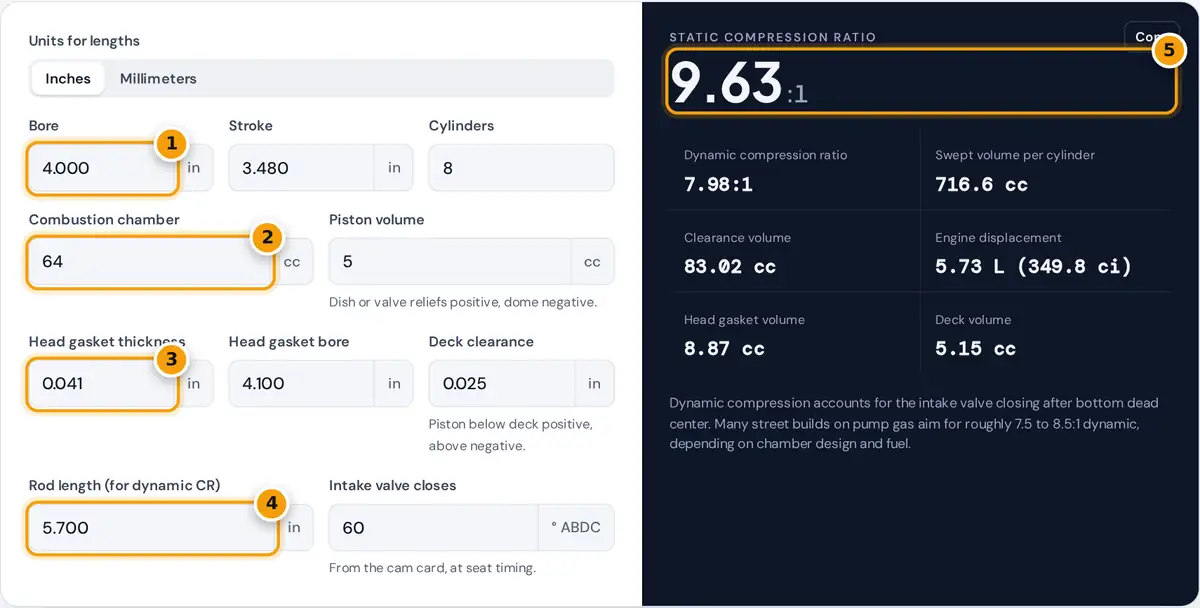
- Enter the bore and stroke, and the number of cylinders.
- Enter the combustion chamber and piston dish or dome volume in cc.
- Add head gasket thickness and bore, and deck clearance.
- For dynamic compression, enter rod length and intake valve closing from your cam card.
- Read the static compression ratio, with dynamic CR and displacement below.
Enter the cylinder bore and crankshaft stroke in inches or millimeters, and the number of cylinders for the displacement. Then enter the volumes that make up the space above the piston at top dead center: the combustion chamber volume in the cylinder head (in cc), the piston volume (positive for a dish or valve reliefs, negative for a dome), the compressed head gasket thickness and bore, and the deck clearance (how far the piston sits below the block deck at TDC). The static compression ratio updates as you type.
For dynamic compression, add the connecting rod length and the intake valve closing point in degrees after bottom dead center from your cam card. Use the advertised or seat timing figure, not the 0.050 in figure.
Compression ratio formula
gasket volume = π ÷ 4 × gasket bore² × gasket thickness
deck volume = π ÷ 4 × bore² × deck clearance
clearance volume = chamber + piston + gasket volume + deck volume
static CR = (swept volume + clearance volume) ÷ clearance volume
1 cubic inch = 16.387 cc
For dynamic compression, the calculator finds how far the piston is from TDC when the intake valve closes, using the slider-crank equation: distance = r + L − (r cos θ + √(L² − r² sin² θ)), where r is half the stroke, L is the rod length and θ is 180 degrees plus the closing angle. The swept volume from that point replaces the full stroke in the ratio.
Worked example: small block 350
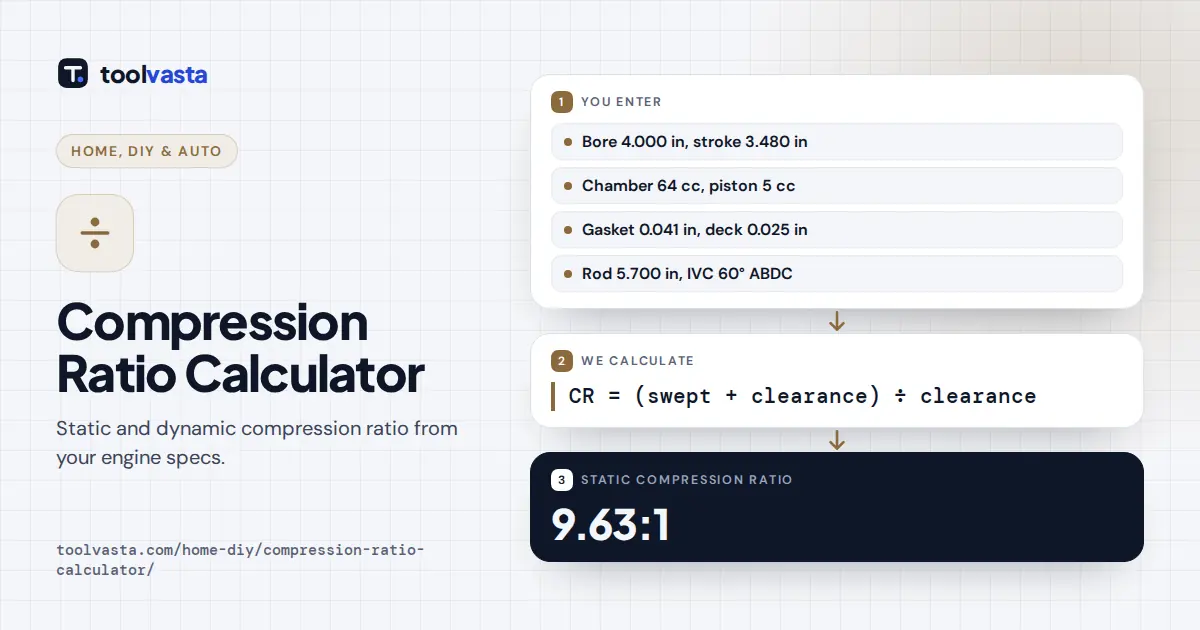
A 350 cubic inch V8 has a 4.000 in bore and 3.480 in stroke. The swept volume per cylinder is π ÷ 4 × 4² × 3.48 = 43.73 cubic inches, or 716.6 cc. With 64 cc chambers, 5 cc of valve reliefs, a 0.041 in gasket with a 4.100 in bore (8.87 cc) and the piston 0.025 in below deck (5.15 cc), the clearance volume is 64 + 5 + 8.87 + 5.15 = 83.02 cc.
The static ratio is (716.6 + 83.02) ÷ 83.02 = 9.63:1. With a 5.7 in rod and the intake closing at 60 degrees ABDC, the piston is 2.81 in from TDC when compression really starts, so the dynamic ratio is about 7.98:1. Total displacement is 5.73 L (349.8 cubic inches).
Switching to 58 cc heads, a 3 cc dome (enter −3), a 0.039 in gasket and zero deck clearance raises the static ratio to 12.30:1. That shows how much small volume changes matter.
What changes compression
| Change | Effect on compression |
|---|---|
| Smaller chamber (cc) | Raises it |
| Domed piston | Raises it |
| Dished piston or larger reliefs | Lowers it |
| Thinner head gasket | Raises it |
| Decking the block (less clearance) | Raises it |
| Later intake closing | Lowers dynamic, not static |
Getting accurate inputs
- Chamber volumes vary from casting to casting. For a serious build, cc the chambers with a burette and a plate.
- Piston dish and dome volumes are listed by the piston maker. Remember valve reliefs on flat tops, often 4 to 6 cc.
- Gasket thickness is the compressed thickness given by the manufacturer.
- Measure deck clearance with a dial indicator at TDC. Some engines have pistons above the deck, entered as a negative value.
Limits
Static compression is a geometric ratio. Whether an engine will detonate depends on dynamic compression, chamber design, quench, fuel octane, ignition timing, temperatures and boost. Use the numbers to compare combinations and confirm with your engine builder.
Frequently asked questions
How do I calculate compression ratio?
Add the swept volume of one cylinder to the clearance volume, then divide by the clearance volume. Clearance includes the chamber, piston dish or dome, head gasket and deck volumes.
What is the difference between static and dynamic compression?
Static compression uses the full stroke. Dynamic compression starts counting only when the intake valve closes, so it is lower and better predicts cylinder pressure and detonation risk.
What compression ratio is safe on pump gas?
It depends on the engine, but many street engines with iron heads run around 9 to 10:1 static on premium fuel. Modern engines with direct injection run higher.
Does a thinner head gasket raise compression?
Yes. Going from a 0.041 in to a 0.027 in gasket on a 4.1 in bore removes about 3 cc of clearance, raising compression by roughly a third of a point on a small block.
How do I enter a domed piston?
Enter the dome volume as a negative number of cc, because a dome takes up space in the clearance volume. A dish or valve reliefs are positive.