How to use the BTU calculator
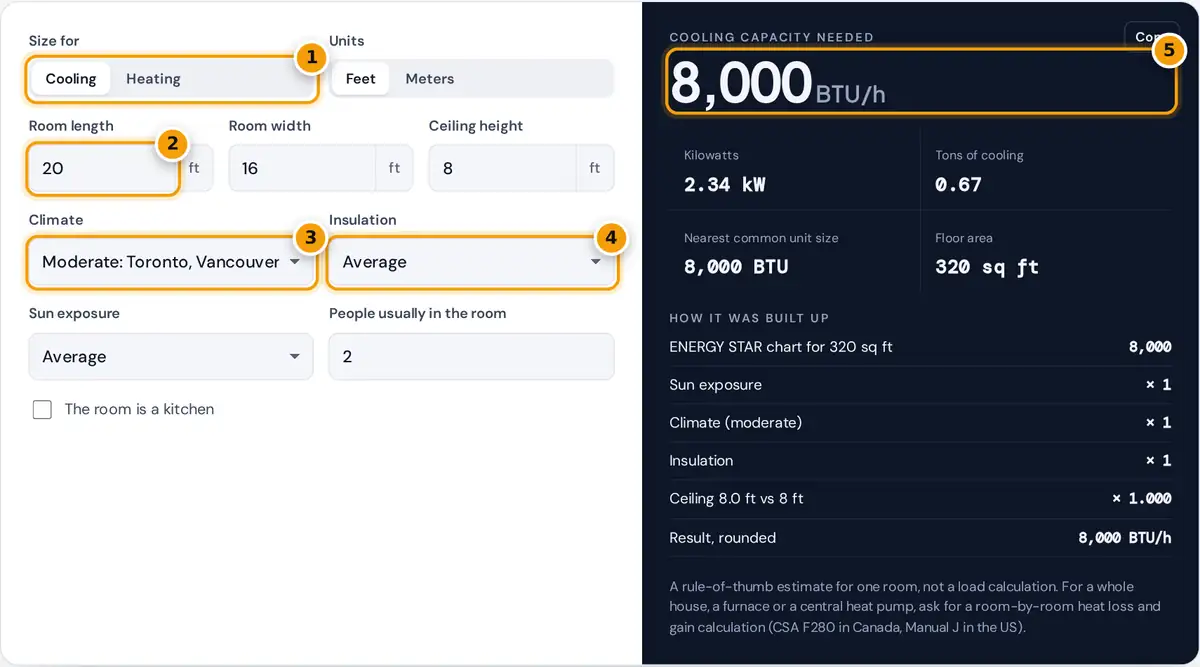
- Choose cooling for an air conditioner or heating for a heater.
- Enter the room length, width and ceiling height in feet or meters.
- Pick your climate, from hot US South to very cold northern Canada.
- Set insulation, sun exposure, people and whether it is a kitchen.
- Read the BTU/h you need, then check kW, tons and the nearest common unit size.
Choose Cooling to size a window, portable or ductless air conditioner, or Heating to size a space heater, baseboard or a ductless heat pump head for one room. Enter the room length, width and ceiling height in feet or meters. Then pick the climate, how well the room is insulated and, for cooling, how sunny it is, how many people usually use it and whether it is a kitchen. The result shows BTU per hour, kilowatts, tons and the nearest common unit size, with each step of the estimate listed underneath.
This is a rule-of-thumb estimate. It is useful for choosing between, say, an 8,000 and a 12,000 BTU window unit. It is not a substitute for a proper heat loss and heat gain calculation, which an HVAC contractor should do before you buy a furnace, central air conditioner or whole-home heat pump.
How the estimate is calculated
× sun (shaded 0.9, average 1.0, very sunny 1.1)
× climate (hot 1.2, warm 1.1, moderate 1.0, cold 0.95, very cold 0.9)
× insulation (poor 1.2, average 1.0, good 0.9) × ceiling height ÷ 8 ft
+ 600 for each person beyond two + 4,000 for a kitchen
heating BTU/h = area (sq ft) × 20 to 60 BTU per sq ft by climate × insulation (0.8 to 1.3) × ceiling ÷ 8 ft
1 kW = 3,412 BTU/h 1 ton of cooling = 12,000 BTU/h
The cooling base and the sun, occupant and kitchen adjustments come from the ENERGY STAR room air conditioner sizing guide. That chart runs from 5,000 BTU for 100 to 150 sq ft up to 34,000 BTU for 2,000 to 2,500 sq ft. The climate, insulation and ceiling height multipliers, and the heating values per square foot, are common rules of thumb used for quick estimates. They are not from a standard, so treat them as a reasonable range rather than an exact figure.
Worked examples
Cooling a living room
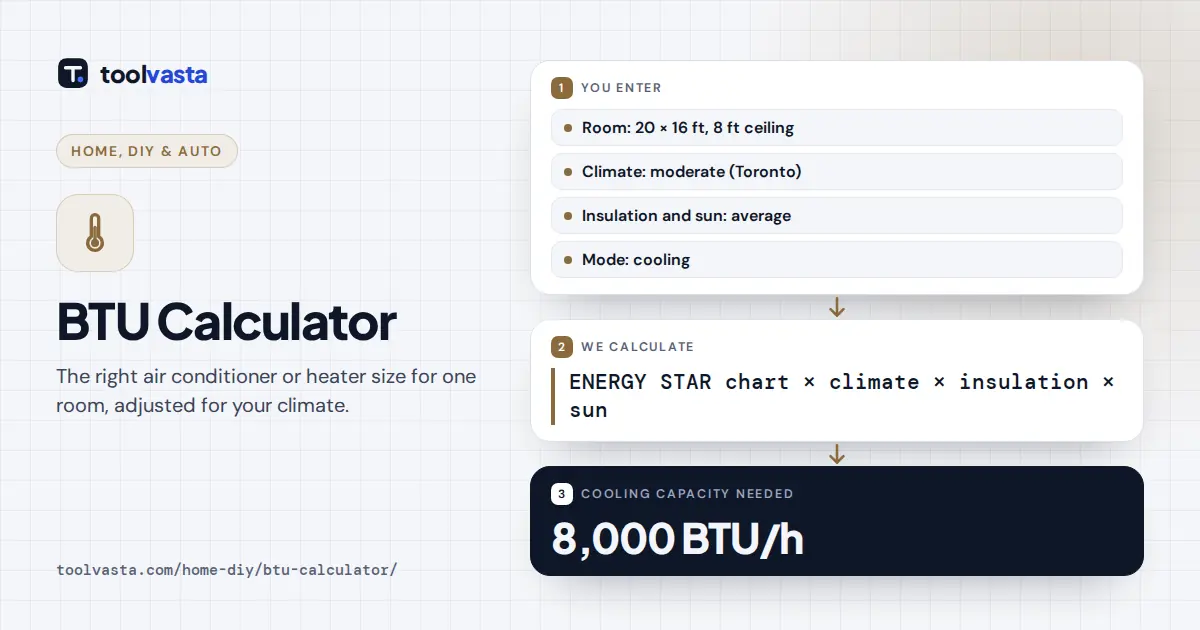
A 20 ft by 16 ft living room is 320 sq ft, which falls in the 300 to 350 sq ft row of the ENERGY STAR chart: 8,000 BTU/h. With average sun, a moderate climate, average insulation and 8 ft ceilings, the multipliers are all 1.0, so the estimate stays at 8,000 BTU/h (2.34 kW, 0.67 tons). If the room is very sunny and four people often use it, the estimate becomes 8,000 × 1.1 + 2 × 600 = 10,000 BTU/h.
Heating the same room
In a moderate Canadian climate at about 40 BTU per sq ft, the room needs 320 × 40 = 12,800 BTU/h, which is 3.75 kW. That is roughly 3,750 W of electric baseboard, so in practice a 4,000 W total.
Room AC sizing chart
| Area (sq ft) | Area (m²) | BTU/h |
|---|---|---|
| 100 to 150 | 9 to 14 | 5,000 |
| 150 to 250 | 14 to 23 | 6,000 |
| 250 to 300 | 23 to 28 | 7,000 |
| 300 to 350 | 28 to 33 | 8,000 |
| 350 to 400 | 33 to 37 | 9,000 |
| 400 to 450 | 37 to 42 | 10,000 |
| 450 to 550 | 42 to 51 | 12,000 |
| 550 to 700 | 51 to 65 | 14,000 |
| 700 to 1,000 | 65 to 93 | 18,000 |
Source: ENERGY STAR. Square meter ranges are rounded conversions.
Why the right size matters
An oversized air conditioner cools the air quickly and shuts off before it removes much humidity, leaving the room cold and clammy. An undersized unit runs constantly and still cannot keep up on hot afternoons. For heating, too little capacity leaves the room cold in a January cold snap, while a heat pump that is much too large cycles on and off and loses efficiency.
Limits of a rule of thumb
- Window area, wall orientation, air leakage, basement walls and local design temperatures all change the real load.
- Open-plan spaces share air with other rooms, so the area that a unit actually serves may be larger than the room.
- For a new furnace, central air or a heat pump, Canadian rebate programs and installers usually require a proper heat loss calculation. Ask for one.
Frequently asked questions
How many BTU do I need per square foot?
For cooling, the ENERGY STAR chart works out to roughly 20 BTU per sq ft for mid-sized rooms. For heating in Canada, rules of thumb range from about 30 to 60 BTU per sq ft depending on climate and insulation.
What size air conditioner do I need for a 300 sq ft room?
ENERGY STAR suggests 7,000 BTU for 250 to 300 sq ft and 8,000 BTU for 300 to 350 sq ft. Add 10% for a very sunny room.
How do I convert BTU to kW?
Divide BTU per hour by 3,412. For example, 12,000 BTU/h is 3.52 kW. To go the other way, multiply kW by 3,412.
What is a ton of air conditioning?
One ton equals 12,000 BTU per hour of cooling. A 24,000 BTU unit is a 2 ton unit.
Is this calculator accurate enough to size a furnace or heat pump?
No. It is a quick room estimate. Whole-home equipment should be sized from a room-by-room heat loss calculation by a qualified contractor.