How to Use the Gravel Calculator
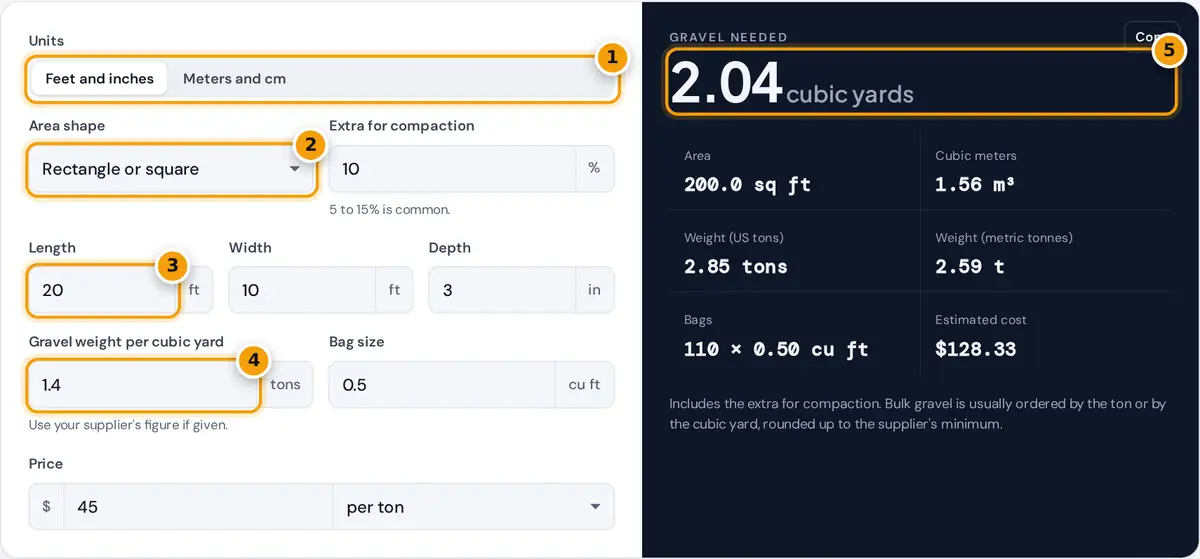
- Choose feet and inches or meters and centimeters.
- Pick a rectangle or a circle for the area you are covering.
- Enter the length and width (or diameter), then the depth of gravel you want.
- Check the gravel weight per cubic yard or meter and set your price.
- Read the cubic yards or meters, plus tons, tonnes, bags and cost below.
Pick feet and inches or meters and centimeters, then choose the shape of the area. For a rectangle enter the length and width; for a round bed or fire pit area enter the diameter. Enter the finished depth of gravel you want. Add an allowance for compaction, because loose gravel settles when it is spread and rolled, and a base layer under pavers or a driveway is usually compacted on purpose.
The weight per cubic yard (or cubic meter) converts volume to tons. Quarries and landscape yards sell by the ton or by the cubic yard, so use your supplier's figure if they give one. Enter a bag size if you plan to buy bagged stone, and a price per ton, per cubic yard or per bag. The result shows volume, weight, bags and cost together.
Gravel Volume and Weight Formula
volume (cu ft) = area (sq ft) × depth (in) ÷ 12 × (1 + extra %)
cubic yards = cubic feet ÷ 27 cubic meters = cubic feet × 0.0283168
weight = volume × weight per unit volume
bags = round up (volume ÷ bag size)
The calculator works internally in exact unit factors: 1 ft is 0.3048 m, 1 cubic yard is 0.764555 m³ and 1 US ton is 0.907185 metric tonnes. A default of 1.4 US tons per cubic yard equals about 1.66 tonnes per cubic meter. Gravel weight changes with stone size, rock type and moisture, which is why the field can be edited.
Worked Example: A Gravel Path
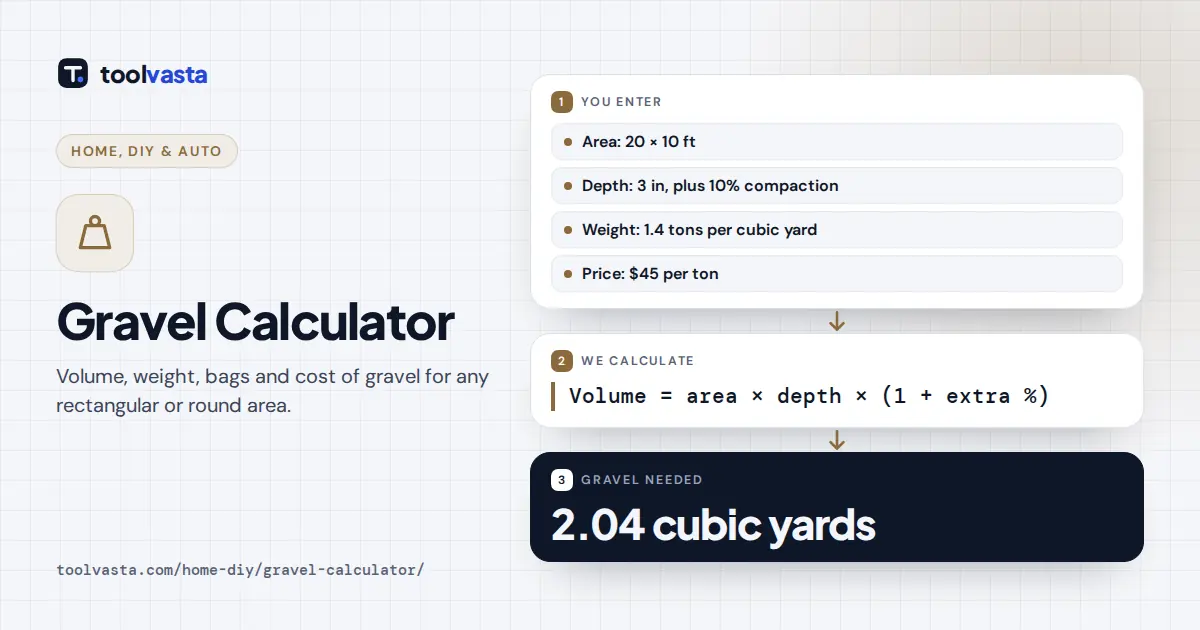
A path is 20 ft long and 10 ft wide, covered 3 in deep. The area is 200 sq ft and the volume is 200 × 3 ÷ 12 = 50 cu ft. Adding 10% for compaction gives 55 cu ft, which is 55 ÷ 27 = 2.04 cubic yards or 1.56 m³.
At 1.4 tons per cubic yard the order weighs 2.04 × 1.4 = 2.85 US tons, or 2.59 metric tonnes. At $45 per ton the gravel costs about $128.33 before delivery. In 0.5 cu ft bags you would need 55 ÷ 0.5 = 110 bags, which shows why bulk delivery is usually cheaper for anything beyond a small bed.
Bulk suppliers usually quote by the ton, the tonne or the cubic yard, while garden centers sell bags by volume or weight. Comparing the bag price with the bulk price, plus the delivery fee, shows the point where a truckload becomes cheaper than carrying bags home.
Recommended Gravel Depths
| Project | Typical depth | Metric |
|---|---|---|
| Decorative top layer or mulch replacement | 2 to 3 in | 5 to 8 cm |
| Garden path or patio surface | 3 to 4 in | 8 to 10 cm |
| Paver or slab base (compacted) | 4 to 6 in | 10 to 15 cm |
| Driveway, total of all layers | 8 to 12 in | 20 to 30 cm |
These are common planning ranges, not engineering specifications. Soft soil, heavy vehicles and frost-prone ground need a deeper, well-compacted base, so follow your paver manufacturer's or contractor's instructions for load-bearing work.
Tips for Ordering Gravel
- Measure irregular areas as several rectangles and add the volumes together.
- For a driveway, calculate each layer separately: a coarse base such as crusher run, then a finer top layer.
- Ask whether the price includes delivery and whether there is a minimum load.
- Lay landscape fabric under decorative gravel to slow weeds and stop the stone sinking into soil.
- Order slightly more than the exact figure. A small top-up delivery often costs more than the extra stone.
Assumptions and Limits
The calculator assumes an even depth over a flat area. Sloped ground, dips and edging that sits below grade change the real volume. Weight figures are typical values for dry gravel; wet stone weighs more. Use the result as a planning estimate and confirm the order with your supplier.
Frequently asked questions
How much gravel do I need for a 10 x 20 area?
At 3 inches deep, a 10 by 20 ft area needs 50 cu ft, or 1.85 cubic yards. With 10% extra for compaction, order about 2.04 cubic yards, roughly 2.85 tons.
How many tons are in a cubic yard of gravel?
A common planning figure is about 1.4 US tons per cubic yard, which is about 1.66 tonnes per cubic meter. Real weight depends on stone size, rock type and moisture.
How do I convert cubic yards to tons?
Multiply the cubic yards by the weight per cubic yard. For example, 3 cubic yards at 1.4 tons per cubic yard is 4.2 US tons, or about 3.81 metric tonnes.
How deep should gravel be for a driveway?
Many driveways use 8 to 12 inches of gravel in total, laid in compacted layers with coarse stone at the bottom and finer stone on top. Soft or wet soil may need more.
How many bags of gravel equal a cubic yard?
A cubic yard is 27 cubic feet, so it takes 54 bags of 0.5 cu ft. In metric terms, a cubic meter is 1,000 liters, or about 40 bags of 25 liters.
Why add extra gravel for compaction?
Loose gravel settles when it is spread and compacted, so the finished depth is less than the loose depth. Adding 5 to 15% helps you reach the planned depth without a second delivery.