How to Use the Baluster Spacing Calculator
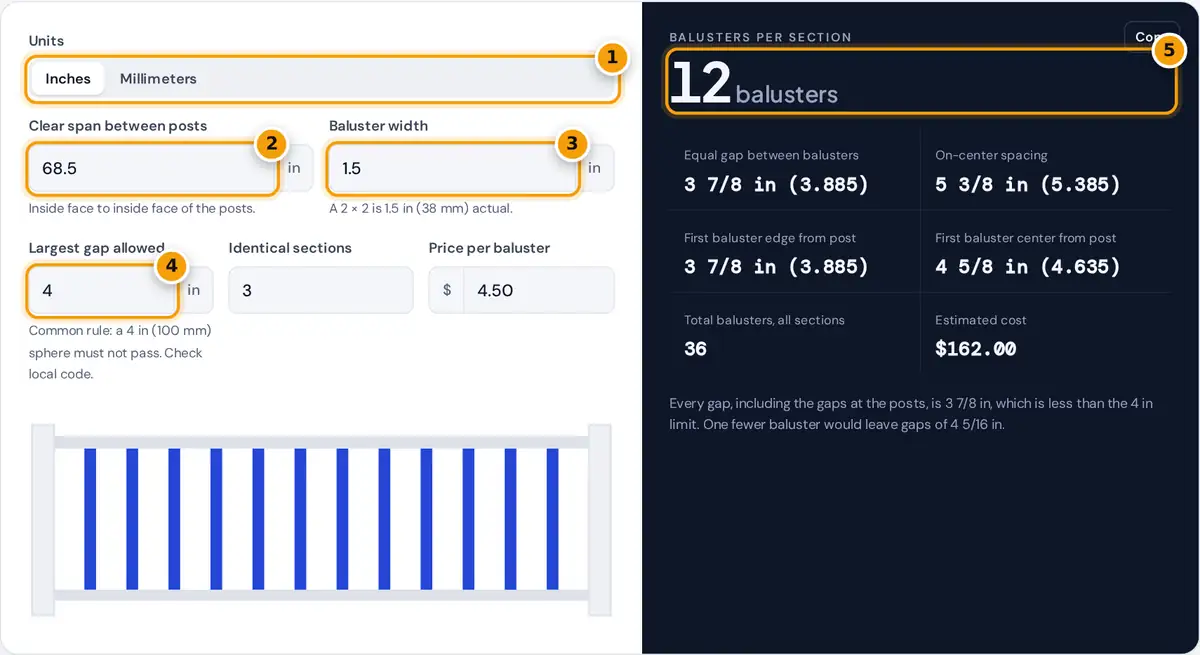
- Choose inches or millimeters.
- Enter the clear span between the inside faces of the posts.
- Enter the actual baluster width.
- Enter the largest gap allowed. Check your local code.
- Read the baluster count, equal gap and on-center spacing.
Measure the clear span between two posts, from the inside face of one post to the inside face of the other, at the height where the balusters will sit. Enter the actual width of your balusters, not the nominal lumber size: a wood 2 × 2 is about 1.5 in (38 mm) wide, and many metal balusters are 3/4 in (19 mm) square or round.
Enter the largest gap allowed. Many residential codes say a sphere of 4 in (in some places 100 mm) must not pass through the guard, so the gap must be smaller than that figure. Check the rule that applies where you live. Add the number of identical sections and a price per baluster. The result shows the baluster count, the equal gap, the on-center spacing and a mark for every baluster.
Baluster Spacing Formula
gap = (span − n × width) ÷ (n + 1)
on-center spacing = gap + width
edge of baluster k = gap + (k − 1) × on-center spacing
With n balusters there are n + 1 gaps, one at each post and one between each pair of balusters. The formula finds the smallest n that makes every gap strictly smaller than the limit, so a gap of exactly 4 in is treated as too wide and one more baluster is added. Equal gaps look better than a layout that starts at one post and leaves an odd gap at the other.
Worked Example: A 6 Foot Deck Section
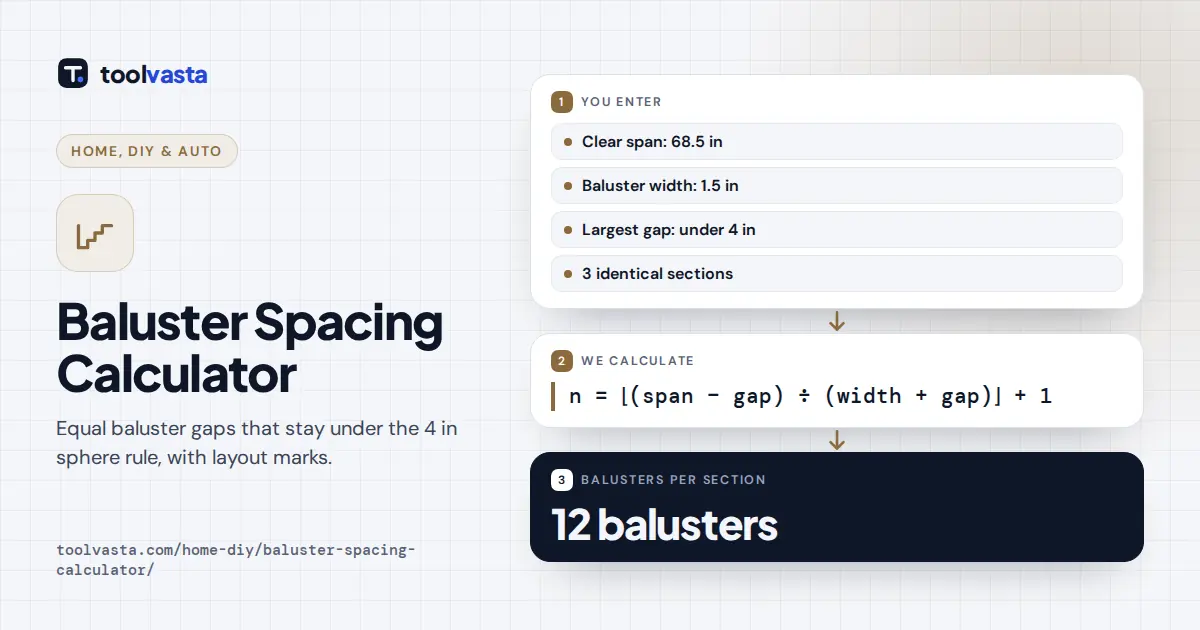
Posts are set 6 ft on center and are 3.5 in wide, so the clear span is 72 − 3.5 = 68.5 in. The balusters are 1.5 in wide and the gap must be under 4 in. The count is (68.5 − 4) ÷ (1.5 + 4) = 11.73, which rounds down to 11, plus 1 gives 12 balusters.
The 12 balusters take up 18 in, leaving 50.5 in for 13 gaps, so each gap is 3.885 in, just under 3 7/8 in. The on-center spacing is 5.385 in, about 5 3/8 in. The first baluster starts 3 7/8 in from the post and its center is 4 5/8 in from the post. For three such sections you need 36 balusters.
Balusters per Section at a 4 Inch Limit
| Clear span | 1.5 in balusters | Gap | 0.75 in balusters | Gap |
|---|---|---|---|---|
| 36 in | 6 | 3.86 in | 7 | 3.84 in |
| 48 in | 9 | 3.45 in | 10 | 3.68 in |
| 68.5 in | 12 | 3.88 in | 14 | 3.87 in |
| 92.5 in | 17 | 3.72 in | 19 | 3.91 in |
The 48 in row shows why the strict rule matters. Eight 1.5 in balusters leave nine gaps of exactly 4.00 in, which does not keep a 4 in sphere out, so the calculator uses nine balusters with gaps of 3.45 in.
Tips for Installing Balusters
- Cut a spacer block to the calculated gap and use it between balusters so every gap stays equal.
- Mark the center line of each baluster on the top and bottom rails from the same post before fastening.
- Check the gap at the bottom rail as well as the top. A bottom rail set too high can leave an opening under the guard.
- On stairs, the triangle formed by the tread, riser and bottom rail has its own limit in many codes, often a 6 in sphere.
Assumptions and Limits
The calculator assumes straight, square or round balusters of equal width and a level section. Turned spindles are measured at their widest point, but the narrow parts leave larger openings, so check the widest gap. Guard height, post spacing, loads and the exact opening rule are set by your building code and inspector. This tool lays out spacing only and is not a code approval.
Frequently asked questions
How far apart should balusters be?
Many residential codes require that a 4 inch sphere cannot pass between balusters, so gaps must be less than 4 inches. Some regions use 100 mm. Most builders aim for gaps of about 3.5 to 3.9 inches.
How many balusters do I need for a 6 foot section?
With 3.5 inch posts set 6 ft apart, the clear span is 68.5 inches. Using 1.5 inch balusters and a 4 inch limit, you need 12 balusters with equal gaps of about 3 7/8 inches.
What is the 4 inch sphere rule?
The rule says a 4 inch diameter sphere must not pass through any opening in a guard, which helps keep small children from slipping through. It is common in residential codes, but check your local requirements.
How do I calculate baluster spacing?
Divide the clear span minus the maximum gap by the baluster width plus the maximum gap, round down and add one to get the count. Then divide the space left after the balusters by the count plus one.
What is on-center baluster spacing?
On-center spacing is the distance from the center of one baluster to the center of the next. It equals the gap plus one baluster width, so 3 7/8 inch gaps with 1.5 inch balusters give about 5 3/8 inches.
Should balusters start at the post or with a gap?
For an even look, start with a gap at each post equal to the gap between balusters. The calculator gives every gap the same width, including the first and last gaps beside the posts.