How to Use the Pizza Dough Calculator
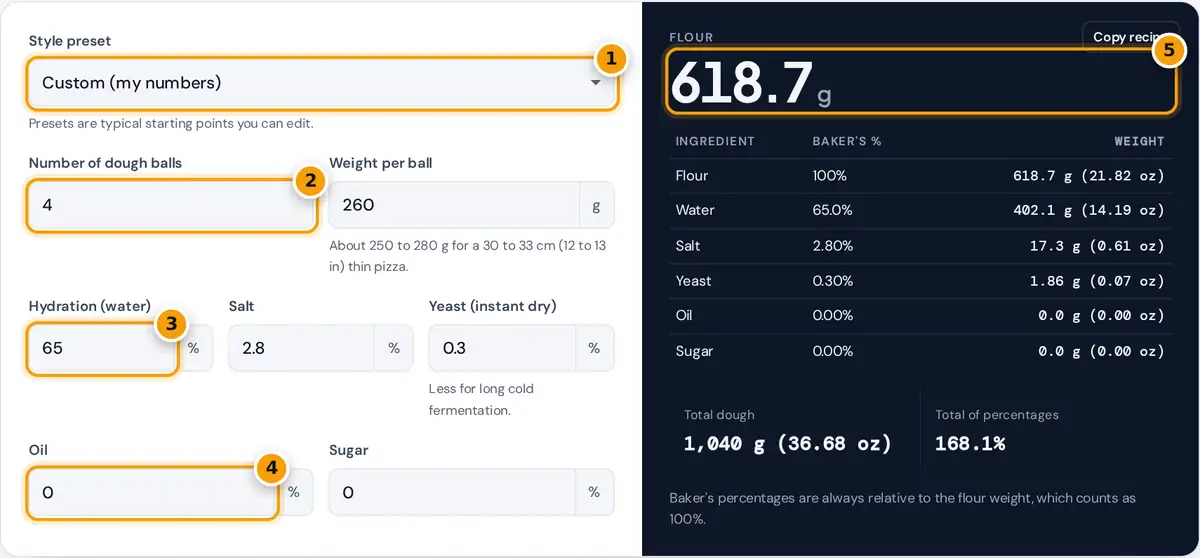
- Pick a style preset or keep your own numbers.
- Enter the number of dough balls and the weight of each.
- Set hydration, salt and yeast as percentages.
- Add oil and sugar if your style uses them.
- Read every ingredient in grams and ounces.
Start with a style preset or keep your own numbers. Enter how many dough balls you want and the weight of each ball. A ball of about 250 to 280 g makes a thin 30 to 33 cm (12 to 13 in) pizza; larger or thicker pizzas need heavier balls. If you plan a pan pizza, use the weight that suits the size of your pan.
Then set the baker's percentages: hydration is the water as a percentage of the flour, and salt, yeast, oil and sugar are also percentages of the flour. Most home ovens and pizza styles work well between 60 and 70% hydration. The result lists every ingredient in grams and ounces, ready to weigh on a kitchen scale.
Baker's Percentage Formula
flour = total dough × 100 ÷ (100 + water % + salt % + yeast % + oil % + sugar %)
each ingredient = flour × its percentage ÷ 100
Baker's percentages describe a recipe relative to the flour, which is always 100%. Because the percentages add up to more than 100, the flour weight is the total dough divided by the sum of all percentages. This makes it easy to scale a recipe up or down, or to change one ingredient without rewriting the rest.
Worked Example: Four Thin Pizzas
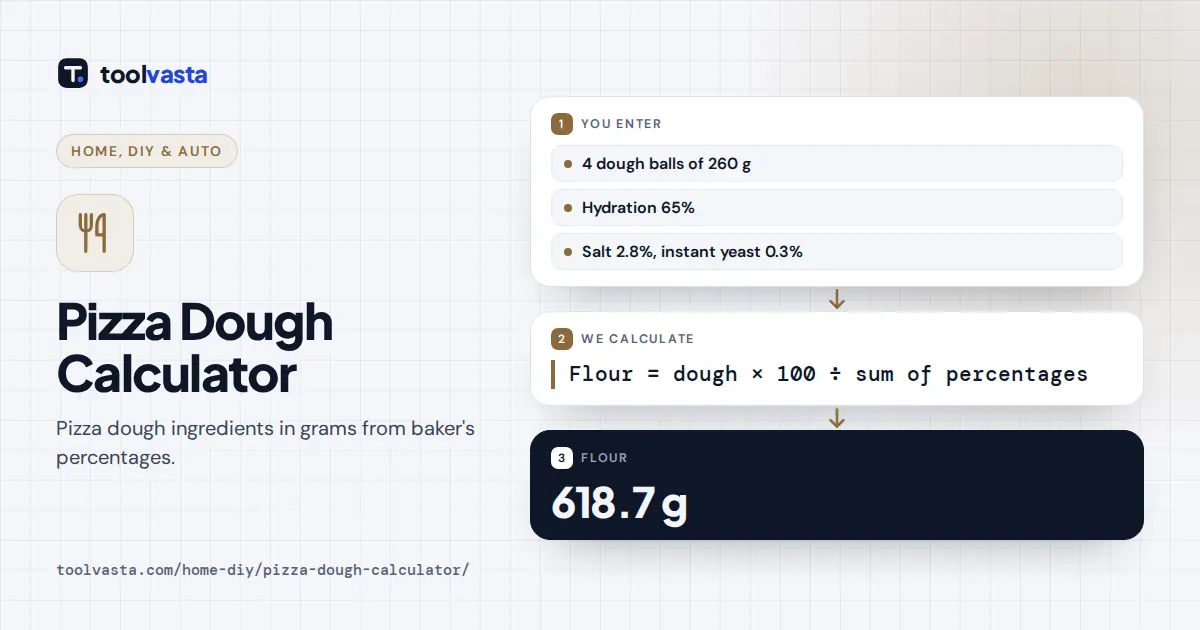
Four dough balls of 260 g each make 1,040 g of dough. With 65% water, 2.8% salt and 0.3% instant yeast, the percentages add to 168.1%. The flour is 1,040 × 100 ÷ 168.1 = 618.7 g.
The water is 618.7 × 0.65 = 402.1 g, the salt is 17.3 g and the yeast is 1.86 g. Weighed out, the four ingredients add back to 1,040 g. Using the New York preset with 300 g balls, the same four pizzas need 712.6 g flour, 448.9 g water, 14.3 g oil and 7.1 g sugar.
Doubling the number of balls doubles every ingredient. Changing only the hydration moves weight between flour and water while the total dough stays fixed, which is why baker's percentages make it easy to test one change at a time and compare results.
Typical Pizza Dough Percentages
| Style | Hydration | Salt | Instant yeast | Oil | Sugar |
|---|---|---|---|---|---|
| Neapolitan style | 58 to 65% | 2.5 to 3% | 0.1 to 0.3% | 0% | 0% |
| New York style | 60 to 65% | 2% | 0.3 to 0.5% | 1 to 3% | 0 to 2% |
| Pan or Detroit style | 68 to 75% | 2% | 0.5 to 1% | 1 to 3% | 0% |
| Thin and crispy | 50 to 55% | 1.5 to 2% | 0.5 to 1% | 2 to 5% | 1 to 2% |
These are common ranges, not fixed rules. Neapolitan pizzas baked in very hot ovens usually skip oil and sugar, while home ovens often benefit from a little of both to help browning at lower temperatures.
Tips for Better Pizza Dough
- Weigh ingredients in grams. Small amounts such as yeast are hard to measure accurately by volume.
- Use less yeast for longer fermentation. A dough with 0.1 to 0.2% yeast can rest in the fridge for one to three days and develops more flavor.
- Higher hydration makes a lighter, more open crust but a stickier dough. Raise it a few points at a time.
- Let cold dough balls warm up for an hour or two before shaping so they stretch without tearing.
Assumptions and Limits
The calculator does not include dough lost to the bowl and bench, so add a few grams per ball if you want exact finished weights. Flour absorbs water differently by brand and protein content, so adjust hydration to the feel of your dough. Yeast amounts depend on temperature and timing, and the yeast field assumes instant dry yeast.
Frequently asked questions
What is baker's percentage in pizza dough?
Baker's percentage expresses each ingredient as a percentage of the flour weight. In a 65% hydration dough, the water weighs 65% as much as the flour, so 1,000 g of flour takes 650 g of water.
How much dough do I need for a 12 inch pizza?
A thin 12 inch (30 cm) pizza usually uses about 230 to 260 g of dough. A New York style 14 inch pizza often uses roughly 280 to 350 g, depending on how thin you stretch it.
What hydration is best for pizza dough?
Many home pizza makers use 60 to 70% hydration. Lower hydration is easier to handle, while higher hydration gives a lighter crust but a stickier dough. Pan pizzas often go above 70%.
How much salt goes in pizza dough?
Most pizza doughs use 2 to 3% salt by flour weight. For 600 g of flour that is 12 to 18 g of salt. Neapolitan dough is often at the higher end of that range.
How much yeast do I need for pizza dough?
With instant dry yeast, 0.2 to 0.5% of the flour weight suits most same-day or overnight doughs. Long cold fermentations use less, often 0.1 to 0.2%.
How do I calculate flour from total dough weight?
Divide the total dough weight by the sum of all baker's percentages, with flour as 100, then multiply by 100. For 1,040 g of dough at 168.1% total, the flour is 618.7 g.