How to use the drywall calculator
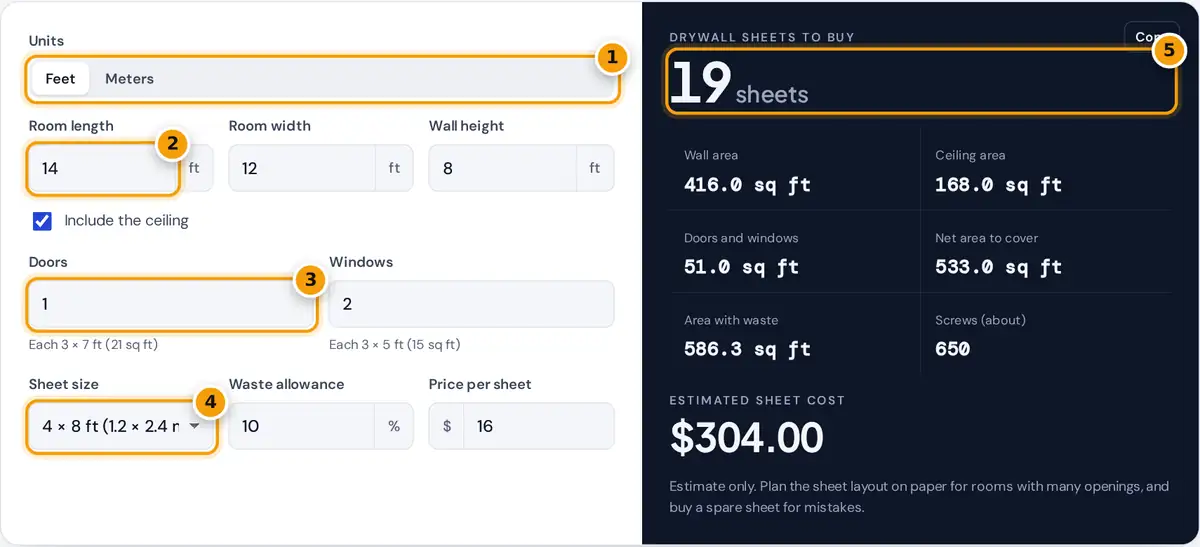
- Choose feet or meters.
- Enter the room length, width and wall height.
- Enter the number of doors and windows to subtract.
- Pick a sheet size and set waste and price per sheet.
- Read how many drywall sheets to buy, with screws and estimated cost below.
Measure the room's length and width along the floor and the wall height from floor to ceiling. Choose feet or meters, then enter the three numbers. Tick Include the ceiling if you are boarding it too. Count the doors and windows: the calculator subtracts a standard 3 × 7 ft door and a 3 × 5 ft window for each one. Pick the sheet size you plan to buy, set a waste allowance and a price per sheet, and the result updates as you type.
Drywall formula
ceiling area = length × width
net area = wall area + ceiling area − doors × 21 sq ft − windows × 15 sq ft
sheets = round up (net area × (1 + waste %) ÷ sheet area)
sheet area: 4 × 8 = 32 sq ft, 4 × 10 = 40 sq ft, 4 × 12 = 48 sq ft
Worked example
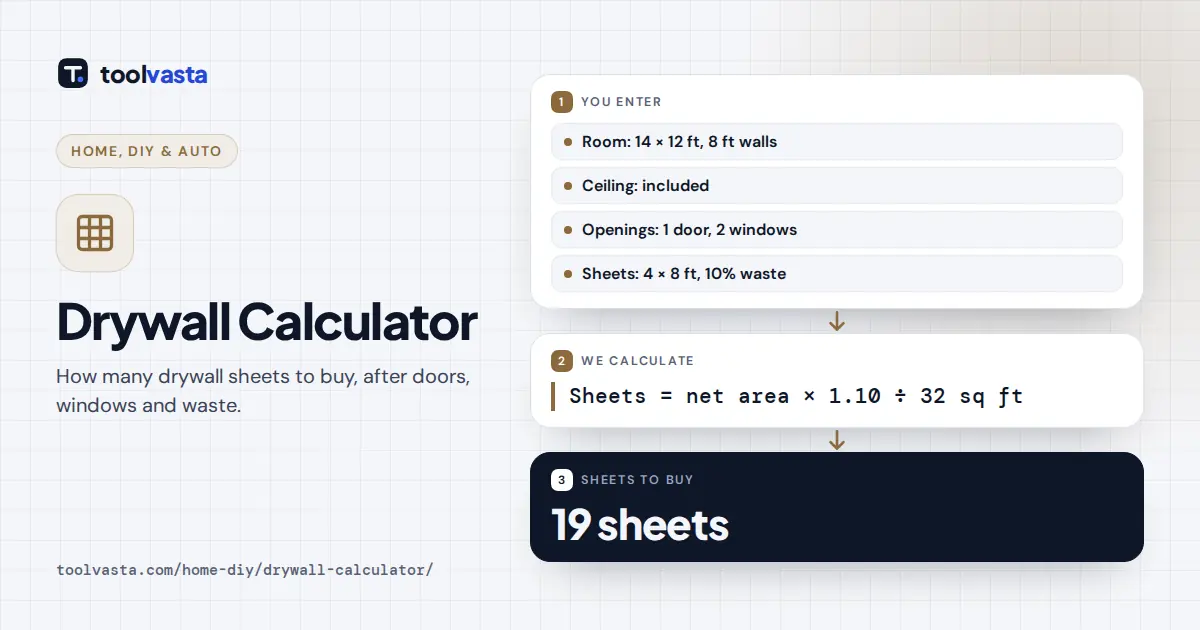
A bedroom is 14 ft by 12 ft with 8 ft walls, one door and two windows. The perimeter is 2 × (14 + 12) = 52 ft, so the walls are 52 × 8 = 416 sq ft. The ceiling adds 14 × 12 = 168 sq ft, for 584 sq ft. The openings remove 21 + 2 × 15 = 51 sq ft, leaving 533 sq ft to cover.
With 10% waste you need 533 × 1.10 = 586.3 sq ft. Divided by 32 sq ft per 4 × 8 sheet, that is 18.3, so buy 19 sheets. At $16 per sheet the board costs $304. Using 4 × 12 sheets instead, 586.3 ÷ 48 = 12.2, so 13 sheets.
Choosing a sheet size
| Sheet | Area | Best for |
|---|---|---|
| 4 × 8 ft | 32 sq ft (2.97 m²) | DIY work, small rooms, easy to carry |
| 4 × 10 ft | 40 sq ft (3.72 m²) | Walls up to 10 ft hung vertically |
| 4 × 12 ft | 48 sq ft (4.46 m²) | Long walls and ceilings with fewer joints |
In Canada, gypsum board is sold in the same 4 ft (1,220 mm) widths in metric and imperial lengths. Larger sheets mean fewer butt joints to tape, but they are heavy: a 4 × 12 sheet of 1/2 in board is a two-person lift. Common thicknesses are 1/2 in for walls, 5/8 in fire-rated board where code requires it (for example between an attached garage and the house), and moisture-resistant board in bathrooms.
Screws and finishing
The screw count assumes roughly one screw per square foot of board, which matches a typical pattern on walls with studs at 16 in (406 mm) centers. Ceilings and 24 in framing patterns differ, so check the manufacturer's fastening schedule. Screws are rounded up to the nearest 50. You will also need joint tape, joint compound, corner bead for outside corners, and primer.
How much waste to allow
- Simple rectangular rooms with few openings: about 10%.
- Rooms with many windows, angled ceilings or small sections: 15% or more.
- Large rooms with long sheets: 5 to 10% if you plan the layout carefully.
Assumptions
Openings use standard sizes. Large patio doors, bay windows or closets with no drywall inside should be adjusted by entering a different count or adding the area back. Sloped ceilings, stairwells and bulkheads are not included. This is a material estimate for planning, not a contractor's quote.
Frequently asked questions
How many sheets of drywall do I need for a 12 x 12 room?
With 8 ft walls, the walls are 384 sq ft and the ceiling 144 sq ft. After one door and one window and 10% waste, that is about 17 sheets of 4 × 8 drywall.
How do I calculate drywall square footage?
Multiply the room perimeter by the wall height for the walls, add length times width for the ceiling, and subtract the area of doors and windows.
How many screws per sheet of drywall?
About 32 screws for a 4 × 8 sheet on walls with studs at 16 in centers, which is roughly one per square foot. Follow the board maker's fastening schedule for ceilings.
Should I subtract windows and doors?
Yes for an estimate, but many installers board straight over small openings and cut them out, so the waste allowance covers the offcuts.
Is 4x12 drywall better than 4x8?
Bigger sheets leave fewer joints to tape and finish, which saves time on long walls and ceilings. Smaller sheets are easier to carry, lift and fit into tight rooms.