How to use the deck board calculator
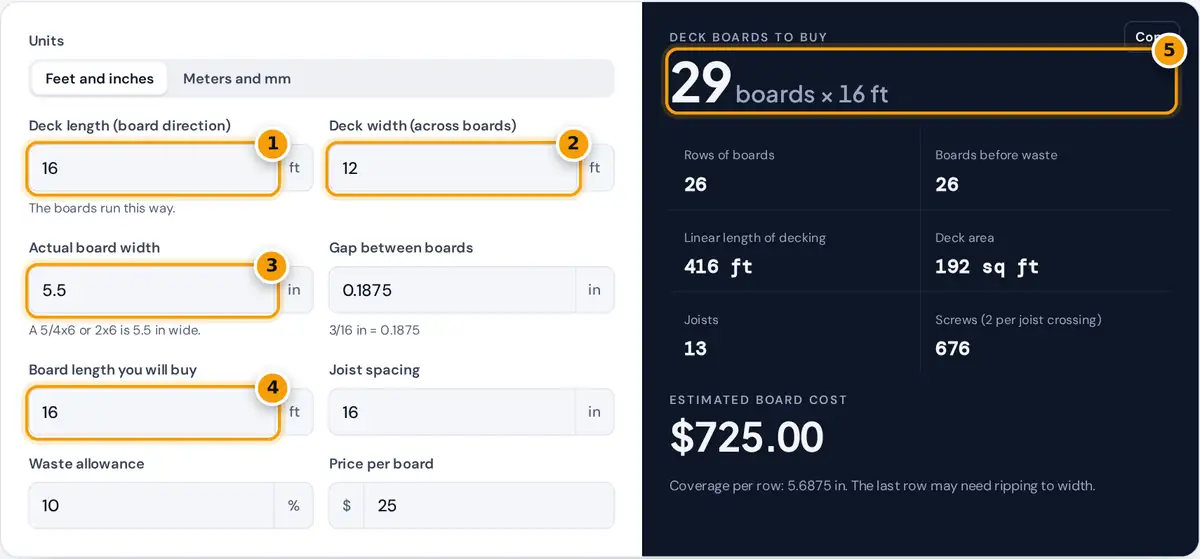
- Enter the deck length in the direction the boards run.
- Enter the deck width across the boards.
- Enter the actual board width and the gap between boards.
- Set the board length you will buy, joist spacing, waste and price.
- Read how many boards to buy, then check screws, joists and cost.
Enter the deck length in the direction the boards will run and the deck width across the boards. Then enter the actual board width (not the nominal size), the gap you plan to leave between boards, the length of the boards you will buy and the joist spacing. Add a waste allowance and the price per board. Imperial mode uses feet for deck and board lengths and inches for widths and spacing. Metric mode uses meters and millimeters.
Deck board formula
boards per row = round up (deck length ÷ board length)
boards = round up (rows × boards per row × (1 + waste %))
linear feet = rows × deck length
joists = round up (deck length ÷ joist spacing) + 1
screws = rows × joists × 2
Worked example
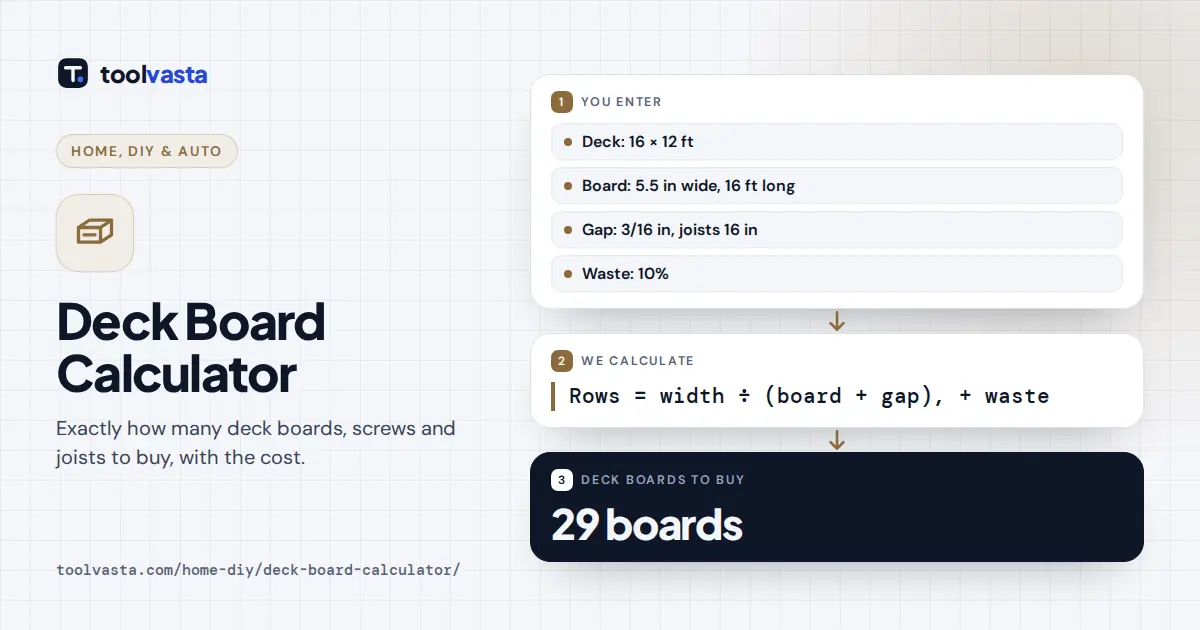
A 16 ft by 12 ft deck with 5.5 in boards and a 3/16 in gap. Each row covers 5.5 + 0.1875 = 5.6875 in. The width is 144 in, so 144 ÷ 5.6875 = 25.3, which rounds up to 26 rows. With 16 ft boards, each row is one board, so 26 boards. Adding 10% gives 28.6, so buy 29 boards. That is 416 linear feet of decking over 192 sq ft.
With joists at 16 in on center, 16 ft = 192 in gives 192 ÷ 16 + 1 = 13 joists. Two screws at each crossing means 26 × 13 × 2 = 676 screws. At $25 a board the decking costs $725.
Common deck board sizes
| Board | Actual width | Rows per foot of deck (3/16 in gap) |
|---|---|---|
| 5/4 × 6 pressure treated | 5.5 in (140 mm) | 2.11 |
| 2 × 6 | 5.5 in (140 mm) | 2.11 |
| Composite, standard | about 5.5 in | 2.11 |
| 1 × 4 hardwood | 3.5 in (89 mm) | 3.25 |
Composite and PVC boards can vary slightly by brand. Use the width printed in the product specifications.
Board gaps and joist spacing
Wood boards need a gap so water drains and the boards can move. Kiln-dried lumber is often gapped at about 1/8 to 3/16 in. Wet pressure-treated boards shrink as they dry, so many builders butt them tightly or leave a very small gap. Composite manufacturers specify their own side and end gaps, which change with temperature, and hidden fastener clips often set the gap automatically.
Joist spacing of 16 in (400 mm) is common for wood decking laid square to the joists. Diagonal decking and many composite products require 12 in (300 mm) spacing. Always follow the board maker's span rating and your local building code.
Tips for ordering
- Choose board lengths that match the deck or divide it evenly to reduce offcuts. A 14 ft deck built from 16 ft boards wastes 2 ft a row.
- When a deck is longer than your boards, joints must land on a joist. Plan for a doubled joist or blocking at each joint.
- Picture frame borders, stairs and fascia boards are extra. Add them as separate lines in your order.
- Add 10% for straight decks and around 15% for diagonal layouts.
Frequently asked questions
How many deck boards do I need for a 12x16 deck?
With 5.5 in boards, a 3/16 in gap and 16 ft boards, a 12 ft wide deck needs 26 rows. With 10% extra, buy 29 boards.
How many linear feet of decking do I need?
Multiply the number of rows by the deck length. A 16 ft long deck with 26 rows needs 416 linear feet before waste.
What is the actual width of a 5/4x6 deck board?
A 5/4 × 6 pressure-treated deck board is about 5.5 in (140 mm) wide and about 1 in thick.
How much gap should be between deck boards?
About 1/8 to 3/16 in for dry wood. Wet treated lumber is often installed tight because it shrinks. Composite boards use the gap in the manufacturer's instructions.
How many screws do I need for a deck?
Use two screws per board at every joist. A 16 ft deck with joists at 16 in on center has 13 joists, so each row needs 26 screws.