How to Use the Pool Volume Calculator
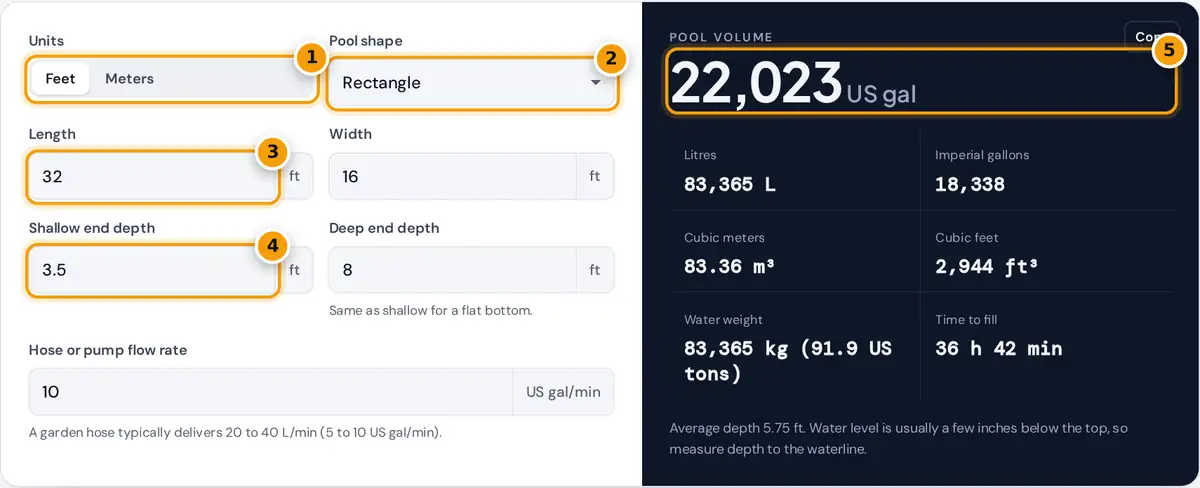
- Choose feet or metres.
- Pick your pool shape: rectangle, round, oval or kidney.
- Enter the length and width of the pool.
- Enter the shallow and deep end depths, measured to the waterline.
- Read the pool volume, then check litres, imperial gallons and fill time.
Choose the pool shape and units first. For a rectangle or oval, enter the length and width, and for a round above-ground pool, enter the diameter. A kidney pool needs its length and two widths.
For the kidney shape, width A is measured across the wide end and width B across the narrow end. Then enter the water depth at the shallow end and the deep end of the pool.
Measure depth to the waterline, not the top of the wall, and enter the same depth twice for a flat-bottom pool. Add a hose or pump flow rate to see how long filling will take.
Pool Volume Formulas
Every shape uses the same idea: surface area times average depth. The average depth is the shallow end plus the deep end, divided by 2, which works well for any pool with a gradual slope.
rectangle: volume = length × width × average depth
round: volume = π × diameter² ÷ 4 × average depth
oval: volume = π ÷ 4 × length × width × average depth
kidney: volume ≈ 0.45 × (A + B) × length × average depth
1 ft³ = 28.317 L = 7.4805 US gal 1 m³ = 1,000 L 1 US gal = 3.785 L 1 imperial gal = 4.546 L
The rectangle, round and oval formulas are exact for vertical walls and a smooth, uniform slope. The kidney formula is an industry approximation that works well for most typical kidney shapes and irregular freeform pools.
One cubic foot holds 7.4805 US gallons, which many pool guides simply round up to 7.5. The calculator uses the exact NIST unit conversion factors, so litres, US gallons and imperial gallons all agree exactly.
Worked Examples
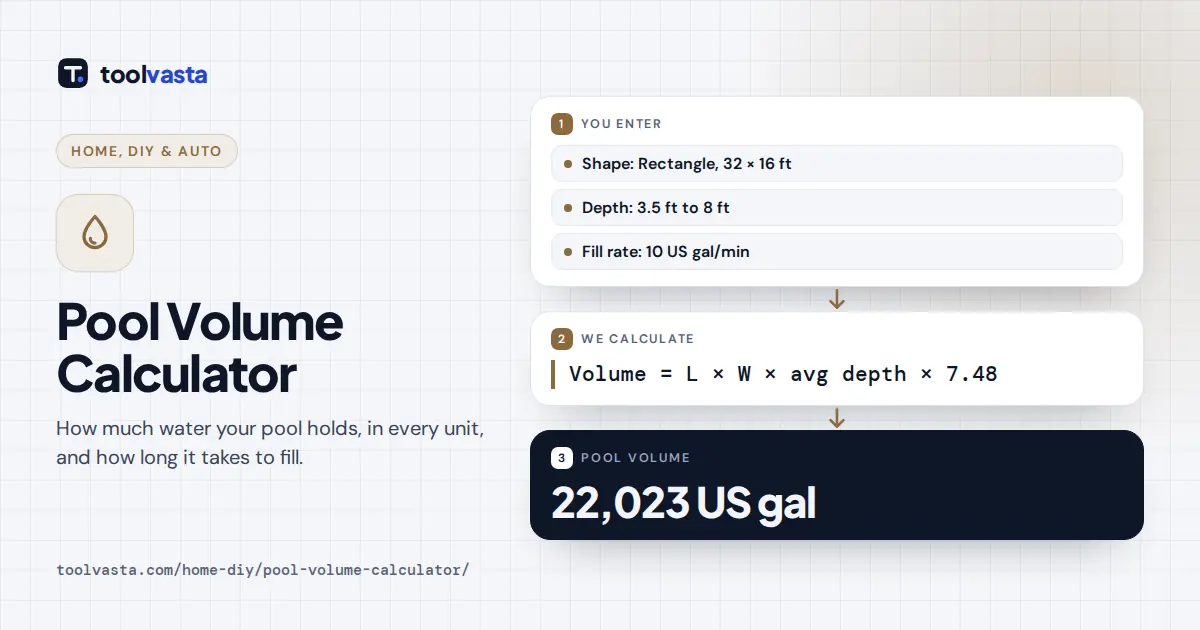
A 32 ft by 16 ft inground pool runs from 3.5 ft at the shallow end to 8 ft at the deep end. Average depth is 5.75 ft, so the volume is 2,944 cubic feet.
Multiplying by 28.317 gives 83,365 litres, which is 22,023 US gallons or 18,338 imperial gallons. With a garden hose at 10 US gallons per minute, filling it from empty takes about 36 hours 42 minutes.
A 24 ft round pool with 4 ft of water holds 51,241 litres or 13,536 US gallons. A metric 8 m by 4 m pool, 1.4 m deep, holds 44.8 cubic meters, or 44,800 litres.
| Pool | Size | US gallons |
|---|---|---|
| Rectangle | 32 × 16 ft, 3.5 to 8 ft deep | 22,023 |
| Round | 24 ft, 4 ft deep | 13,536 |
| Oval | 30 × 15 ft, 4.5 ft deep | 11,897 |
| Kidney | 30 ft long, A 12 ft, B 8 ft, 3.5 to 5.5 ft deep | 9,089 |
| Metric rectangle | 8 × 4 m, 1.4 m deep | 11,835 |
Common Above-Ground Pool Volumes
Most above-ground pools are round, with a 52 in wall and roughly 4 ft of water. The table shows how much they hold, which is useful when you buy chemicals or plan the first fill.
| Round pool | Water depth | Litres | US gallons |
|---|---|---|---|
| 12 ft (3.7 m) | 4 ft | 12,810 | 3,384 |
| 15 ft (4.6 m) | 4 ft | 20,016 | 5,288 |
| 18 ft (5.5 m) | 4 ft | 28,823 | 7,614 |
| 24 ft (7.3 m) | 4 ft | 51,241 | 13,536 |
| 27 ft (8.2 m) | 4 ft | 64,852 | 17,132 |
Volume grows with the square of the diameter, so a small step up adds lots of water. A 24 ft pool holds four times the water of a 12 ft pool at the same depth.
Water weighs about 1 kg per litre, so a full 24 ft pool holds roughly 51 tonnes of water. Above-ground pools need firm, level ground, and the frame must sit evenly all the way round.
Pool Volume and Water Chemistry
Knowing the exact volume matters most for water chemistry. Chlorine, pH adjusters, shock and algaecide doses on the label are given per 10,000 litres or per 10,000 gallons of pool water, depending on the brand.
An accurate volume keeps you from under dosing, which leaves algae and cloudy water, or over dosing, which wastes money and can cause skin or eye irritation. Treat this as your first pool chemical calculator.
Chemical strength is often written in parts per million (ppm), the weight of a chemical per million equal parts of water. Always follow the product label, and add chemicals to water, never water to chemicals.
Fill Time and Water Cost
Fill time is simply the pool volume divided by the flow rate you enter. A garden hose delivers far less than a pump, and its flow depends on your water pressure and the hose diameter.
At 10 gallons per minute, the 22,023 gallon pool takes about 36 hours 42 minutes, and at 30 litres per minute the 44,800 litre pool takes 24 hours 53 minutes to fill completely from empty.
To estimate the total cost of filling, multiply the volume by your local water rate. In some areas you can also order bulk water by truck, which avoids running a hose for days on end.
Accuracy Tips
Measure inside the walls, not the outside of the frame or coping. Pools with a long flat shallow area and a short steep deep end hold less than a straight slope suggests to most people.
For better accuracy, split the whole pool into a flat shallow section and a sloped deep end section. Freeform pools can be split into rectangles and circles, calculated separately, and then simply added up together.
Steps, benches and sun ledges take up some volume, so the result slightly overestimates for pools with large built-in features. The NIST guide to SI units defines the litre and the cubic meter used here.
Frequently asked questions
How do I calculate how many litres are in my pool?
Multiply length by width by average depth in meters to get cubic meters, then multiply by 1,000. For a pool measured in feet, multiply the cubic feet by 28.317 to get litres.
How many gallons are in a 24 ft round pool?
At 4 ft of water, a 24 ft round pool holds about 13,536 US gallons, or about 51,241 litres. A 15 ft round pool at the same depth holds about 5,288 US gallons.
How do I find the average depth of a pool?
Add the shallow end depth and the deep end depth and divide by 2. A pool from 3.5 ft to 8 ft has an average depth of 5.75 ft. Measure to the waterline, not the wall top.
How long does it take to fill a pool with a garden hose?
Divide the volume by the flow rate. A 22,000 US gallon pool at 10 gallons per minute takes about 37 hours, so most people fill a large pool over two days.
Why do I need to know my pool volume?
Chemical doses are given per volume of water. Using the correct volume prevents wasted chemicals, cloudy water and skin or eye irritation, and helps you size pumps, filters and heaters properly.
How many gallons are in a cubic foot?
One cubic foot of water is 7.4805 US gallons, often rounded to 7.5, or 28.317 litres. One cubic meter is 1,000 litres, which is about 264 US gallons of water.