How to Use the VIN Decoder
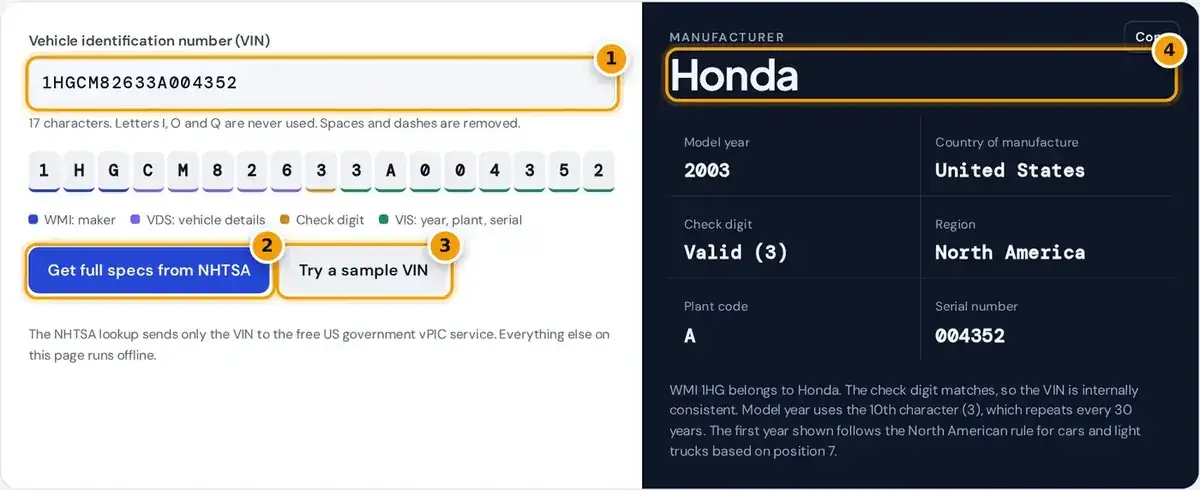
- Type or paste the 17-character VIN. Spaces and dashes are removed for you.
- Optional: get full make, model and engine specs from the free NHTSA service.
- No VIN handy? Try a sample VIN to see how decoding works.
- Read the manufacturer, model year, country, plant and check digit result.
Type or paste the 17-character vehicle identification number into the box. The vin decoder removes spaces and dashes, checks every character and colours the three standard sections so you can clearly see each separate part.
You instantly see the manufacturer, the country of manufacture, the model year, the plant code, the serial number and whether the check digit is valid. Try a sample VIN to see exactly how it works.
For more detail, press Get full specs from NHTSA. This sends only the VIN to the free vPIC database, which returns make, model, trim, body class and engine for most vehicles sold in North America.
Where to Find Your VIN
On cars, SUVs and light trucks, the VIN is on a plate at the bottom of the windshield on the driver side. You can easily read it from outside the vehicle without opening any doors.
It also appears on a sticker in the driver door jamb and on your registration, insurance slip and ownership papers. Compare all these copies when buying a used vehicle, because they should all match exactly.
On trailers, the VIN is usually stamped on the tongue or on the front of the frame rail. Motorcycles often carry it stamped on the steering head, and many owners' manuals show the exact location.
What Each Part of a VIN Means
Since the 1981 model year, road vehicles in North America use a 17-character VIN defined by ISO 3779 and, in the United States, the 49 CFR Part 565 VIN requirements. Older vehicles used shorter formats.
| Positions | Name | What it tells you |
|---|---|---|
| 1 to 3 | WMI | World manufacturer identifier: country and maker |
| 4 to 8 | VDS | Vehicle descriptor: model, body, engine, restraints (maker specific) |
| 9 | Check digit | Detects typing errors (required in North America) |
| 10 | Model year | Letter or digit for the model year |
| 11 | Plant | Assembly plant code (maker specific) |
| 12 to 17 | Serial | Production sequence number |
The WMI in positions 1 to 3 names the maker, and the VDS in positions 4 to 8 describes the model, body, engine and restraints. Each manufacturer defines its own VDS codes, so meanings vary.
Position 9 is the check digit. The VIS, positions 10 to 17, then holds the model year, the assembly plant code and a six-character serial number that identifies the individual vehicle on the production line.
Country and Manufacturer Codes
The first character of the world manufacturer identifier shows the broad region: 1 to 5 for North America, H to R for Asia, S to Z for Europe and either 6 or 7 for Oceania.
Within North America, a 2 means Canada and a 3 means Mexico, while 1, 4 and 5 mean the United States. J is Japan, K is South Korea, L is China and W is Germany.
A 9 in position 3 marks a small manufacturer that builds fewer than 1,000 vehicles a year. The offline table covers common makers in Canada and the United States, so rare builders may not appear.
How the Check Digit Is Calculated
Each letter is converted to a number using a fixed table, then every character is multiplied by a weight for its position. Position 9 has a weight of zero, so it never affects the sum.
Weights (positions 1 to 17): 8 7 6 5 4 3 2 10 0 9 8 7 6 5 4 3 2
check digit = (sum of value × weight) mod 11, and 10 becomes X
The products are added up and divided by 11, which is mod 11 arithmetic. The remainder is the check digit, and a remainder of 10 is written as the letter X instead of a number.
This catches most typing errors and transcription mistakes, such as a swapped pair of adjacent characters. A valid check digit does not prove a VIN plate is genuine, only that the number is internally consistent.
Worked Example
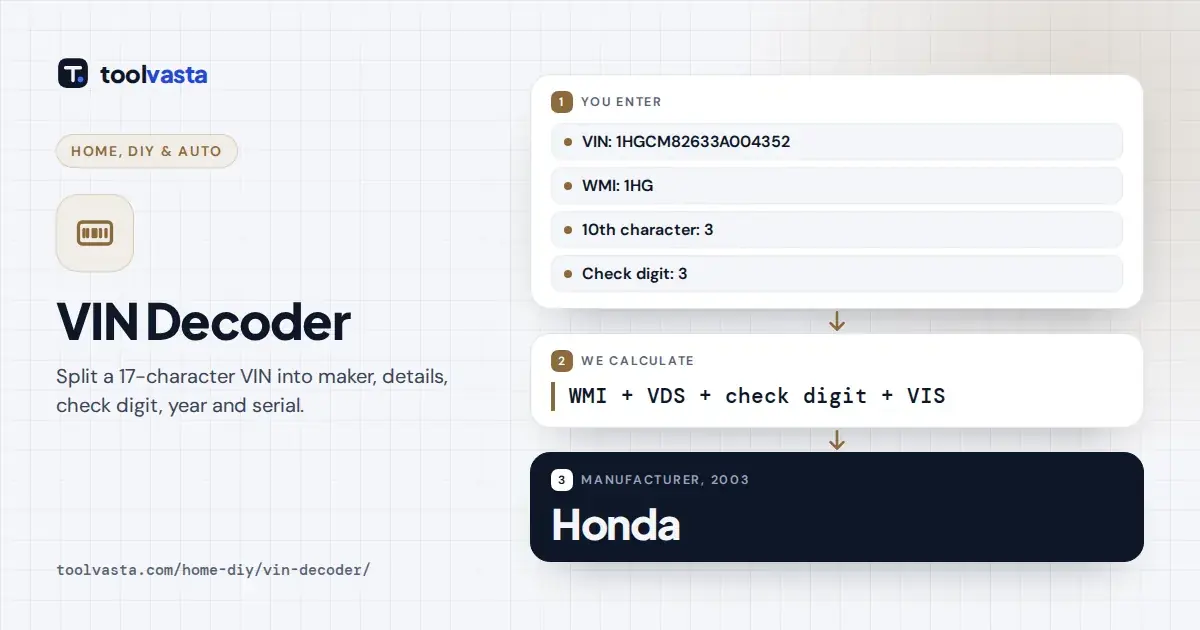
For the sample VIN 1HGCM82633A004352, the weighted values add up to 311. Dividing 311 by 11 gives 28 with a remainder of 3, because 11 times 28 is 308. The decoder does this arithmetic instantly.
That remainder matches the ninth character, which is also 3, so the VIN is internally consistent. A single wrong character anywhere else would almost always produce a different remainder and fail the validation check completely.
The 10th character is 3, which stands for 2003 because the 7th character, 2, is a digit. The WMI 1HG belongs to Honda built in the United States, which the decoder shows as the manufacturer.
Model Year Codes
The model year character in position 10 cycles every 30 years and skips I, O, Q, U, Z and 0. For example, A means either 1980 or 2010, and S means either 1995 or 2025.
For cars, SUVs and light trucks sold in North America, a letter in position 7 points to the 2010 to 2039 cycle, while a digit points to 1980 to 2009. That settles which year applies.
Heavy trucks, buses, trailers and motorcycles do not follow the position 7 rule, so the decoder shows both possible years. VINs never use I, O and Q anywhere, because they closely resemble 1 and 0.
Trailer VINs and NIV Decoding
This works as a trailer vin decoder for any trailer with a 17-character VIN. Many trailer builders are small manufacturers, marked by a 9 in position 3, so the maker name may be missing offline.
The NHTSA lookup often identifies those builders, and the check digit and model year still decode offline without it. Look for the number on the trailer tongue, the frame rail or the manufacturer's certification label.
NIV is the French abbreviation for the same number, used on Quebec documents and French-language paperwork. Enter a NIV exactly like a VIN, and this niv decoder reads it the same way with identical results.
Limits and Vehicle History
Positions 4 to 8 and the plant code are defined by each manufacturer, so model and engine details need the NHTSA lookup. Vehicles built for other markets may not use a check digit at all.
A pre-1981 vehicle uses a shorter, maker-specific serial that this tool cannot reliably decode. Classic car owners should rely on manufacturer records, marque clubs or provincial registration documents to confirm the vehicle's identity and history.
A decoder does not show accident history, a lien, theft or open recall status. Before buying a used vehicle, get a full vehicle history report, check provincial lien records and search the NHTSA vPIC database.
Frequently asked questions
How do I decode a VIN number for free?
Enter the 17-character VIN above. The decoder shows the manufacturer, country, model year and check digit instantly, and the NHTSA button adds make, model and engine data from the free US government database.
What does the 10th digit of a VIN mean?
The 10th character is the model year code. It repeats every 30 years, so J can mean 1988 or 2018. For cars and light trucks, a letter in position 7 points to the newer cycle.
Why do VINs not use the letters I, O and Q?
They are excluded because they are easily confused with the digits 1 and 0. If your VIN seems to contain one of them, it is almost certainly a 1 or a 0 instead.
Can I decode a trailer VIN?
Yes, if it has 17 characters. Many trailer builders are small manufacturers, shown by a 9 in position 3, so the maker name may not be in the offline table. The NHTSA lookup often identifies them.
Does a VIN decoder show accident history?
No. A decoder reads the information encoded in the number itself. Accident, lien and odometer history come from paid vehicle history reports and provincial or state records, not from the VIN.
What is a NIV?
NIV is the French abbreviation for numero d'identification du vehicule, the same 17-character number called a VIN in English. This decoder works with it the same way and gives identical results.