How to use the tile calculator
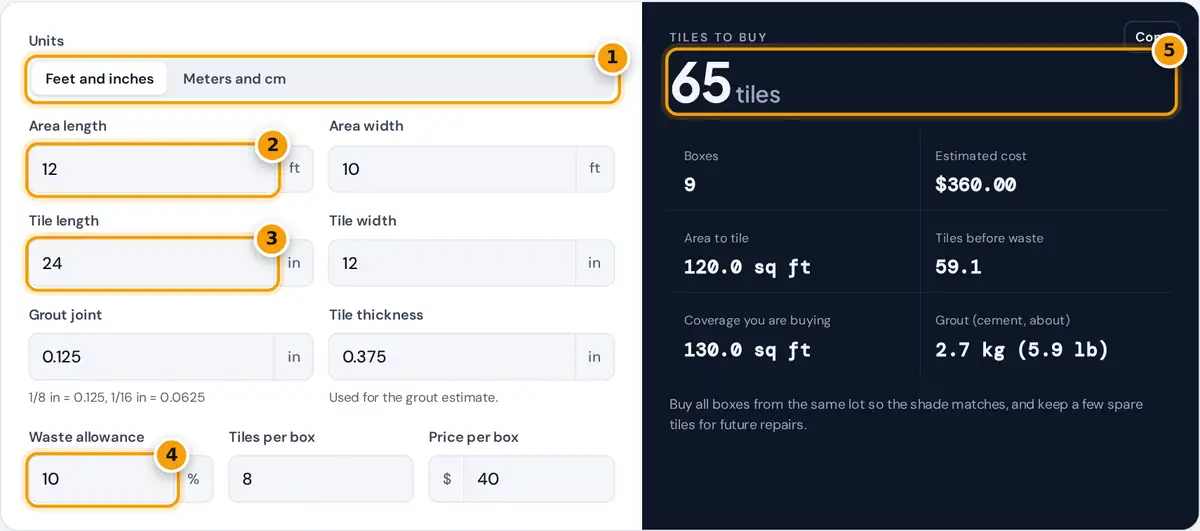
- Choose feet and inches or metres and centimetres.
- Enter the length and width of the floor or wall.
- Enter the tile length and width, then the grout joint.
- Set a waste allowance, tiles per box and price per box.
- Read the tiles to buy, then check boxes, cost and the grout estimate.
Measure the floor or wall you want to tile and enter its length and width. For an L-shaped floor, split it into rectangles and run each one, or enter the total area as length × 1. Enter the tile size as printed on the box, the grout joint width and the tile thickness. Set a waste allowance, the number of tiles per box and the box price. The calculator counts tiles, rounds up to whole boxes and estimates the grout.
Tile formulas
tiles = round up (area ÷ tile footprint × (1 + waste %))
boxes = round up (tiles ÷ tiles per box)
grout (L) = area (m²) × (A + B) ÷ (A × B) × joint × depth
with tile length A, width B, joint and depth in mm; grout kg ≈ litres × 1.6
Including the grout joint in the footprint is slightly more accurate than dividing by the tile size alone, because each tile actually covers its own area plus half the joint on every side.
Worked example
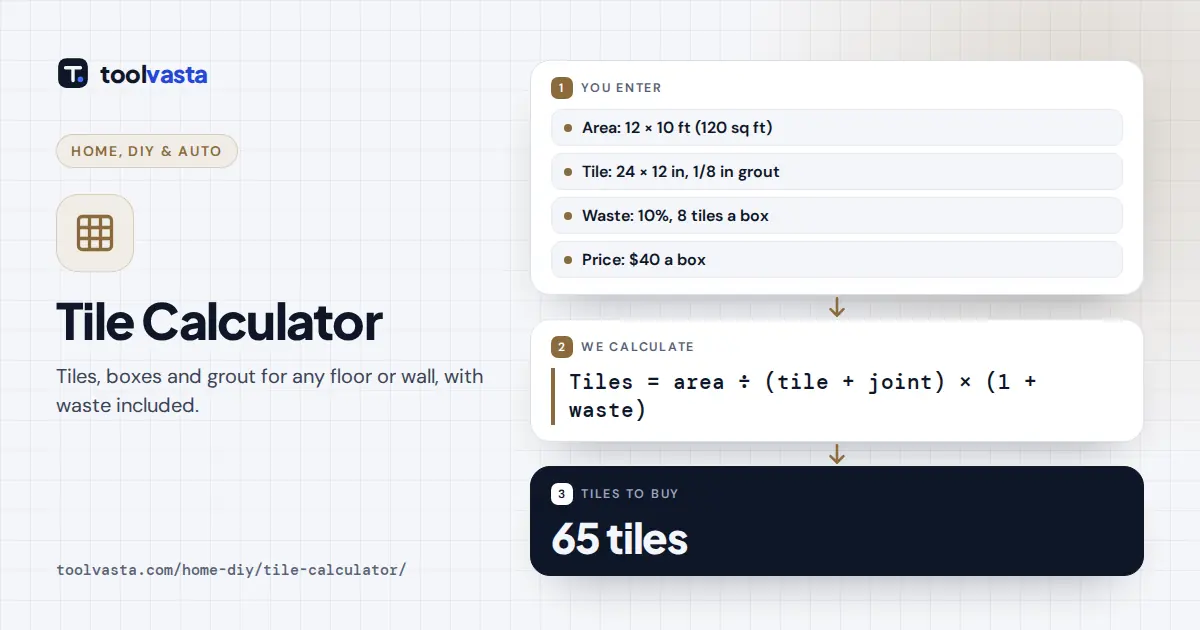
A 12 ft by 10 ft floor is 120 sq ft. A 12 × 24 in tile with a 1/8 in joint has a footprint of 12.125 × 24.125 = 292.5 sq in, or 2.031 sq ft. That gives 120 ÷ 2.031 = 59.1 tiles. With 10% waste, 59.1 × 1.10 = 65.0, so buy 65 tiles. At 8 tiles per box that is 9 boxes, and at $40 per box the tile costs $360.
For grout, the floor is 11.15 m², the tile is 304.8 × 609.6 mm, and a 3.175 mm joint 9.525 mm deep gives 11.15 × 914.4 ÷ 185,806 × 3.175 × 9.525 = 1.66 L, which is about 2.7 kg of cement grout.
How much extra tile to buy
| Layout | Typical waste |
|---|---|
| Straight lay, simple room | 10% |
| Brick or offset pattern, large format tile | 10 to 15% |
| Diagonal layout | 15% |
| Herringbone or complex patterns | 15 to 20% |
These are common rules of thumb. Small rooms with many cuts, such as bathrooms, waste proportionally more than large open floors. Large format tile over 15 in on a side is often laid at a 1/3 offset rather than 1/2 to reduce lippage, which can change your waste.
About the grout estimate
The grout formula is the one most grout manufacturers publish: joint volume per square meter equals the joint perimeter per tile area times joint width times depth. The 1.6 kg per litre density is a typical value for cement-based sanded grout. Epoxy and urethane grouts differ, so check the coverage chart on the product you buy and round up to whole bags.
Tips and limits
- Dry lay a row of tiles to confirm the real joint width and where the cuts fall.
- Rectified porcelain often allows joints as small as 1/16 in (1.5 mm). Follow the tile maker's minimum.
- Thinset coverage depends on the trowel size, which this calculator does not estimate.
- Subtract fixed cabinets, tubs and shower bases from the area if you are not tiling under them.
Frequently asked questions
How do I calculate how many tiles I need?
Divide the area by the area of one tile plus its grout joint, then add 10 to 15% for cuts and breakage and round up. A 120 sq ft floor needs 65 tiles of 12 × 24 in with 10% waste.
How many 12x24 tiles are in a box?
It depends on the brand and thickness. Many 12 × 24 in porcelain boxes hold 6 to 8 tiles, covering 12 to 16 sq ft, so check the label.
How much extra tile should I buy?
About 10% for a straight lay and 15% or more for diagonal, herringbone or rooms with many cuts.
How do I calculate grout?
Multiply the area in m² by (tile length + width) ÷ (length × width), then by joint width and depth, all in mm. The result is litres; multiply by about 1.6 for kilograms of cement grout.
Should I include grout lines when counting tiles?
Yes for accuracy. Wide joints and small tiles make a noticeable difference, while for large tiles with thin joints it changes the count only slightly.