Quick answer: To find square metres, multiply the length by the width with both measured in metres. A room 4.2 m long and 3.5 m wide is 4.2 × 3.5 = 14.7 m². Convert centimetres by dividing by 100 first. This square meter calculator does that for rectangles, triangles and circles, adds waste and prices the job.

What Is Measured in Square Metres?
A square meter calculator turns the measurements of a floor, wall, garden or plot into an area in square metres (m²). Square metres are the unit UK suppliers use to price carpet, laminate, tiles, turf, paving and plaster, and the unit estate agents and planning documents use for floor space, so getting the number right is the first step in almost every home project.
You can enter measurements in metres, centimetres, millimetres, feet or inches. The calculator converts them to metres before multiplying, which avoids the most common mistake: multiplying two figures in centimetres and reading the answer as square metres. It also shows the area in square feet and square yards, adds a waste allowance and multiplies by a price per square metre.
How Do You Work Out the Area of a Room?
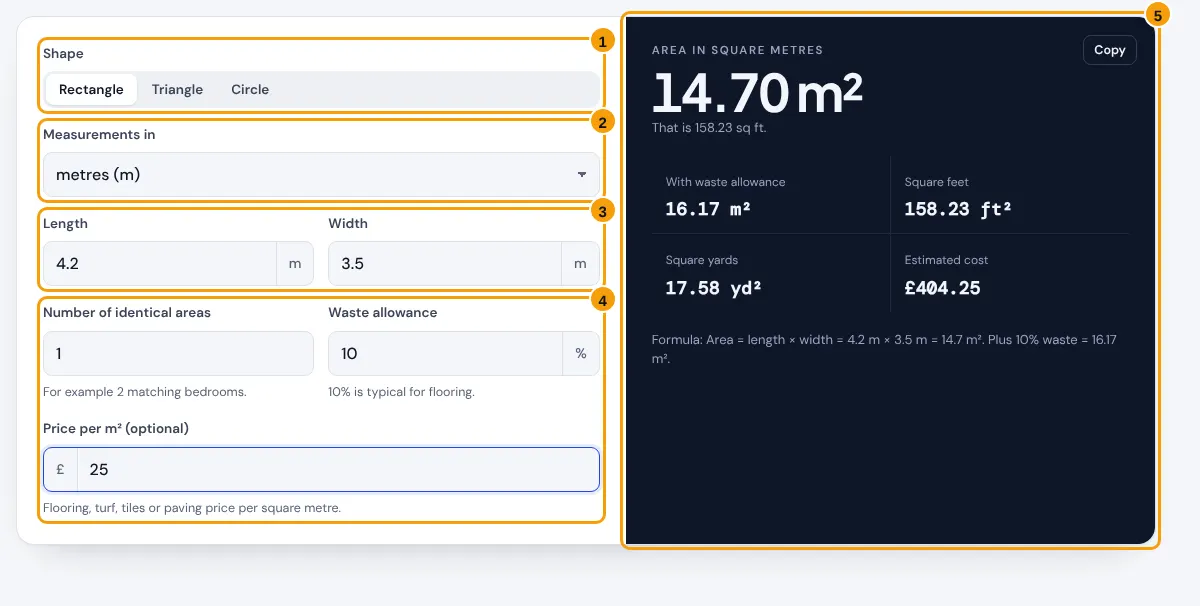
- Choose the shape: rectangle, triangle or circle.
- Pick the unit your tape measure shows, such as metres or centimetres.
- Enter the length and width, or the base and height of a triangle, or the diameter of a circle.
- Enter how many identical areas there are, a waste allowance and, if you are buying materials, a price per square metre.
- Read the area in square metres, square feet and square yards, the total with waste and the estimated cost, then copy the result.
For a whole room, measure wall to wall at floor level in two places and use the larger figure, because few rooms are perfectly square. Set the waste to 0 when you only need the floor area, for example to compare houses or check an energy certificate. If your measurements are in feet, the square footage calculator works the other way round, with square feet as the main result.
How Do You Calculate Square Metres?
You calculate square metres by multiplying two lengths in metres. Each shape has its own formula, but the unit rule is the same: convert first, multiply second.
Triangle: area = ½ × base × height
Circle: area = π × diameter² ÷ 4
Centimetres to metres: ÷ 100 · millimetres to metres: ÷ 1,000
1 m² = 10.764 ft² = 1.196 yd²
Worked example. A living room measures 420 cm by 350 cm and you want laminate at £25 per m² with 10% extra for cuts.
- Convert: 420 cm = 4.2 m and 350 cm = 3.5 m.
- Area = 4.2 × 3.5 = 14.7 m².
- With 10% waste = 14.7 × 1.10 = 16.17 m².
- Cost = 16.17 × £25 = £404.25.
Multiplying 420 by 350 directly gives 147,000, which is square centimetres, not square metres. Because there are 100 × 100 = 10,000 cm² in one m², you would need to divide by 10,000. The National Physical Laboratory explains how derived units like the square metre are built from the metre in its guide to SI units.
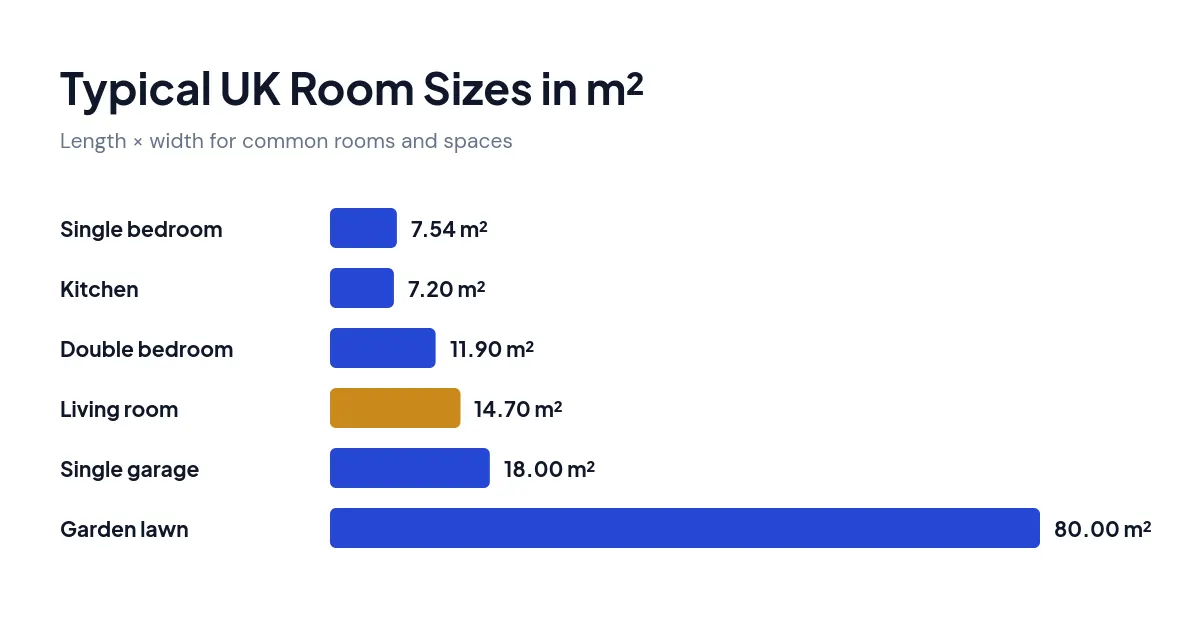
| Space | Typical size | Area | Area in ft² |
|---|---|---|---|
| Single bedroom | 2.6 m × 2.9 m | 7.54 m² | 81.2 ft² |
| Double bedroom | 3.5 m × 3.4 m | 11.90 m² | 128.1 ft² |
| Living room | 4.2 m × 3.5 m | 14.70 m² | 158.2 ft² |
| Kitchen | 3.0 m × 2.4 m | 7.20 m² | 77.5 ft² |
| Single garage | 6.0 m × 3.0 m | 18.00 m² | 193.8 ft² |
| Garden lawn | 10 m × 8 m | 80.00 m² | 861.1 ft² |
For context, the government’s nationally described space standard sets a minimum of 7.5 m² for a single bedroom and 11.5 m² for a double, so the first two rows sit right at those limits.
How Do You Measure an Irregular Room?
You measure an irregular room by splitting it into rectangles, triangles and circles, working out each one and adding them together. An L-shaped room becomes two rectangles. A bay window is usually a rectangle plus two small triangles, and a curved bay can be treated as half a circle.
- L-shaped room. A 5 m × 4 m main area plus a 2 m × 1.5 m alcove is 20 + 3 = 23 m².
- Room with a chimney breast. Work out the full rectangle, then subtract the chimney breast footprint, for example 0.4 m × 1.2 m = 0.48 m².
- Semi-circular bay. Use the circle option with the full diameter of the bay, then halve the result.
For tiling, add 10% waste for straight lay and 15% for diagonal or herringbone patterns, then round up to whole packs. The tile calculator works out the number of tiles and boxes, and the paint calculator turns wall areas into litres of paint.
Related Tools
- Square Footage Calculator
- Tile Calculator
- Paint Calculator
- Sod Calculator
- Linear Feet Calculator
- Acres Calculator
Frequently asked questions
How do I calculate square metres of a room?
Measure the length and width in metres and multiply them. A room 3.6 m by 3.2 m is 11.52 m². If you measured in centimetres, divide each figure by 100 before multiplying.
How do I convert square feet to square metres?
Divide square feet by 10.764, or multiply by 0.0929. For example, 200 ft² is 18.58 m².
How many square metres is a 10 by 10 room?
A 10 m by 10 m room is 100 m². A 10 ft by 10 ft room is 100 ft², which is 9.29 m².
How much extra flooring should I buy?
Add 5% to 10% for most straight-laid flooring and carpet, and 15% for diagonal or herringbone patterns or rooms with many corners. Then round up to whole packs.
Is a square metre the same as a metre squared?
For area, yes. Both mean the area of a square 1 m on each side, written m². Be careful with phrases such as “2 metres squared”, which some people use to mean a 2 m by 2 m square, which is 4 m².