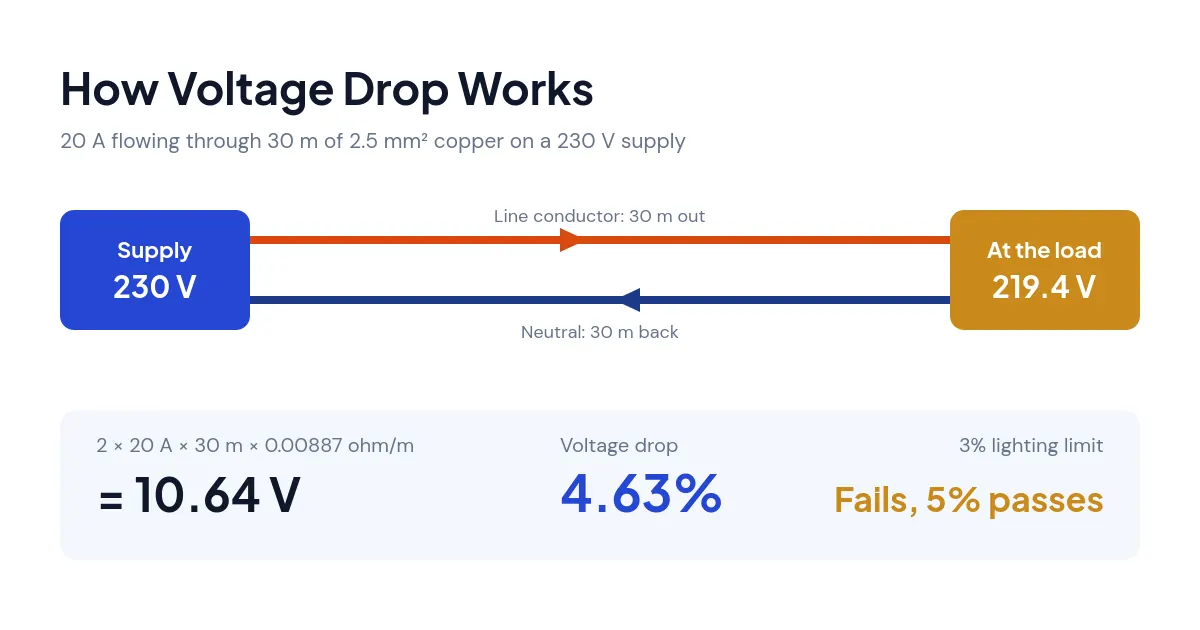
Quick answer: Voltage drop = 2 × current × one-way length × conductor resistance per metre (use √3 instead of 2 for three phase). A 30 m run of 2.5 mm² copper carrying 20 A at 230 V drops about 10.6 V, or 4.6%. This voltage drop calculator also finds the smallest cable that stays within 3% or 5%.
Why Do Long Cables Lose Voltage?
A voltage drop calculator works out how many volts are lost in a cable between the supply and the load. Every conductor has resistance, so when current flows some of the supply voltage is used up pushing it along the wire. On a short run the loss is tiny. On a long run to a garden office, an outbuilding, an EV charger or a pump at the end of a field, it can be large enough to make lights dim, motors run hot and equipment trip.
The calculator handles both common sizing systems. Metric mode uses cable cross-sections in mm² and lengths in metres, with conductor resistances taken from the standard values for copper and aluminium conductors and corrected for operating temperature. US mode uses AWG and kcmil sizes, lengths in feet and the familiar K-factor method. Both modes work for single-phase and three-phase circuits.
How Do You Check a Cable Run?
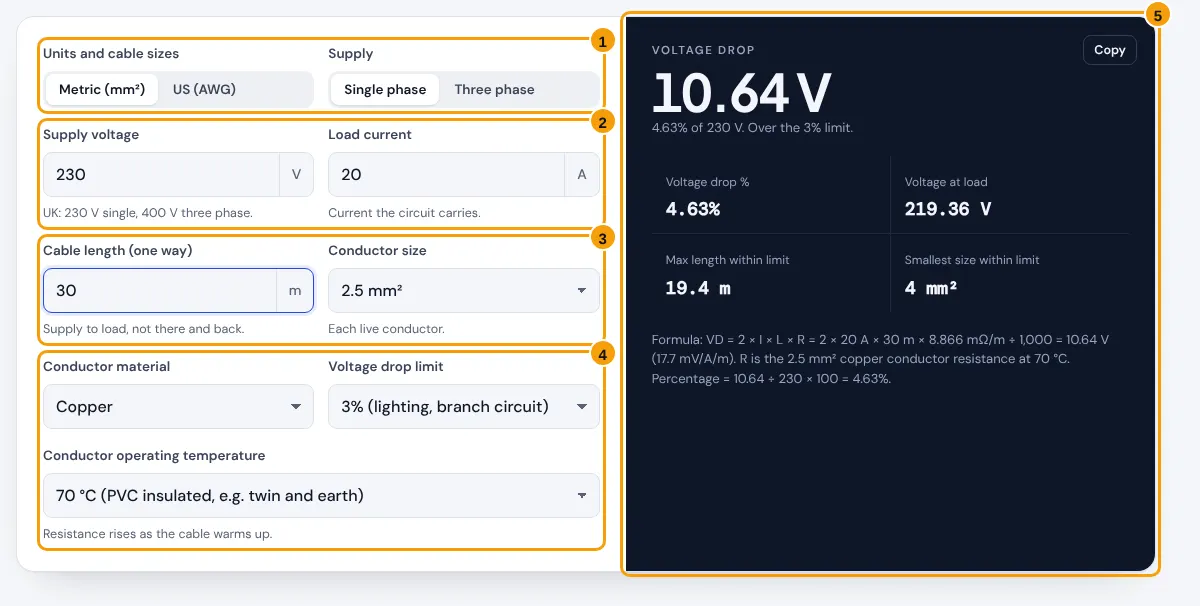
- Choose metric (mm² and metres) or US (AWG and feet), then single phase or three phase.
- Enter the supply voltage and the current the circuit will actually carry.
- Enter the one-way cable length and pick the conductor size.
- Choose copper or aluminium, the voltage drop limit and, in metric mode, the conductor temperature.
- Read the drop in volts and percent, the voltage at the load, the longest run that stays within your limit and the smallest cable that would pass.
Measure the length along the actual cable route, including the rises up walls and the drops into consumer units, not the straight-line distance. Use the design current of the circuit, not the rating of the breaker, unless you want a worst-case figure. If you know the load in kilowatts rather than amps, the amps to kW converter turns one into the other.
What Is the Voltage Drop Formula?
Voltage drop is current multiplied by the resistance of the cable path. In a single-phase circuit the current flows out on the line conductor and back on the neutral, so the length counts twice. In a balanced three-phase circuit the line-to-line drop uses √3 (about 1.732) instead of 2.
VD = √3 × I × L × R (three phase)
R = R20 × [1 + α × (T − 20)]
US: VD = 2 × K × I × L ÷ CM (single phase)
Voltage drop % = VD ÷ supply voltage × 100
Here I is the current in amps, L the one-way length, R the resistance of one conductor per metre at its operating temperature, α the temperature coefficient (0.00393 for copper, 0.00403 for aluminium), K the resistivity constant in ohm circular mils per foot (12.9 for copper and 21.2 for aluminium at 75 °C) and CM the conductor area in circular mils.
Worked example (UK). A 230 V radial circuit carries 20 A over 30 m of 2.5 mm² copper twin and earth.
- R at 20 °C = 7.41 mΩ/m. At 70 °C: 7.41 × (1 + 0.00393 × 50) = 8.866 mΩ/m.
- VD = 2 × 20 × 30 × 0.008866 = 10.64 V.
- Percentage = 10.64 ÷ 230 × 100 = 4.63%, so the circuit fails a 3% lighting limit but passes 5%.
Worked example (US). A 120 V branch circuit carries 16 A over 100 ft of 12 AWG copper (6,530 circular mils). VD = 2 × 12.9 × 16 × 100 ÷ 6,530 = 6.32 V, which is 5.27%. Moving up to 10 AWG brings it to 3.31%, and 8 AWG to 2.08%.
The metric method gives the same results as the resistive part of the mV/A/m tables in the IET Wiring Regulations, which you can read about on the IET guide to BS 7671. For cables of 25 mm² and above, reactance starts to add a little to the drop on AC circuits, so treat large-cable results as a close estimate and check the full impedance values for a final design.
What Voltage Drop Is Acceptable?
The usual targets are 3% for lighting and 5% for other uses in the UK, and 3% for a branch circuit with 5% in total in the US. BS 7671 Appendix 4 gives the 3% and 5% figures for installations fed from a public low-voltage supply. In the US, an informational note in NFPA 70, the National Electrical Code, recommends no more than 3% on a branch circuit and 5% across feeder and branch together.
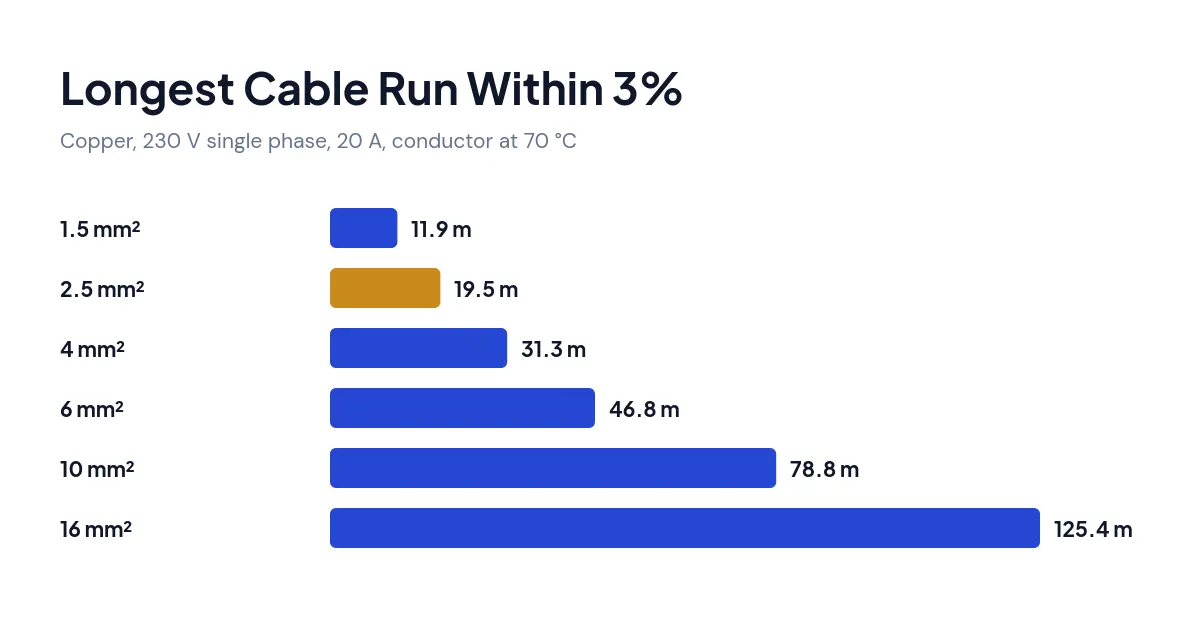
| Copper cable (single phase, 230 V, 70 °C) | mV/A/m | Max length at 20 A for 3% | Max length at 20 A for 5% |
|---|---|---|---|
| 1.5 mm² | 29.0 | 11.9 m | 19.9 m |
| 2.5 mm² | 17.7 | 19.5 m | 32.4 m |
| 4 mm² | 11.0 | 31.3 m | 52.1 m |
| 6 mm² | 7.4 | 46.8 m | 78.0 m |
| 10 mm² | 4.4 | 78.8 m | 131.3 m |
| 16 mm² | 2.8 | 125.4 m | 208.9 m |
Voltage drop is only one of the checks a cable has to pass. It must also carry the current without overheating, which depends on how it is installed, and the earth fault loop impedance must be low enough for the protective device to disconnect in time. In the UK, electrical work in homes also falls under Part P of the Building Regulations, so use these results for planning and have the final design checked by a qualified electrician.
How Can You Reduce Voltage Drop?
The quickest way to reduce voltage drop is to use a larger conductor, because the drop falls in direct proportion to the cross-sectional area. Going from 2.5 mm² to 4 mm² cuts the drop by about 38%, and doubling the area halves it. Other options:
- Shorten the route. Drop is proportional to length, so a more direct cable path or a sub-board closer to the loads helps.
- Raise the voltage. The same power at 400 V three phase draws far less current per conductor than at 230 V single phase, and the √3 factor helps too.
- Split the load. Two circuits each carrying 10 A drop half as much as one carrying 20 A.
- Choose copper over aluminium. Aluminium has about 1.6 times the resistance of copper at the same size.
Long low-voltage runs are where voltage drop bites hardest. A 12 V garden lighting circuit loses the same number of volts as a 230 V one for the same current and cable, but those volts are a far bigger share of the supply. The transformer calculator helps when you are stepping voltages up or down, and the conduit fill calculator checks that a larger cable will still fit in the conduit you have planned.
Related Tools
- Conduit Fill Calculator
- Amps to kW Converter
- EV Charging Cost Calculator
- Heat Pump Cost Calculator
- Transformer Calculator
- Parallel Circuit Calculator
For the reasoning behind cable sizing, read voltage drop explained: why long cable runs need thicker wire.
Frequently asked questions
How do you calculate voltage drop?
Multiply 2 by the current, the one-way length and the resistance of one conductor per metre. For three phase use 1.732 instead of 2. Divide the result by the supply voltage and multiply by 100 to get the percentage.
What is the maximum voltage drop allowed in the UK?
BS 7671 Appendix 4 gives 3% for lighting circuits and 5% for other uses when the installation is supplied from the public low-voltage network. On a 230 V supply that is 6.9 V and 11.5 V.
What is the maximum voltage drop under the NEC?
The NEC recommends, in informational notes rather than mandatory rules, no more than 3% on a branch circuit and no more than 5% for the feeder and branch circuit combined. Some local codes and specific articles make limits mandatory.
Should I use the one-way or round-trip length?
Enter the one-way length from the supply to the load. The calculator already doubles it for single phase, because current flows out and back, and applies the √3 factor for three phase.
Does voltage drop depend on the breaker size?
No. It depends on the current actually flowing. Using the breaker rating gives a worst-case figure, which is a safe choice when the load is not known, but it can lead you to a larger cable than you need.
Why does a hot cable have more voltage drop?
Copper resistance rises by about 0.39% for every degree Celsius. A cable running at 70 °C has roughly 20% more resistance than the same cable at 20 °C, so its voltage drop is about 20% higher.