Quick answer: Conduit fill = total wire area ÷ conduit internal area × 100. The NEC allows 53% for one wire, 31% for two and 40% for three or more. Four 12 AWG THHN wires (4 × 0.0133 = 0.0532 in²) in 1/2 in EMT (0.304 in²) fill 17.5%, so they pass. This conduit fill calculator checks any mix of wires.

Why Do Conduit Fill Limits Exist?
A conduit fill calculator checks whether a set of wires fits inside a conduit without exceeding the fill limits in the National Electrical Code. Overfilled conduit is hard to pull, scrapes insulation as the wires go in and traps heat, which lowers how much current the wires can safely carry. Inspectors check fill on every job, so it pays to work it out before you buy pipe.
The calculator uses the wire areas from NEC Chapter 9, Table 5 for THHN, THWN-2 and XHHW-2 conductors, and the internal areas of EMT, rigid metal conduit and PVC Schedule 40 and 80 from Table 4. You can mix wire sizes, for example three 6 AWG conductors with a 10 AWG ground, and it tells you the fill percentage, whether it passes and the smallest trade size that would work.
How Do You Enter the Conduit and Wire Sizes?
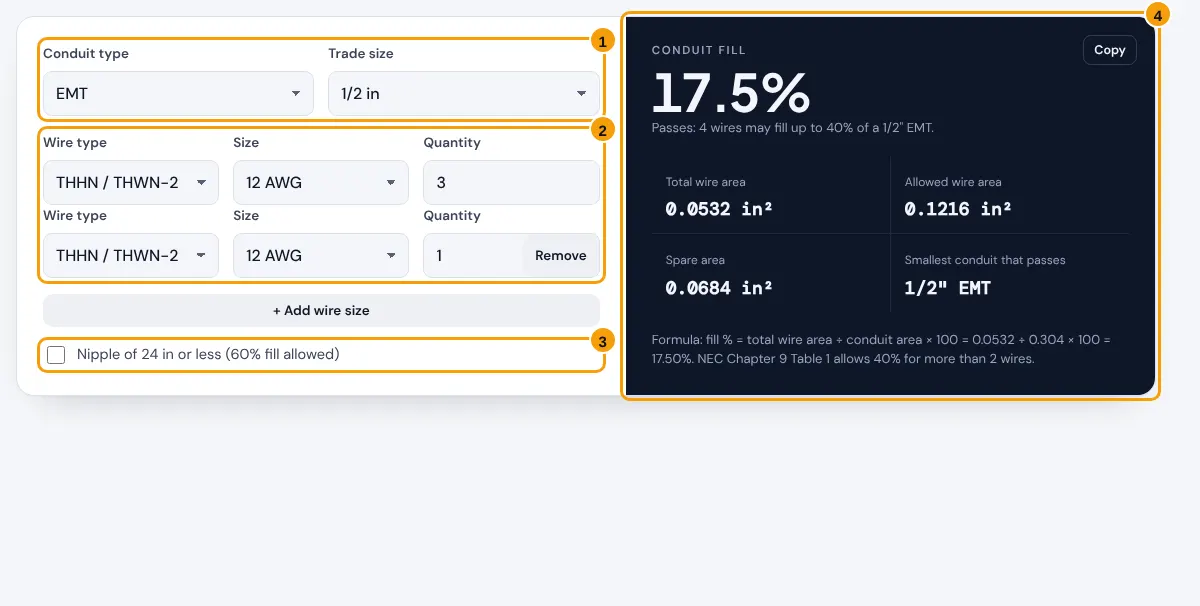
- Choose the conduit type (EMT, rigid metal, or PVC Schedule 40 or 80) and the trade size you plan to use.
- Enter each wire type, size and quantity, including the equipment grounding conductor.
- Tick the nipple box only for a short run of 24 in or less between enclosures.
- Read the fill percentage, the pass or fail result and the smallest conduit that passes.
Count every insulated conductor in the conduit: hots, neutrals, travelers and insulated grounds. An insulated equipment ground counts at its own size. A bare ground has a smaller area than an insulated one, so entering it as THHN gives a slightly conservative answer. Remember that fill is only the space check; wire size for the load comes first, and the voltage drop calculator tells you whether a long run needs a size up, which may then need a bigger conduit.
How Is Conduit Fill Calculated?
Conduit fill is the total cross-sectional area of the wires divided by the internal area of the conduit, as a percentage. The result is compared with the limit in NEC Chapter 9, Table 1, which depends only on how many wires there are.
Fill % = total wire area ÷ conduit internal area × 100
Limits: 1 wire 53% · 2 wires 31% · 3 or more wires 40% · nipple 24 in or less 60%
Worked example. A feeder in 1 in PVC Schedule 40 carries three 6 AWG THHN conductors and one 10 AWG THHN ground.
- Wire area = 3 × 0.0507 + 1 × 0.0211 = 0.1732 in².
- Conduit area (1 in PVC 40) = 0.832 in².
- Fill = 0.1732 ÷ 0.832 × 100 = 20.8%, well under the 40% limit for four wires.
- The smallest size that passes is 3/4 in, at 0.1732 ÷ 0.508 = 34.1%.
Two wires get the lowest limit, 31%, because two round conductors side by side tend to jam across the conduit during a pull. When every wire is the same size and type, NEC Chapter 9 Note 7 lets you round the permitted count up to the next whole number if the decimal is 0.8 or more, and the calculator applies that rule. The code itself is published by the NFPA as NFPA 70, the National Electrical Code, and your local inspector enforces the edition your state has adopted.
How Many Wires Fit in a Conduit?
The number of wires that fit is the allowed area (40% of the conduit for three or more wires) divided by the area of one wire, rounded down. The table below uses THHN/THWN-2 in EMT, the most common combination in commercial work.
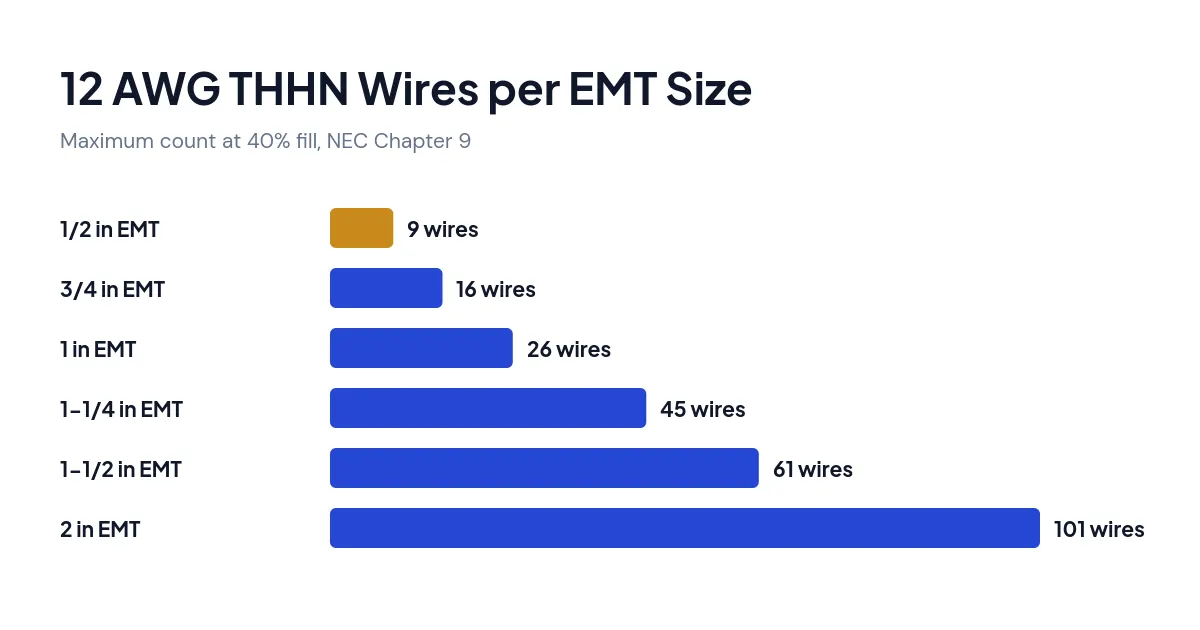
| EMT size | Internal area | 40% allowed | 14 AWG | 12 AWG | 10 AWG | 8 AWG |
|---|---|---|---|---|---|---|
| 1/2 in | 0.304 in² | 0.1216 in² | 12 | 9 | 5 | 3 |
| 3/4 in | 0.533 in² | 0.2132 in² | 22 | 16 | 10 | 6 |
| 1 in | 0.864 in² | 0.3456 in² | 35 | 26 | 16 | 9 |
| 1-1/4 in | 1.496 in² | 0.5984 in² | 61 | 45 | 28 | 16 |
| 1-1/2 in | 2.036 in² | 0.8144 in² | 84 | 61 | 38 | 22 |
| 2 in | 3.356 in² | 1.3424 in² | 138 | 101 | 63 | 36 |
XHHW-2 has thicker insulation in the small sizes, so fewer fit: a 1/2 in EMT holds eight 14 AWG XHHW-2 but twelve 14 AWG THHN. For a long or bendy pull, leave more room than the minimum. Pulling force rises quickly with each bend, and the code limits a run to 360 degrees of bends between pull points. If you also need to work out the circuit load, the amps to kW converter converts between current and power.
Related Tools
- Voltage Drop Calculator
- Amps to kW Converter
- Rolling Offset Calculator
- EV Charging Cost Calculator
- Transformer Calculator
For the reasoning behind cable sizing, read voltage drop explained: why long cable runs need thicker wire.
Frequently asked questions
What is the maximum conduit fill?
NEC Chapter 9, Table 1 allows 53% of the conduit area for one wire, 31% for two wires and 40% for three or more. A nipple no longer than 24 in may be filled to 60%.
How many 12 AWG wires can go in 1/2 in EMT?
Nine 12 AWG THHN wires fit in 1/2 in EMT. The allowed area is 40% of 0.304 in², which is 0.1216 in², and each wire is 0.0133 in², giving 9.14, rounded down to 9.
Do ground wires count toward conduit fill?
Yes. Every equipment grounding or bonding conductor in the conduit counts toward fill, at its actual area. Bare grounds use the bare conductor area from Chapter 9, Table 8.
Why is the limit for two wires lower than for three?
Two round wires can wedge across the conduit during a pull, which is called jamming. The 31% limit leaves enough room to prevent it. Three or more wires pack in a way that is less likely to jam, so 40% is allowed.
Does conduit fill affect ampacity?
Fill itself does not, but the number of current-carrying conductors does. With more than three current-carrying conductors in one raceway, the NEC adjustment factors require you to derate their ampacity, so a full conduit may also need larger wire.