How to Use the Asphalt Calculator
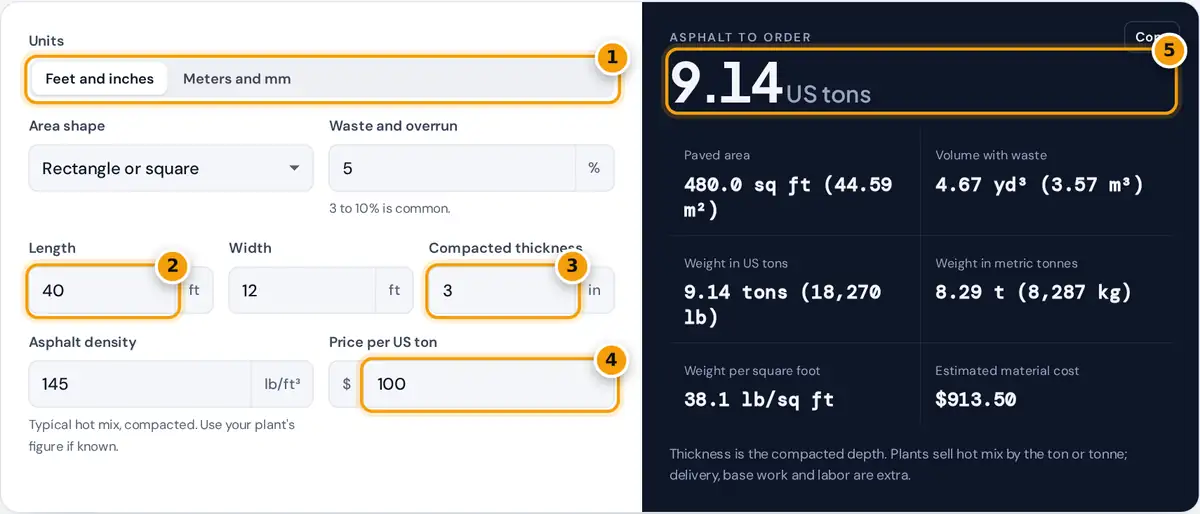
- Choose feet and inches or meters and millimeters.
- Enter the length and width of the area, or pick a circle and enter the diameter.
- Enter the compacted asphalt thickness and keep or edit the typical density.
- Add your price per ton or tonne to see the material cost.
- Read the tonnage to order, with volume, metric tonnes and cost.
Choose feet and inches or meters and millimeters, then pick the shape of the area. For a driveway, parking pad or path enter the length and width. For a round turnaround or a circular patch enter the diameter. Next, enter the compacted thickness of asphalt you plan to lay. This is the finished depth after rolling, not the loose depth that leaves the paver.
The density field turns volume into weight. Compacted hot mix asphalt typically weighs about 145 lb per cubic foot, or about 2,320 kg per cubic meter, and the field is filled with that typical value. If your asphalt plant quotes a different figure for its mix, type it in. Add a waste allowance for uneven base, edges and handling, then enter your price per ton or tonne to see the material cost.
Asphalt Tonnage Formula
volume (ft³) = area (sq ft) × thickness (in) ÷ 12 × (1 + waste %)
weight (lb) = volume × density (lb/ft³)
US tons = lb ÷ 2,000 metric tonnes = lb × 0.45359237 ÷ 1,000
The calculator works in exact unit factors: 1 ft is 0.3048 m, 1 lb is 0.45359237 kg and 1 lb/ft³ is 16.0185 kg/m³. A US ton (short ton) is 2,000 lb, while a metric tonne is 1,000 kg, about 10% heavier. In the United States plants usually quote per ton; in Canada, the UK and most other countries prices are per tonne.
Worked Example: A Single-Car Driveway
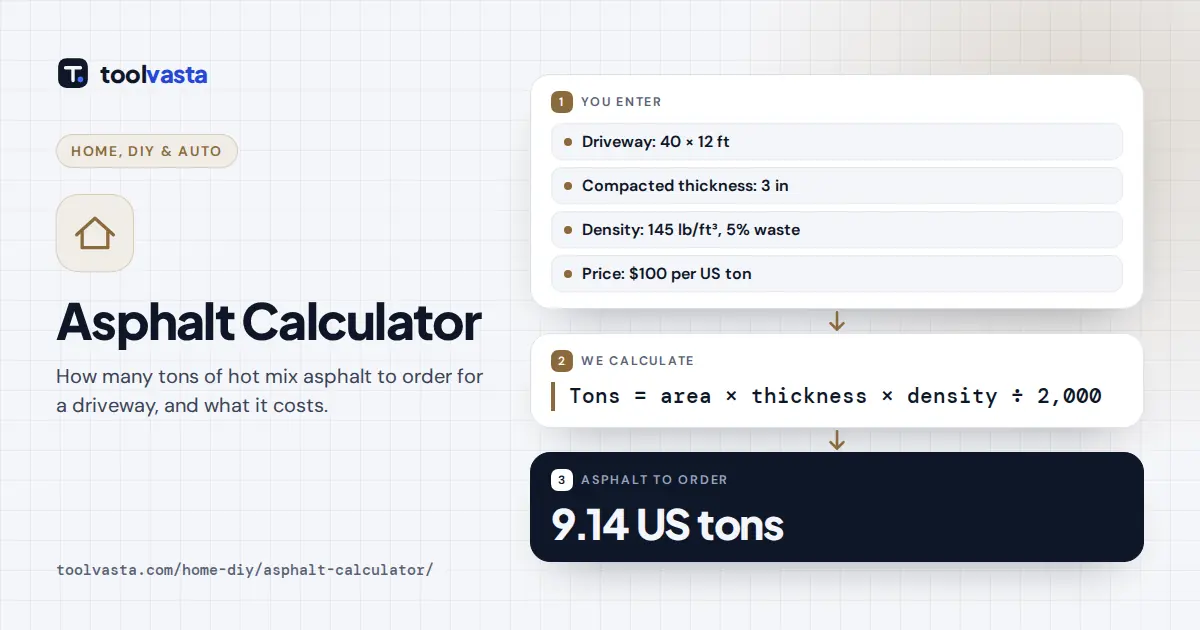
A driveway is 40 ft long and 12 ft wide, so the area is 480 sq ft. At a compacted thickness of 3 in the volume is 480 × 3 ÷ 12 = 120 cu ft. Adding 5% for waste gives 126 cu ft, which is 4.67 cubic yards or 3.57 m³.
At 145 lb/ft³ the asphalt weighs 126 × 145 = 18,270 lb. That is 18,270 ÷ 2,000 = 9.14 US tons, or 8.29 metric tonnes. At $100 per ton the material costs about $913.50. A plant will usually round the order up to the nearest half ton or full ton, so this job would be ordered as 9.5 or 10 tons.
Typical Asphalt Thickness
| Use | Compacted asphalt | Metric | Weight per sq ft |
|---|---|---|---|
| Patch or overlay on sound pavement | 1.5 to 2 in | 40 to 50 mm | 18 to 24 lb |
| Residential driveway | 2 to 3 in | 50 to 75 mm | 24 to 36 lb |
| Driveway for heavier vehicles | 3 to 4 in | 75 to 100 mm | 36 to 48 lb |
| Parking lot, two lifts | 3 to 5 in | 75 to 125 mm | 36 to 60 lb |
These are common planning ranges, not design values. The weight column uses 145 lb/ft³, which works out to about 12 lb per square foot for every inch of thickness. The right thickness depends on traffic, soil and climate, and a well compacted granular base under the asphalt matters as much as the asphalt itself.
Tips for Ordering Asphalt
- Measure irregular driveways as several rectangles and circles, then add the tonnages together.
- For a two-lift job, such as a base course and a surface course, calculate each layer separately, because the mixes and prices often differ.
- Ask the plant for its compacted density and any minimum load size. Small orders may carry a short-load fee.
- Hot mix must be placed and rolled while hot, so plan the delivery for the size of crew and equipment you have.
- Cold patch in bags is a different product. Use the bag weight and coverage printed on the bag for small repairs.
Assumptions and Limits
The calculator assumes an even thickness over the whole area. Low spots in the base, thickened edges and drainage swales change the real quantity, which is why a waste allowance is included. Density varies with the aggregate, binder content and compaction, so the result is a planning estimate. Confirm the order with your paving contractor or asphalt plant before you book a delivery.
Frequently asked questions
How many tons of asphalt do I need for a driveway?
Multiply area in square feet by thickness in inches, divide by 12 for cubic feet, multiply by about 145 lb per cubic foot and divide by 2,000. A 40 by 12 ft driveway at 3 inches needs about 9.1 tons.
How much does a cubic yard of asphalt weigh?
At a typical compacted density of 145 lb per cubic foot, one cubic yard of asphalt weighs about 3,915 lb, or roughly 1.96 US tons. In metric terms, one cubic meter weighs about 2.32 tonnes.
How thick should a residential driveway be?
Many residential driveways use 2 to 3 inches of compacted asphalt over a well compacted gravel base. Driveways that carry heavier vehicles often use 3 to 4 inches, sometimes laid in two lifts.
What is the difference between a ton and a tonne?
A US ton, also called a short ton, is 2,000 lb, about 907 kg. A metric tonne is exactly 1,000 kg, about 2,205 lb. Check which unit your asphalt plant uses before comparing prices.
How many square feet does a ton of asphalt cover?
At 145 lb per cubic foot, one ton covers about 166 sq ft at 1 inch thick, 83 sq ft at 2 inches or 55 sq ft at 3 inches. Divide 2,000 by the weight per square foot at your thickness.
Why add a waste allowance for asphalt?
Some asphalt is lost at the edges, in low spots of the base and when handling the material. Ordering 3 to 10% extra avoids running short, because a second small delivery usually costs more than the extra material.