How to Use the Mulch Calculator
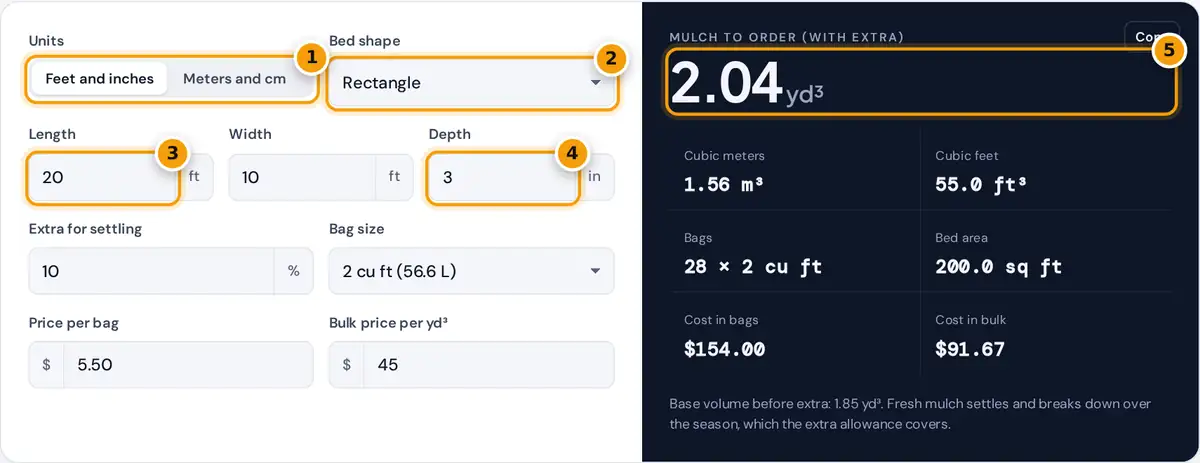
- Choose feet and inches or metres and centimetres.
- Pick the bed shape: rectangle, circle, or a known area.
- Enter the length and width of the bed.
- Enter the mulch depth, then extra for settling, bag size and prices below.
- Read the mulch to order, then compare the number of bags with the bulk cost.
Choose feet and inches or meters and centimeters, then pick the bed shape: a rectangle, a circle around a tree, or I know the area if you have already measured the bed's total square footage.
Enter the length and width, or the diameter for a circle, and the depth you plan to spread. Add an extra percentage to allow for settling, and choose the bag size your garden center sells.
Optional bag and bulk prices let you compare the two ways of buying mulch. For irregular beds, split the space into rectangles and circles, run each piece through the calculator, and add the results together.
Mulch Formula
Mulch is ordered by volume, and volume is simply area multiplied by depth. The only tricky part is keeping units consistent, because beds are measured in feet while depth is almost always measured in inches.
cubic feet = area (sq ft) × depth (in) ÷ 12
cubic yards = cubic feet ÷ 27 cubic meters = area (m²) × depth (cm) ÷ 100
bags = round up (volume with extra ÷ bag size)
1 yd³ = 27 ft³ = 0.7646 m³ = 764.6 L 2 ft³ bag = 56.6 L
Multiply square feet by inches and divide by 12 for cubic feet, then divide by 27 for cubic yards. In metric, square meters times centimeters divided by 100 gives cubic meters directly without another step.
Bags are counted by dividing the total volume, including the extra, by the bag size and rounding up to a whole bag. One cubic yard equals 764.6 L, which helps when bag labels show litres.
Worked Example: A 20 by 10 Foot Bed
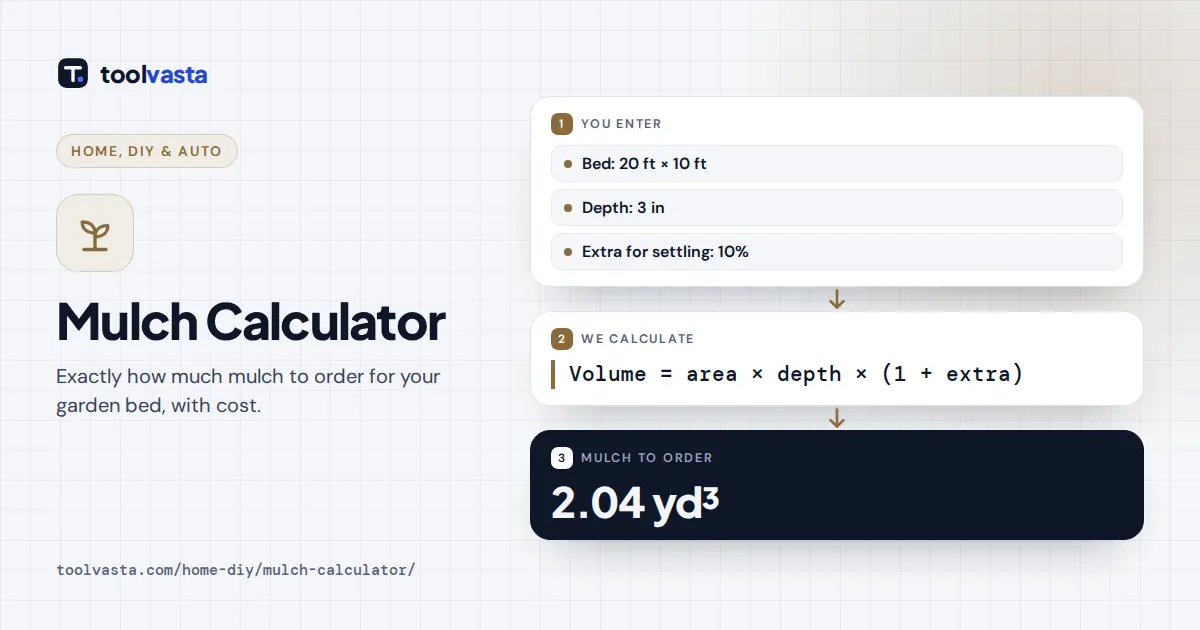
A typical front bed 20 ft long and 10 ft wide covers 200 sq ft. At 3 in deep, the volume is 200 × 3 ÷ 12 = 50 cubic feet before any allowance for settling is added.
Adding 10% extra for settling gives 55 cubic feet, which is 55 ÷ 27 = 2.04 cubic yards or 1.56 cubic meters. In 2 cubic foot bags that is 27.5, so you need to buy 28 bags.
| Option | Quantity | Price | Cost |
|---|---|---|---|
| Bags, 2 cu ft | 28 bags | $5.50 a bag | $154.00 |
| Bulk | 2.04 yd³ | $45 a yard | $91.67 plus delivery |
For a metric example, a bed 5 m by 4 m with 7.5 cm of mulch needs 1.5 cubic meters. With 10% extra, that becomes 1.65 cubic meters, or 33 bags of 50 L each.
How Deep Should Mulch Be?
Most beds need 2 to 3 inches, or 5 to 7.5 cm. Fine mulch packs down and needs less depth, while coarse chips and bark nuggets need more to block light and slow weed growth.
| Use | Typical depth |
|---|---|
| Top-up of existing mulch | 1 to 2 in (2.5 to 5 cm) |
| Flower and shrub beds | 2 to 3 in (5 to 7.5 cm) |
| Weed suppression, new beds | 3 to 4 in (7.5 to 10 cm) |
| Paths and play areas | 3 to 6 in (7.5 to 15 cm) |
A yearly top-up of 1 to 2 inches is usually enough each spring. New beds needing weed suppression can take 3 to 4 inches, while paths and play areas often use deeper layers for cushioning.
Deeper than about 4 inches can keep water and air from reaching roots. Keep mulch a few inches from tree trunks and stems, as the Penn State Extension mulching guide advises, and avoid volcano piles.
Coverage of One Cubic Yard
One cubic yard covers 324 sq ft at 1 inch deep, 162 sq ft at 2 inches, 108 sq ft at 3 inches and 81 sq ft at 4 inches. Coverage halves whenever depth doubles.
In metric, one cubic meter covers 20 square meters at 5 cm or about 13.3 square meters at 7.5 cm. A single 2 cubic foot bag covers about 8 sq ft at 3 inches deep.
For bags per yard, remember a cubic yard holds 27 cubic feet, so it equals 13.5 bags of 2 cubic feet, 9 bags of 3 cubic feet, or about 15.3 bags of 50 L each.
Bags or Bulk Mulch?
Bagged mulch is easy to carry, stores neatly and suits small beds or yards a truck cannot reach. It costs more per cubic yard, so the price gap grows quickly as a project gets larger.
Bulk mulch from a landscape supplier is usually cheaper above about two cubic yards. In the worked example, bulk costs $91.67 against $154 in bags, before any delivery fee is added to the bulk price.
Many suppliers set a minimum order and charge for delivery by distance, so ask for the total delivered price. Bulk loads also need a tarp or clear driveway space where the pile can sit briefly.
Assumptions and Mulch Types
The same formula works for wood chips, bark nuggets, stone mulch, rubber mulch and compost spread as a top dressing. Volume stays the same whatever the material, although weight per bag varies widely between materials.
Organic mulch gradually breaks down over the season and feeds the soil, which is why beds need topping up. The settling allowance covers early compaction, and 10% suits most fresh wood products like shredded bark.
Bag sizes in Canada are often printed in both litres and cubic feet, so check the label. Unit conversions here follow NIST volume standards, and results are estimates to guide your order, not exact quantities.
Frequently asked questions
How much mulch do I need?
Multiply the bed area in square feet by the depth in inches, divide by 12 for cubic feet and by 27 for cubic yards. A 200 sq ft bed at 3 inches needs about 1.85 cubic yards, or 2.04 with 10% extra.
How many bags of mulch are in a yard?
A cubic yard is 27 cubic feet, so it equals 13.5 bags of 2 cubic feet, 9 bags of 3 cubic feet or about 15.3 bags of 50 L. Always round up to whole bags.
How much area does a bag of mulch cover?
A 2 cubic foot bag covers about 12 sq ft at 2 inches deep or 8 sq ft at 3 inches deep. Larger 3 cubic foot bags cover half as much again at each depth.
How deep should mulch be?
Two to three inches, or 5 to 7.5 cm, suits most flower and shrub beds. Use 1 to 2 inches when topping up existing mulch, and keep it away from tree trunks and plant stems.
Is bulk mulch cheaper than bags?
Usually yes for more than one or two cubic yards, even after delivery. Bags are handier for small beds, for storing leftovers neatly, or where a delivery truck cannot reach the yard.
How do I calculate mulch for a circle around a tree?
Choose Circle and enter the diameter. The area is pi times the diameter squared divided by four, so a 6 ft ring at 3 inches needs about 7.8 cubic feet with 10% extra, or four 2 cubic foot bags.