How to Use the Solar Panel Angle Calculator
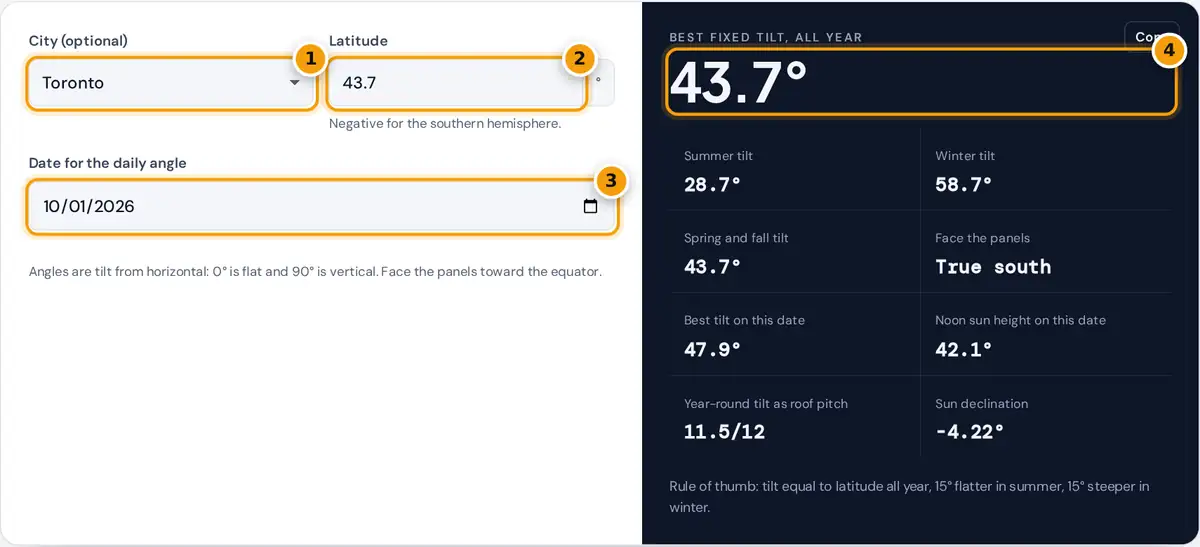
- Pick a city, or choose custom to type your own latitude.
- Check or enter your latitude. Use a negative number south of the equator.
- Choose a date to see the best tilt and noon sun height for that day.
- Read the year-round tilt, then the summer, winter and daily angles below.
Pick a city from the list or type your latitude in decimal degrees. Use a negative number south of the equator, for example −33.9 for Sydney. The calculator shows the best fixed tilt for the whole year, the seasonal tilts for an adjustable mount and the direction the panels should face. Choose any date to see the angle that points the panels straight at the noon sun that day and how high the sun climbs.
The monthly table below the calculator lists the sun's declination, the noon sun height and the ideal tilt on the 15th of each month. Use it to decide how often an adjustable rack is worth moving. Tilt is measured from horizontal, so 0° is flat and 90° is a vertical wall.
How the Angles Are Calculated
summer tilt ≈ |latitude| − 15° winter tilt ≈ |latitude| + 15°
declination δ = 23.45° × sin(360° × (284 + n) ÷ 365), n = day of year
noon sun height = 90° − |latitude − δ|
best tilt on a date = |latitude − δ|
The declination formula, published by P. I. Cooper in 1969, is the standard approximation of where the sun sits relative to the equator through the year. A panel tilted at |latitude − declination| faces the noon sun squarely, which maximizes output around midday on that date. Setting a fixed panel at your latitude balances the high summer sun and the low winter sun, and the ±15° seasonal rule is a widely used simplification of the same geometry.
Worked Example: Toronto
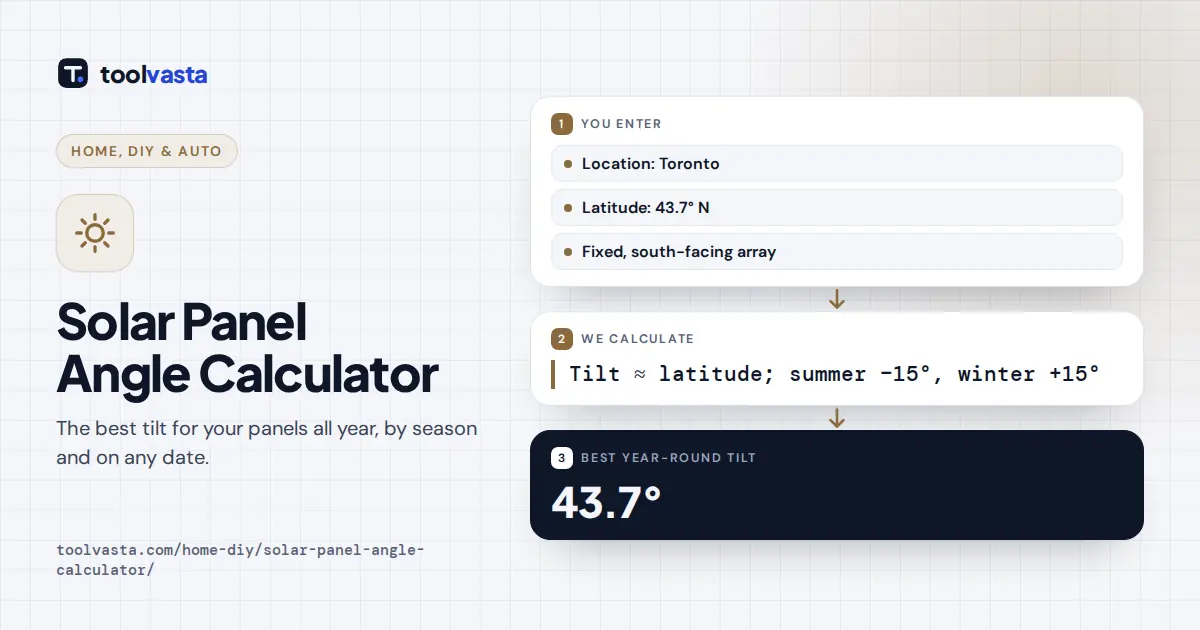
Toronto is at about 43.7° N. A fixed array tilted at 43.7° and facing true south is a sound year-round choice. On an adjustable mount, use about 28.7° in summer and 58.7° in winter, with 43.7° in spring and fall. A 43.7° tilt is the same as an 11.5/12 roof pitch.
On 21 June, day 172, the formula gives a declination of 23.45°. The angle between the noon sun and straight overhead is 43.7 − 23.45 = 20.25°, so the panel angle that faces the sun squarely is about 20.3° and the noon sun stands about 69.7° above the horizon. In mid-December the noon sun is only about 23° high, so the ideal angle steepens to about 67°.
Tilt by Latitude
| Latitude | Example | Year-round | Summer | Winter |
|---|---|---|---|---|
| 34° | Los Angeles | 34° | 19° | 49° |
| 41° | New York | 41° | 26° | 56° |
| 45° | Montreal, Ottawa | 45° | 30° | 60° |
| 49° | Vancouver, Winnipeg | 49° | 34° | 64° |
| 51° | Calgary, London | 51° | 36° | 66° |
| 54° | Edmonton | 54° | 39° | 69° |
For the best orientation data for a specific site in Canada, Natural Resources Canada publishes renewable energy resources including solar potential maps. In the United States, NREL tools provide similar location-based estimates.
Practical Tips
- Face panels toward true south in the northern hemisphere, not magnetic south. Compass readings in much of Canada differ from true south by many degrees.
- Most roof-mounted systems sit at the roof pitch. Losses from a few degrees off the ideal angle are small, so flush mounting is often more cost-effective than tilt racks.
- Steeper winter angles help snow slide off panels, which matters in Canadian winters.
- If you adjust only twice a year, switch around the spring and fall equinoxes.
- Shade from trees, chimneys and neighboring buildings costs far more output than a non-ideal tilt.
Assumptions and Limits
The calculator uses geometry, not local weather. Cloud patterns, snow cover and whether you value winter or summer output can shift the best angle by several degrees, and some studies suggest a slightly flatter year-round tilt than latitude in cloudy climates. The declination formula is accurate to within about a degree. For a final system design, use a solar installer's production model for your exact site.
Frequently asked questions
What is the best angle for solar panels?
For a fixed system, a tilt roughly equal to your latitude gives a good balance over the year. In Toronto that is about 44 degrees, facing true south.
What angle should solar panels be in winter?
Add about 15 degrees to your latitude in winter. At 45 degrees north, a winter tilt near 60 degrees catches more of the low sun and helps snow slide off.
What angle should solar panels be in summer?
Subtract about 15 degrees from your latitude in summer, because the sun is higher. At 45 degrees north, a summer tilt near 30 degrees works well.
Which direction should solar panels face in Canada?
Face them toward true south. East or west facing panels still work but produce less over the year. Use true south rather than magnetic south from a compass.
Does the angle of solar panels matter much?
Being a few degrees off the ideal angle reduces yearly output only slightly. Orientation, shading and snow have a much bigger effect, so flush roof mounting is often fine.
How do I convert a tilt angle to roof pitch?
Multiply the tangent of the tilt angle by 12 to get the rise. A 26.6 degree tilt equals a 6/12 roof pitch, and a 45 degree tilt equals 12/12.