How to Use the Candle Calculator
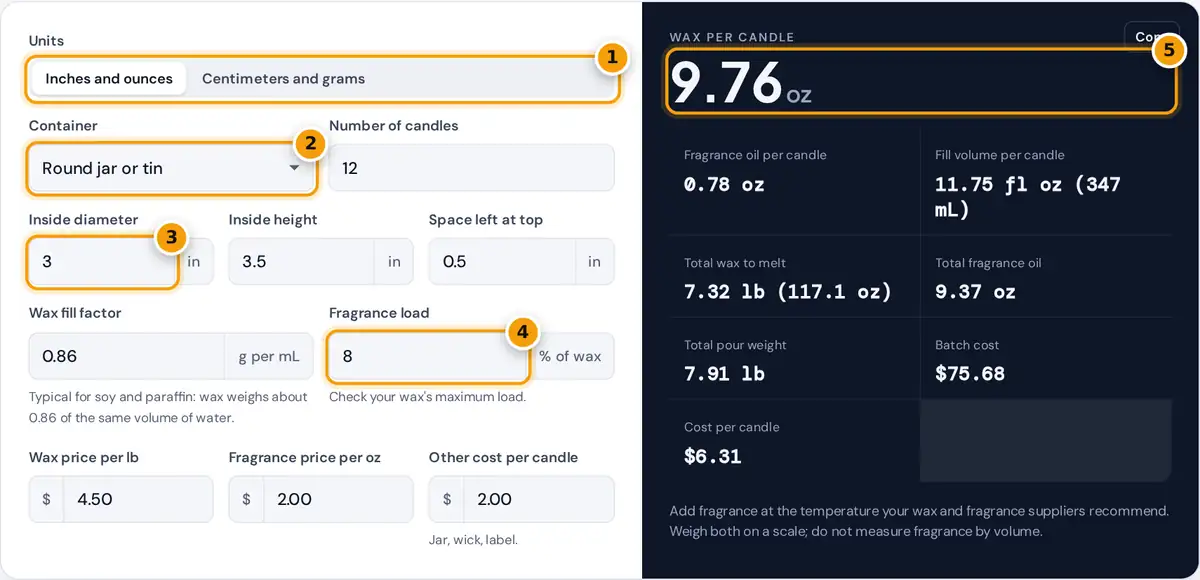
- Choose inches and ounces or centimeters and grams.
- Pick a round or square jar, or enter the fill volume.
- Enter the inside size and space at the top.
- Set the fragrance load and prices.
- Read wax and fragrance per candle, batch totals and cost.
Choose inches and ounces or centimeters and grams, and enter how many candles you are making. For a round jar or tin, enter the inside diameter and inside height; for a square jar, enter the inside length and width. Set how much space you leave at the top, often about 1/2 in (1 cm). If you already know how much water a container holds to its fill line, choose the fill volume option instead.
The wax fill factor converts volume to wax weight. Many candle makers use 0.86, because most container waxes weigh about 86% as much as the same volume of water. Enter the fragrance load as a percentage of the wax weight, then the wax, fragrance and other costs. The result shows the wax and fragrance per candle, the batch totals and the cost per candle.
Candle Wax Formula
pour weight (g) = fill volume (mL) × fill factor
wax = pour weight ÷ (1 + fragrance load %)
fragrance oil = wax × fragrance load %
One cubic inch is 16.387 mL and one US fluid ounce is 29.574 mL. The calculator treats fragrance load as a percentage of the wax weight, which is the most common convention. Some suppliers instead give the fragrance as a percentage of the total pour, so check which method your wax maker uses before you exceed a recommended maximum.
Worked Example: Twelve 3 Inch Tins
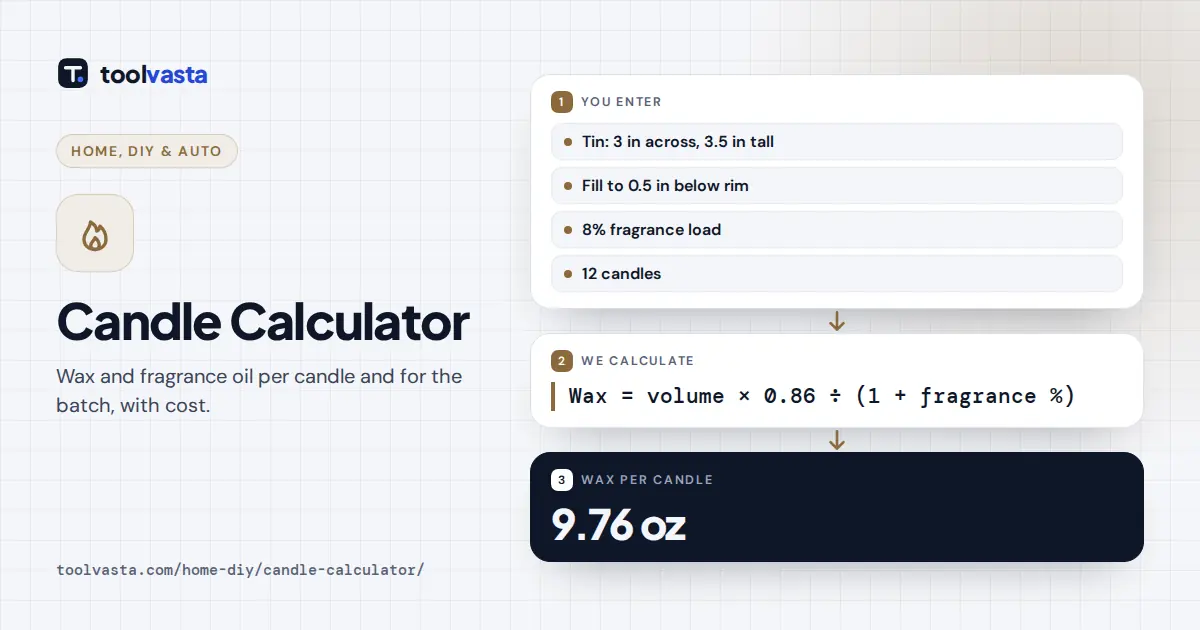
A round tin is 3 in across and 3.5 in tall inside, filled to 1/2 in below the rim. The fill volume is π × 1.5² × 3 = 21.21 cu in, which is 347.5 mL or 11.75 fl oz. At a fill factor of 0.86 each candle takes 298.9 g of wax and fragrance together.
With an 8% fragrance load, each candle needs 298.9 ÷ 1.08 = 276.7 g (9.76 oz) of wax and 22.1 g (0.78 oz) of fragrance oil. Twelve candles need 7.32 lb of wax and 9.37 oz of fragrance. At $4.50 per lb of wax, $2.00 per oz of fragrance and $2.00 for each tin and wick, the batch costs $75.68, about $6.31 per candle.
Wax for Common Container Sizes
| Fill volume | Pour weight at 0.86 | Wax at 8% load | Fragrance at 8% load |
|---|---|---|---|
| 4 fl oz (118 mL) | 3.59 oz (101.7 g) | 3.32 oz | 0.27 oz |
| 8 fl oz (237 mL) | 7.18 oz (203.5 g) | 6.65 oz | 0.53 oz |
| 12 fl oz (355 mL) | 10.77 oz (305.2 g) | 9.97 oz | 0.80 oz |
| 16 fl oz (473 mL) | 14.35 oz (406.9 g) | 13.29 oz | 1.06 oz |
Jars are often sold by their brim-full capacity, so the volume to your fill line is usually less than the label says. Fill one jar with water to your line and measure it for the best figure.
Tips for Container Candles
- Melt a little extra wax for top-offs, since many waxes sink around the wick as they cool.
- Stay within your wax maker's maximum fragrance load. More fragrance does not always mean a stronger scent and can cause sweating or poor burns.
- Choose the wick size from your wax and wick supplier's chart for the container diameter, and test burn before selling.
- Keep fragrance oils away from open flames and follow their safety data sheets.
Assumptions and Limits
The fill factor is a typical value; beeswax, coconut blends and gel wax differ, so adjust it if your supplier gives a density. The calculator assumes straight-sided containers when you use dimensions. Tapered or curved jars are best measured with water. Costs are what you enter and do not include labor, packaging or shipping.
Frequently asked questions
How much wax do I need for a candle?
Measure the fill volume of the container in milliliters and multiply by about 0.86 to get the pour weight in grams. Divide by one plus the fragrance load to separate wax from fragrance.
How much wax for an 8 oz candle?
An 8 fl oz fill volume holds about 7.2 oz by weight of wax and fragrance at a 0.86 factor. With an 8% fragrance load, that is about 6.65 oz of wax and 0.53 oz of fragrance oil.
How do I calculate fragrance load?
Multiply the wax weight by the fragrance load percentage. For 276.7 g of wax at 8%, use 22.1 g of fragrance oil. Always weigh fragrance on a scale rather than measuring by volume.
Why use 0.86 for candle wax?
Most container waxes are lighter than water, weighing roughly 86% as much for the same volume. Multiplying the water capacity by 0.86 gives a good estimate of the wax weight needed.
What fragrance load should I use?
Many container candles use about 6 to 10% fragrance by weight of wax. Each wax has a maximum load, often listed by the supplier, and going beyond it can cause oil to seep out.
How do I find the volume of a candle jar?
Fill the jar with water to the level you will pour your wax, then measure the water in a measuring cup or weigh it. One gram of water is about one milliliter.