How to Use the Grout Calculator
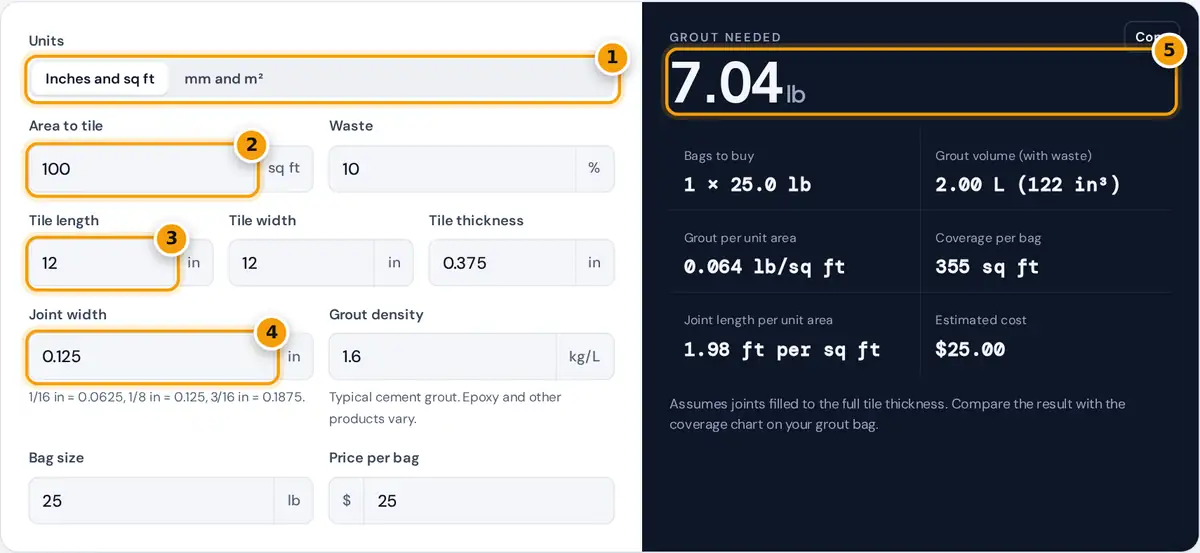
- Choose inches and square feet or millimeters and square meters.
- Enter the area to tile and a waste allowance.
- Enter the tile length, width and thickness.
- Enter the joint width you plan to use.
- Read the grout weight, bags and coverage per bag.
Choose inches and square feet or millimeters and square meters. Enter the area you are tiling and a waste allowance. Then enter the tile length, width and thickness. The thickness matters because grout fills the joint to the depth of the tile, so thick porcelain or stone tiles take far more grout than thin wall tiles of the same size.
Enter the joint width you plan to use. Rectified porcelain is often set with 1/16 in (1.5 mm) joints, while many floor tiles use 1/8 to 3/16 in (3 to 5 mm). The grout density is filled with a typical figure for cement grout; change it if your product data sheet gives another value. Add the bag size and price to see how many bags to buy.
Grout Quantity Formula
weight = volume × density × (1 + waste %)
bags = round up (weight ÷ bag weight)
Here L and W are the tile length and width, T is the tile thickness and J is the joint width. Each tile plus its share of joints forms a repeating cell of (L + J) by (W + J). The grout in that cell is one joint along the length, one along the width and the small square where they cross. With all dimensions in millimeters, the formula gives liters per square meter directly.
Worked Example: 12 by 12 in Floor Tile
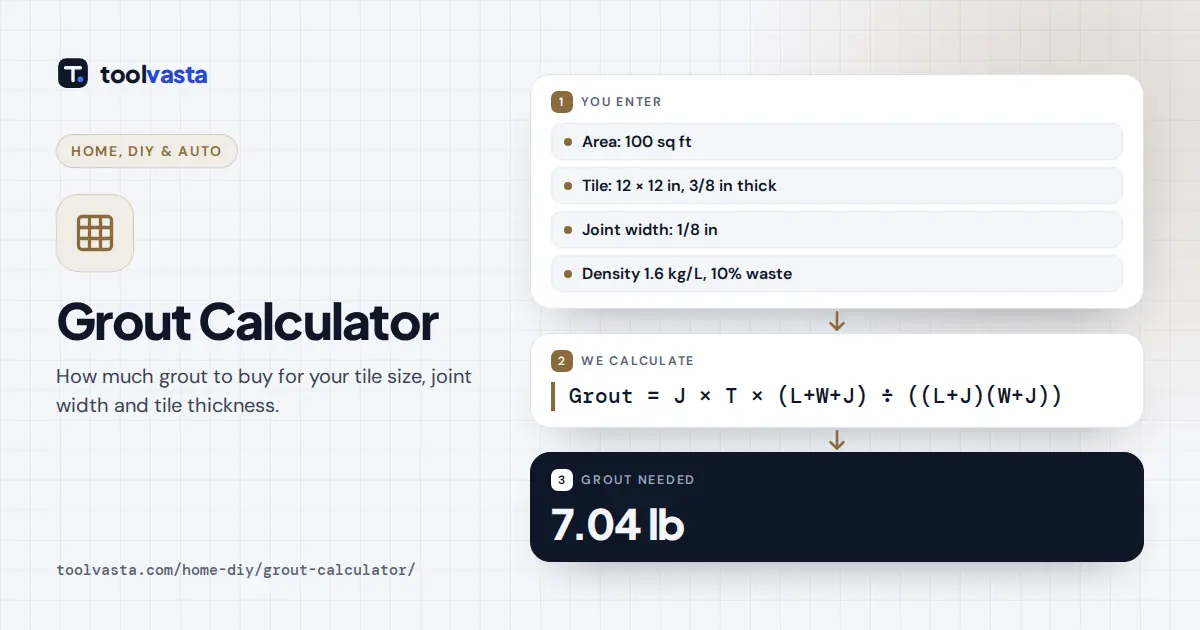
A floor of 100 sq ft (9.29 m²) uses 12 by 12 in tiles that are 3/8 in thick with 1/8 in joints. In millimeters that is 304.8 by 304.8 by 9.525 mm with 3.175 mm joints. The grout per square meter is 3.175 × 9.525 × 612.775 ÷ (307.975 × 307.975) = 0.195 L.
For 9.29 m² that is 1.82 L, or 2.00 L with 10% waste. At a density of 1.6 kg/L the grout weighs 3.19 kg, which is 7.04 lb. One 25 lb bag is plenty, and at this joint size a single 25 lb bag would cover about 355 sq ft of these tiles.
Grout Needed for Common Tiles
| Tile (thickness) | Joint | Grout per 100 sq ft | Grout per m² |
|---|---|---|---|
| 2 × 2 in mosaic (1/4 in) | 1/8 in | 23.8 lb | 1.16 kg |
| 4 × 4 in wall tile (1/4 in) | 1/16 in | 6.4 lb | 0.31 kg |
| 12 × 12 in floor (3/8 in) | 1/8 in | 6.4 lb | 0.31 kg |
| 12 × 24 in porcelain (3/8 in) | 1/8 in | 4.8 lb | 0.23 kg |
| 300 × 600 mm (10 mm) | 3 mm | 4.9 lb | 0.24 kg |
Values use a density of 1.6 kg/L and no waste. Small tiles have far more joint length per square foot, so a 2 by 2 in mosaic floor can take about five times as much grout as 12 by 24 in porcelain.
Tips for Grouting
- Sanded grout is generally used for wider joints and unsanded grout for very narrow joints. Follow the grout maker's joint width range.
- Mix grout in batches you can use before it begins to set, and keep the remainder in the bag dry.
- Rake out excess thinset from joints before grouting so the grout reaches full depth.
- Buy all bags from one batch if color consistency matters, and keep a small amount for repairs.
Assumptions and Limits
The calculator assumes square-edged tiles with joints filled to the full tile thickness. Tiles with rounded or beveled edges need slightly less grout, and textured or uneven stone may need more. Product densities vary, especially for epoxy and premixed grouts. Treat the result as an estimate and check it against the coverage chart on the bag.
Frequently asked questions
How much grout do I need for 100 square feet?
It depends on tile size, thickness and joint width. For 12 by 12 inch tiles 3/8 inch thick with 1/8 inch joints, about 7 lb including 10% waste. Mosaics need much more.
How much does a 25 lb bag of grout cover?
For 12 by 12 inch tiles with 1/8 inch joints, a 25 lb bag covers roughly 350 sq ft. With 2 by 2 inch mosaic tiles 1/4 inch thick it covers only about 105 sq ft, so tile size matters.
Does tile thickness affect how much grout I need?
Yes. Grout fills the joint to the tile depth, so the volume rises in direct proportion to thickness. A 3/8 inch tile uses 50% more grout than a 1/4 inch tile with the same joints.
What joint width should I use for tile?
Rectified tiles are often set with joints of about 1/16 inch, while many floor tiles use 1/8 to 3/16 inch. The tile manufacturer usually recommends a minimum joint width for each product.
Should I use sanded or unsanded grout?
Sanded grout is generally recommended for wider joints because the sand adds strength and limits shrinkage. Unsanded grout suits very narrow joints. Always follow the joint range on the grout package.
How do I convert grout kilograms per square meter to pounds per square foot?
Multiply kilograms per square meter by 0.2048 to get pounds per square foot. For example, 0.31 kg per square meter is about 0.064 lb per square foot.