How to use the concrete calculator
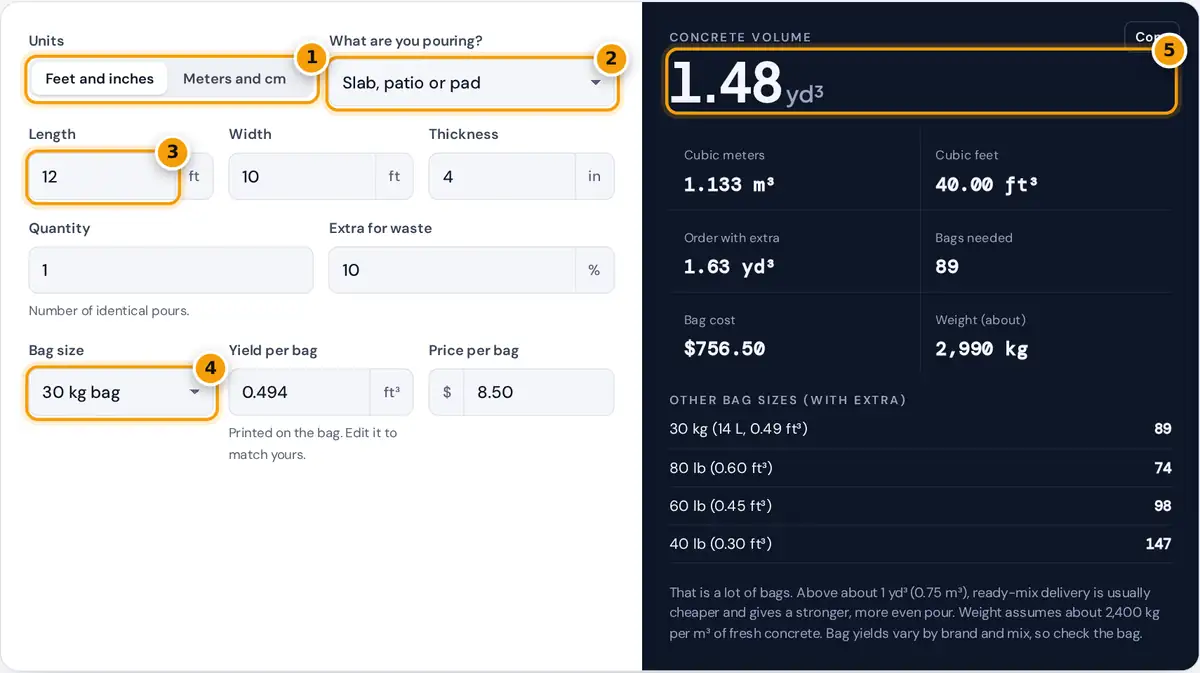
- Choose feet and inches or meters and cm.
- Pick what you are pouring: slab, footing, round column or steps.
- Enter the length, width and thickness, plus quantity and waste.
- Choose your bag size and price per bag.
- Read the concrete volume, then the bags needed and cost for every bag size.
Choose what you are pouring: a slab, a strip footing or wall, a round column (sonotube) or a set of steps. Pick imperial or metric units. In imperial mode, long dimensions are in feet and thicknesses and diameters in inches. In metric mode, they are in meters and centimeters. Set the number of identical pours, such as six deck footings, and an extra percentage for spillage, uneven ground and form bulge.
Choose your bag size or type the yield printed on your bag. The result shows the volume in cubic yards, cubic meters and cubic feet, the number of bags, the cost and the approximate weight.
Concrete volume formulas
round column: volume = π × diameter² ÷ 4 × height
steps (n steps): volume = width × rise × run × n × (n + 1) ÷ 2
cubic yards = cubic feet ÷ 27 1 yd³ = 0.7646 m³
bags = round up (volume with extra ÷ yield per bag)
The steps formula treats the stair as a solid block on grade: the bottom step is one rise high, the next is two rises high, and so on. If your stair sits on a sloped base or has a landing, add the landing as a separate slab.
Bag yields used
| Bag | Yield | Bags per yd³ | Bags per m³ |
|---|---|---|---|
| 30 kg | 0.014 m³ (14 L, about 0.5 ft³) | 55 | 72 |
| 80 lb | 0.60 ft³ (17 L) | 45 | 59 |
| 60 lb | 0.45 ft³ (12.7 L) | 60 | 79 |
| 40 lb | 0.30 ft³ (8.5 L) | 90 | 118 |
The 30 kg yield of approximately 0.014 m³ (1/2 ft³) is the figure listed for QUIKRETE Concrete Mix 30 kg at Home Hardware Canada. The 80, 60 and 40 lb yields are the values commonly printed on US pre-mixed concrete bags. High-strength, fast-setting and fibre mixes can yield a little differently, so the yield box is editable.
Worked examples
Patio slab
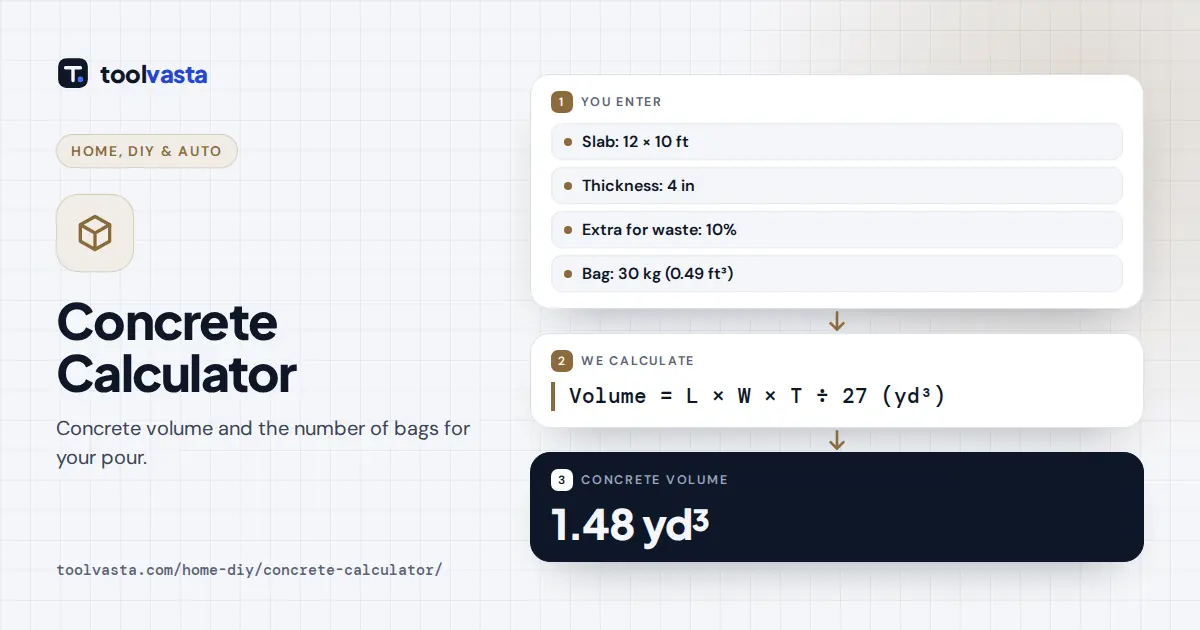
A 12 ft by 10 ft slab 4 in thick is 12 × 10 × 4 ÷ 12 = 40 ft³. That is 40 ÷ 27 = 1.48 yd³, or 1.133 m³. With 10% extra, order 44 ft³ (1.63 yd³, 1.246 m³). In 30 kg bags at 14 L each, 1,246 ÷ 14 = 89.0, so 89 bags, about $756.50 at $8.50 a bag. In 80 lb bags it is 44 ÷ 0.6 = 73.3, so 74 bags. At this size, ready-mix is usually the better choice.
Deck footings
Six sonotubes 10 in across and 4 ft deep hold 6 × π × (10 ÷ 12)² ÷ 4 × 4 = 13.09 ft³ (0.485 yd³). With 10% extra, that is 24 bags of 80 lb or 30 bags of 30 kg.
Three concrete steps
Steps 4 ft wide with a 7 in rise and 11 in run need 4 × (7 ÷ 12) × (11 ÷ 12) × 3 × 4 ÷ 2 = 12.83 ft³, or 0.475 yd³.
Thickness and practical tips
- Walkways and patios are commonly 4 in (100 mm) thick. Driveways and garage floors are often 5 to 6 in (125 to 150 mm).
- Footing depth for frost protection depends on your location. Many Canadian municipalities require deck footings around 4 ft (1.2 m) deep, so check your local building department.
- Mix bags with the amount of water on the label. Too much water makes concrete weaker.
- Have all bags on site before you start so each section can be finished while it is still workable.
Assumptions
Volumes assume flat, square forms and uniform thickness. Gravel bases, rebar and mesh take up very little volume and are ignored. Weight uses about 2,400 kg per m³ for fresh normal-weight concrete. This is an estimate for planning.
Frequently asked questions
How many 30 kg bags of concrete are in a cubic meter?
At about 0.014 m³ per bag, a cubic meter takes roughly 72 bags. A cubic yard takes about 55 bags.
How many bags of concrete do I need for a 10x10 slab?
A 10 × 10 ft slab 4 in thick is 33.3 ft³. With 10% extra that is 62 bags of 80 lb or 75 bags of 30 kg.
How do I calculate concrete for a sonotube?
Multiply π by the diameter squared, divide by 4 and multiply by the height, using the same unit for all. A 10 in tube 4 ft deep holds about 2.18 ft³.
Should I use bags or ready-mix?
Bags suit small jobs such as footings and posts. Above about 1 cubic yard (0.75 m³), ready-mix delivery usually costs less and is much less work.
How much extra concrete should I order?
Most people add 5 to 10% to cover uneven ground, spillage and forms that bulge. Running short in the middle of a pour is worse than having a little left over.