How to Use the Insulation Calculator

- Choose imperial (feet, inches, R-value) or metric (meters, mm, RSI) units.
- Enter the length and width of the attic floor or wall you want to insulate.
- Pick the insulation type. A typical R-value per inch fills in, which you can edit.
- Enter your target R-value and the R-value already in place for a top-up.
- Read the bags or bundles to buy, the new layer thickness and the material cost.
Choose imperial units (feet, inches and R-value) or metric units (meters, millimeters and RSI). Enter the length and width of the area. For an attic floor that is the floor size; for a wall, use the wall length and the wall height. Pick the insulation type and the calculator fills in a typical insulating value per inch. Replace it with the number on your product label if it differs.
Next, enter the total R-value you want to reach and the R-value already in place. Many people use this for an attic top-up, where old insulation stays and a new layer goes on top. Finally, enter the coverage per bag or bundle from the packaging, a waste allowance and the price. The result shows how thick the new layer must be, how many bags or bundles to buy and the material cost.
Insulation Formula and Units
thickness (in) = R-value to add ÷ R-value per inch
bags or bundles = round up (area × (1 + waste %) ÷ coverage per bag)
volume (cu ft) = area (sq ft) × thickness (in) ÷ 12
RSI = R-value × 0.1761
R-value measures resistance to heat flow in imperial units (ft²·°F·h/BTU). RSI is the metric equivalent in m²·K/W, and Canadian building codes and energy programs often quote both. One R is 0.1761 RSI, so R-50 is about RSI 8.81. Spray foam contractors usually price by the board foot, which is one square foot of foam one inch thick, so the calculator shows that figure too.
Worked Example: Topping Up an Attic
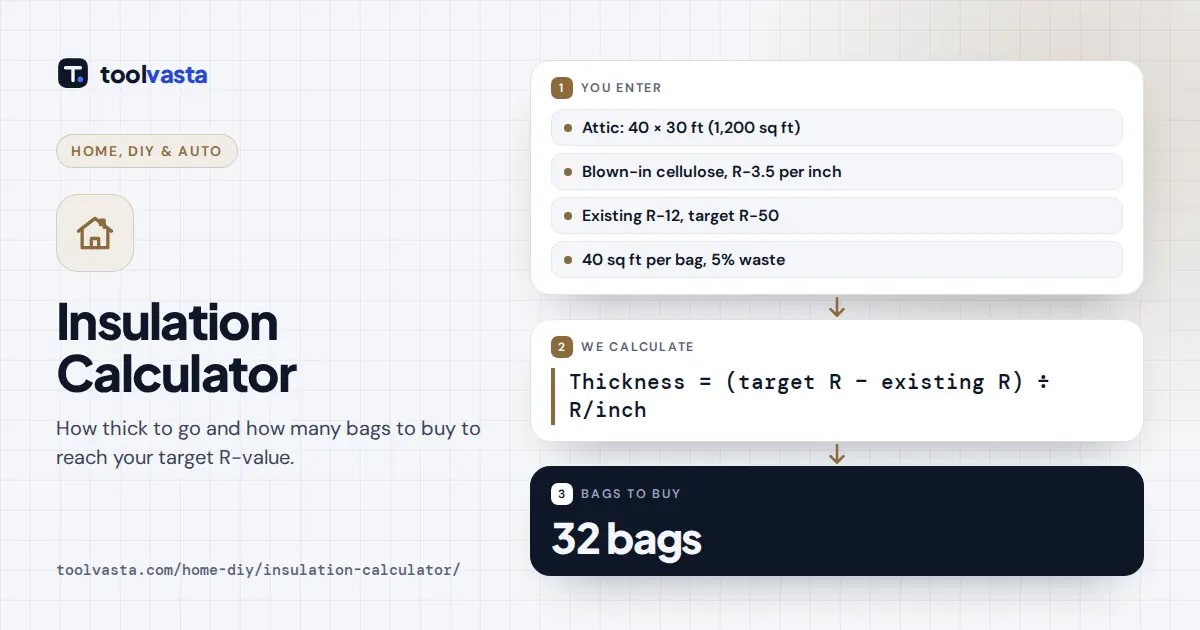
An attic floor measures 40 by 30 ft, or 1,200 sq ft. It already has about R-12 of old insulation and the goal is R-50. The new layer must add 50 − 12 = R-38. Blown-in cellulose at about R-3.5 per inch needs 38 ÷ 3.5 = 10.9 in, roughly 276 mm, of settled depth.
If the bag chart says one bag covers 40 sq ft at that depth, the job needs 1,200 × 1.05 ÷ 40 = 31.5 bags with 5% waste, so buy 32. At $16 a bag the material costs $512. The new layer is 1,085.7 cu ft (30.74 m³) of insulation.
Typical R-Value per Inch
| Material | R per inch | RSI per 25 mm | Inches for R-20 |
|---|---|---|---|
| Blown-in fiberglass | 2.5 | 0.43 | 8.0 |
| Fiberglass batts | 3.2 | 0.55 | 6.3 |
| Blown-in cellulose | 3.5 | 0.61 | 5.7 |
| Open-cell spray foam | 3.6 | 0.62 | 5.6 |
| Mineral wool batts | 4.0 | 0.69 | 5.0 |
| EPS foam board | 4.0 | 0.69 | 5.0 |
| XPS foam board | 5.0 | 0.87 | 4.0 |
| Polyiso foam board | 6.0 | 1.04 | 3.3 |
| Closed-cell spray foam | 6.5 | 1.13 | 3.1 |
These are typical published values and products vary. Batts are sold by their rated R-value for a given thickness, so a nominal R-20 batt is the number to use rather than the per-inch figure. The required R-value or RSI for your attic, walls and basement depends on your climate zone and local code, so check with your building department or a program such as Natural Resources Canada energy efficiency guidance.
Tips for Accurate Quantities
- Measure the area to be covered, not the room below. For walls, subtract large openings such as patio doors.
- For blown-in products, always use the coverage for your target R-value from the bag chart. It already allows for the density and settling of that product.
- Batts fit between framing, so the framing itself takes up some of the area. Bundles are labeled with the square footage they cover at a given stud spacing.
- Foam boards come in set thicknesses. If the calculator says 4.0 in, you might use two 2 in layers with staggered joints.
- Do not block soffit vents when adding attic insulation. Baffles keep the air path open.
Assumptions and Limits
The calculator adds R-values in series, which is how layered insulation works on paper. Real walls lose some performance through studs, gaps and compression, so the effective value of a framed wall is lower than the insulation rating. Air sealing and moisture control matter as much as thickness. This tool estimates material quantities and cost for planning. It is not an energy audit or a code compliance check.
Frequently asked questions
How much insulation do I need for my attic?
Subtract the R-value you already have from your target, then divide by the R-value per inch of the product. Going from R-12 to R-50 with cellulose at R-3.5 per inch needs about 10.9 inches.
How do I convert R-value to RSI?
Multiply the R-value by 0.1761 to get RSI, or divide RSI by 0.1761 to get the R-value. For example, R-20 equals RSI 3.52 and RSI 5.0 equals about R-28.4.
How many bags of blown-in insulation do I need?
Divide the attic area, plus a small waste allowance, by the coverage per bag shown on the bag chart for your target R-value. The chart differs by product, so always use your brand's figures.
Can I put new insulation over old insulation?
Usually yes, if the old insulation is dry, free of mould and not hiding wiring problems. Add the R-values together. Do not add a vapor barrier on top of existing attic insulation.
What is a board foot of spray foam?
A board foot is one square foot of foam one inch thick. Contractors often price spray foam per board foot, so 1,200 sq ft at 3 inches is 3,600 board feet.
Does thicker insulation always perform better?
More thickness raises the R-value, but compressed batts, gaps and air leaks reduce real performance. Air sealing first and installing at full, even depth gives the best result for the money.