How to Use the Pool Chlorine Calculator
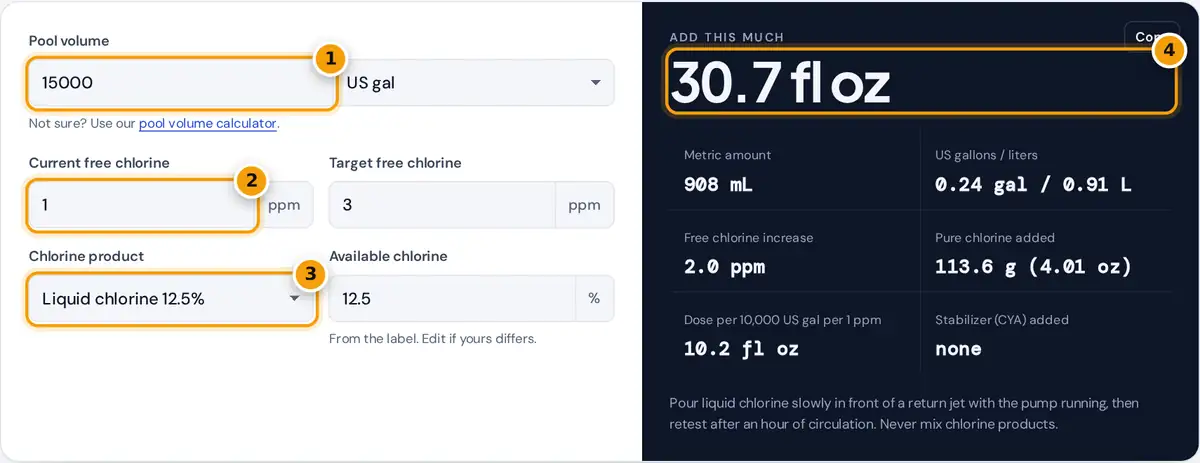
- Enter your pool volume and choose gallons, litres or cubic meters.
- Enter your current free chlorine reading and the target level in ppm.
- Pick your chlorine product. Its strength fills in and can be edited.
- Read the dose to add, with metric and US amounts and any stabilizer added.
Enter your pool volume and choose the unit: US gallons, liters, cubic meters or imperial gallons. Test the water and enter the current free chlorine (FC) reading in parts per million, then the level you want to reach. Pick the chlorine product you are adding. The available chlorine percentage fills in from the product name; change it to match your label if it differs.
The result shows the dose in the units that match your volume (metric if you entered liters or cubic meters) and the other system next to it. It also shows how much pure chlorine you are adding, the dose rate per 10,000 gallons per 1 ppm, and the cyanuric acid (CYA, or stabilizer) that dichlor and trichlor leave behind.
Chlorine Dose Formula
pure chlorine (g) = ppm increase × pool volume (L) ÷ 1,000
liquid dose (L) = pure chlorine (g) ÷ (strength % × 10 g/L)
dry dose (g) = pure chlorine (g) ÷ (available chlorine % ÷ 100)
1 US gal = 3.785 L 1 US fl oz = 29.57 mL
One part per million in water is one milligram per liter, so the chemistry is a simple mass balance. Liquid chlorine strength is treated as grams of available chlorine per 100 mL, which is how pool chlorine is usually labeled. Household bleach labels give the percentage by weight of sodium hypochlorite, so the real strength per millilitre can differ by a few percent. Test and adjust.
Worked Example: Raising Free Chlorine by 2 PPM
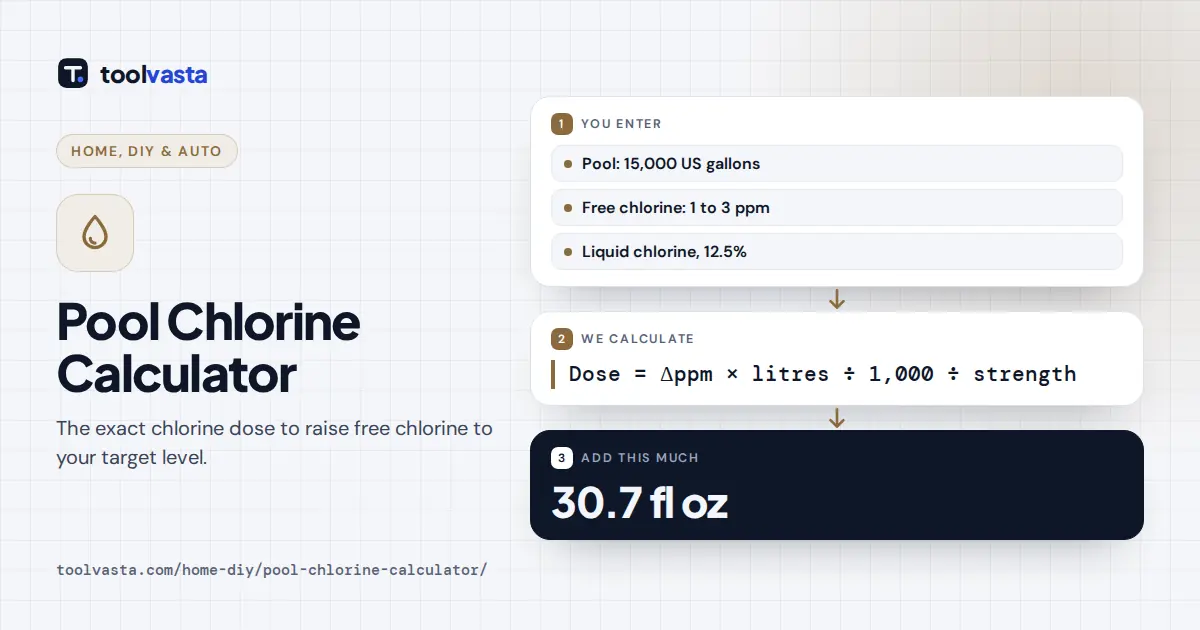
A 15,000 US gallon pool holds 56,781 L. Raising free chlorine by 2 ppm needs 2 × 56,781 ÷ 1,000 = 113.6 g of available chlorine. Liquid chlorine at 12.5% supplies 125 g per liter, so the dose is 113.6 ÷ 125 = 0.908 L, which is 908 mL or 30.7 US fl oz.
Using 65% cal-hypo instead, the dose is 113.6 ÷ 0.65 = 174.7 g, about 6.16 oz. With 90% trichlor it would be 126.2 g, and the trichlor would also raise CYA by about 1.2 ppm, since each 1 ppm of chlorine from trichlor adds roughly 0.6 ppm of stabilizer.
Chlorine Products Compared
| Product | Available chlorine | Per 10,000 US gal per 1 ppm | Side effect |
|---|---|---|---|
| Liquid chlorine | 12.5% | 10.2 fl oz | Raises pH slightly |
| Liquid chlorine | 10% | 12.8 fl oz | Raises pH slightly |
| Bleach | 6% | 21.3 fl oz | Raises pH slightly |
| Cal-hypo | 65% | 2.05 oz | Adds calcium hardness |
| Dichlor | 56% | 2.38 oz | Adds about 0.9 ppm CYA |
| Trichlor | 90% | 1.48 oz | Adds about 0.6 ppm CYA, lowers pH |
The right free chlorine level depends on your stabilizer level, because CYA holds chlorine in reserve. Follow your product label and local guidance, such as public pool rules published by your provincial or state health authority.
Dosing Tips
- Test before and about an hour after dosing, with the pump running. Test strips are less precise than drop-count kits.
- Add chlorine in the evening so sunlight does not burn off much of it straight away.
- Store liquid chlorine cool and out of the sun. It loses strength over weeks, so an old jug may need a larger dose.
- Use stabilized products (dichlor, trichlor) with care. CYA builds up and only falls when water is drained and replaced.
- Never mix different chlorine products, or chlorine with acid, in a container. Add each one to the pool separately.
Assumptions and Limits
The calculator assumes your pool volume and the label strength are accurate and that chlorine mixes evenly. Sunlight, swimmers and organic debris consume chlorine continuously, so the reading you get later will be lower than the target. This tool gives a dose for routine top-ups. For algae, cloudy water or a health concern, follow the product label and ask a pool professional.
Frequently asked questions
How much liquid chlorine do I add to my pool?
For 12.5% liquid chlorine, about 10.2 fluid ounces raises 10,000 US gallons by 1 ppm. A 15,000 gallon pool going from 1 to 3 ppm needs about 30.7 fl oz.
How much chlorine per liter of pool water?
Each 1 ppm needs 1 mg of available chlorine per liter. A 50,000 L pool needs 50 g of available chlorine per 1 ppm, which is 400 mL of 12.5% liquid chlorine.
Can I use household bleach in my pool?
Yes, plain unscented bleach without additives is the same chemical as pool liquid chlorine, just weaker. You need roughly twice as much 6% bleach as 12.5% liquid chlorine.
What is the difference between cal-hypo, dichlor and trichlor?
All three are dry chlorine. Cal-hypo adds calcium, while dichlor and trichlor add cyanuric acid stabilizer. Trichlor tablets dissolve slowly in floaters or feeders and lower pH.
Why is my chlorine level lower than the calculator predicted?
Sunlight, swimmers, debris and algae consume chlorine as soon as it is added, and old liquid chlorine loses strength. Retest after circulation and add a little more if needed.
How long after adding chlorine can I swim?
Wait until the chlorine has fully mixed and a test shows a level within the range on your product label. For routine liquid doses this is often within an hour or so.