How to Use the PPM Calculator
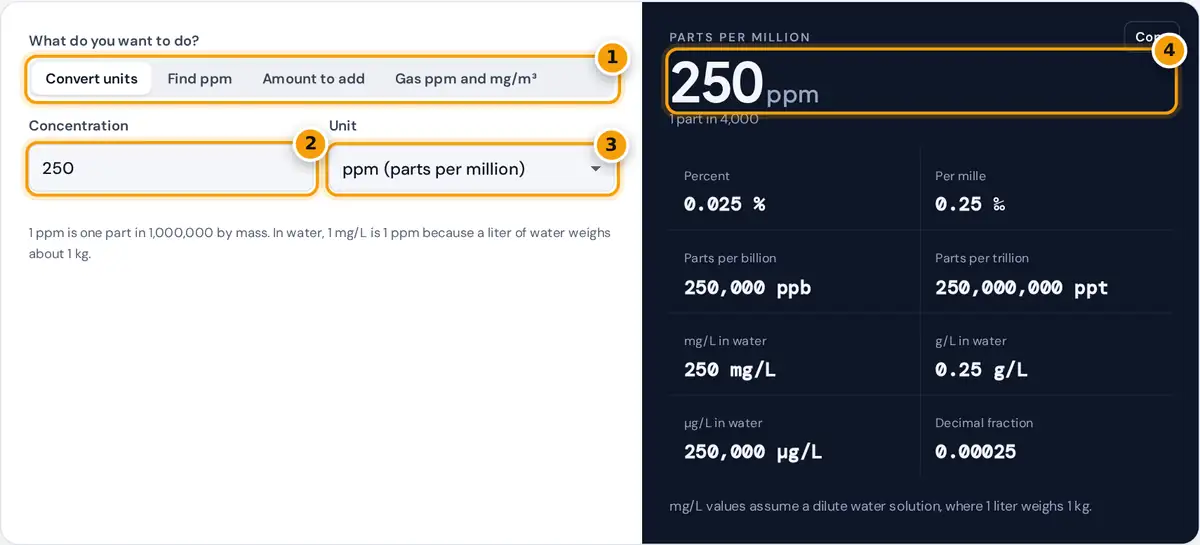
- Choose a mode: convert units, find the ppm of a mix, work out how much to add, or convert gas readings.
- Type the concentration you have, for example 250.
- Pick its unit: ppm, ppb, percent, per mille, mg/L, g/L or a decimal fraction.
- Read the value in ppm, with percent, ppb, mg/L and the 1 part in X ratio listed below.
Pick a mode at the top. Convert units turns a concentration in ppm, ppb, percent, per mille, mg/L or g/L into every other unit at once. Find ppm works out the concentration of a solution you mixed from the amount dissolved and the total amount of solution. Amount to add answers the reverse question: how many grams of a product you need to reach a target ppm in a tank, pool or reservoir. Gas ppm and mg/m³ converts air quality and workplace exposure readings using the molar mass of the gas.
Results update as you type, and the copy button copies the main answer with its unit.
What Parts per Million Means
Parts per million is a ratio. One ppm means one part of a substance in one million parts of the whole, measured the same way. For liquids and solids that usually means mass: 1 mg of salt in 1 kg of water is 1 ppm. Because a liter of water has a mass of very close to 1 kg, 1 mg/L in water is also treated as 1 ppm, which is why water test kits, hydroponic nutrient meters and pool guides use the two interchangeably.
1 ppm = 0.0001% = 1,000 ppb = 1 mg/L (in water)
1% = 10,000 ppm
Worked Examples
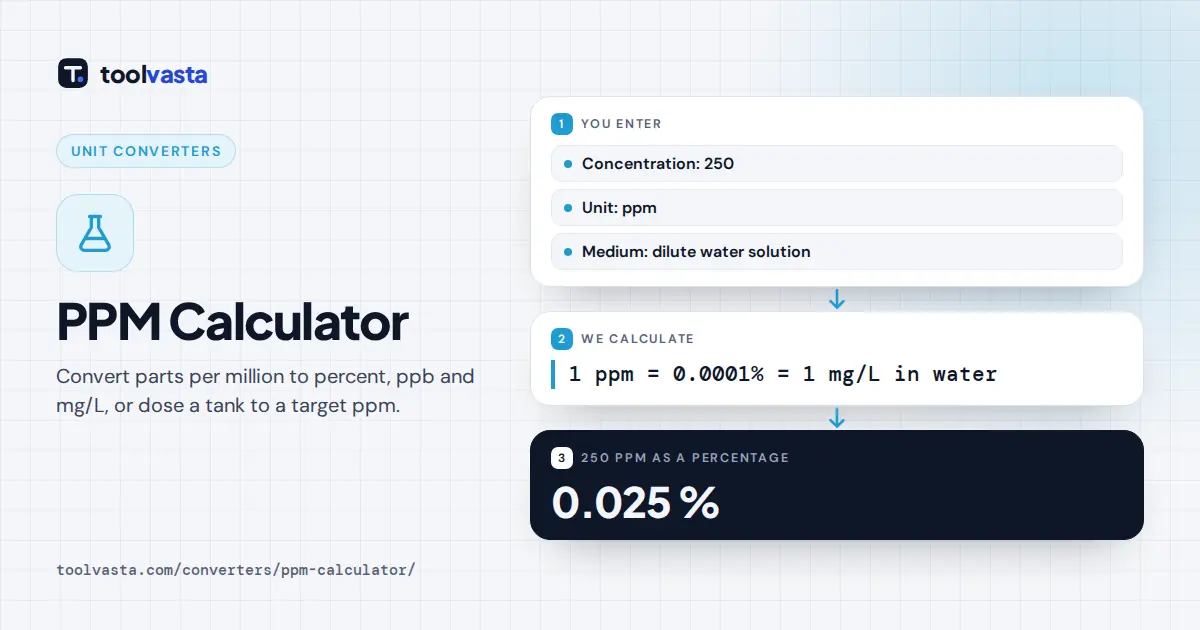
Converting. 250 ppm is 250 ÷ 10,000 = 0.025%. It is also 250,000 ppb, 0.25 g/L in water, and 1 part in 4,000.
Finding ppm. Dissolve 5 g of fertilizer in 20 liters of water. The solution weighs 20 kg, or 20,000,000 mg, so the concentration is 5,000 ÷ 20,000,000 × 1,000,000 = 250 ppm.
Amount to add. To raise 10,000 US gallons (37,854 liters) by 2 ppm you need 2 × 37,854 ÷ 1,000 = 75.7 g of the pure substance. If the product is only 65% active, divide by 0.65 to get 116.5 g.
PPM Conversion Table
| ppm | Percent | ppb | mg/L (water) | g/L (water) |
|---|---|---|---|---|
| 1 | 0.0001% | 1,000 | 1 | 0.001 |
| 10 | 0.001% | 10,000 | 10 | 0.01 |
| 100 | 0.01% | 100,000 | 100 | 0.1 |
| 500 | 0.05% | 500,000 | 500 | 0.5 |
| 1,000 | 0.1% | 1,000,000 | 1,000 | 1 |
| 10,000 | 1% | 10,000,000 | 10,000 | 10 |
| 1,000,000 | 100% | 1,000,000,000 | n/a | n/a |
Gas Concentrations: ppm to mg/m³
For gases, ppm is a ratio by volume (or by moles), not by mass. To turn it into a mass per cubic meter you need the molar mass of the gas and the volume one mole occupies at your temperature and pressure. The ideal gas law gives that molar volume.
mg/m³ = ppm × molar mass ÷ molar volume
At 25°C and 101.325 kPa the molar volume is 24.465 L/mol, the reference most occupational exposure limits use. Carbon monoxide has a molar mass of 28.010 g/mol, so 50 ppm of CO is 50 × 28.010 ÷ 24.465 = 57.24 mg/m³. At 0°C the molar volume falls to 22.414 L/mol and the same 50 ppm becomes 62.48 mg/m³, which is why the temperature input matters.
Tips and Limits
- mg/L equals ppm only for dilute solutions in water. For dense liquids such as brine or syrup, enter the real density in Find ppm.
- Product labels often list strength as a percentage of the active ingredient. Enter that figure so the dose accounts for fillers.
- Parts per trillion (ppt) here means 10−12. In some older texts ppt meant parts per thousand, which is the per mille unit.
- For pools, aquariums and drinking water, follow the product label and local health guidance. This tool does the arithmetic, not the safety judgment.
Where PPM Is Used
Parts per million appears wherever small concentrations matter. Hydroponic growers read nutrient strength in ppm on TDS meters. Pool and spa owners keep free chlorine at a few ppm. Drinking water reports list hardness, nitrate and fluoride in mg/L, which equals ppm for water. Air quality monitors report carbon dioxide and carbon monoxide in ppm, and workplace exposure limits are often given in both ppm and mg/m³. The same arithmetic covers all of these, as long as you keep track of whether the ratio is by mass or by volume.
Frequently asked questions
How do I convert ppm to percent?
Divide ppm by 10,000. For example, 250 ppm is 250 divided by 10,000, which equals 0.025%. Going the other way, multiply a percentage by 10,000 to get ppm, so 1% equals 10,000 ppm.
Is ppm the same as mg/L?
For dilute solutions in water, yes. One liter of water has a mass of about 1 kg, so 1 mg in 1 liter is one part per million by mass. For dense liquids such as brine, mg/L and ppm differ.
How do I calculate ppm from grams and liters?
Convert the grams to milligrams and divide by the liters of water. Five grams in 20 liters is 5,000 mg divided by 20 L, which gives 250 mg/L, or 250 ppm for a dilute water solution.
How many ppb are in 1 ppm?
There are 1,000 parts per billion in one part per million. So 0.5 ppm equals 500 ppb, and 20 ppb equals 0.02 ppm. The calculator shows both values for any concentration you enter.
Why does gas ppm to mg/m³ need temperature?
Gas ppm is a ratio by volume. A mole of gas takes up more space when it is warmer, so the same ppm holds less mass per cubic meter. Most exposure limits use 25 °C and 101.325 kPa.
How much chlorine do I need to raise a pool by 1 ppm?
Multiply 1 ppm by the pool volume in liters and divide by 1,000 to get grams of pure chlorine. Then divide by the product strength, for example 0.65 for 65% calcium hypochlorite. Always follow the label.