How to Use the Feet and Inches Calculator
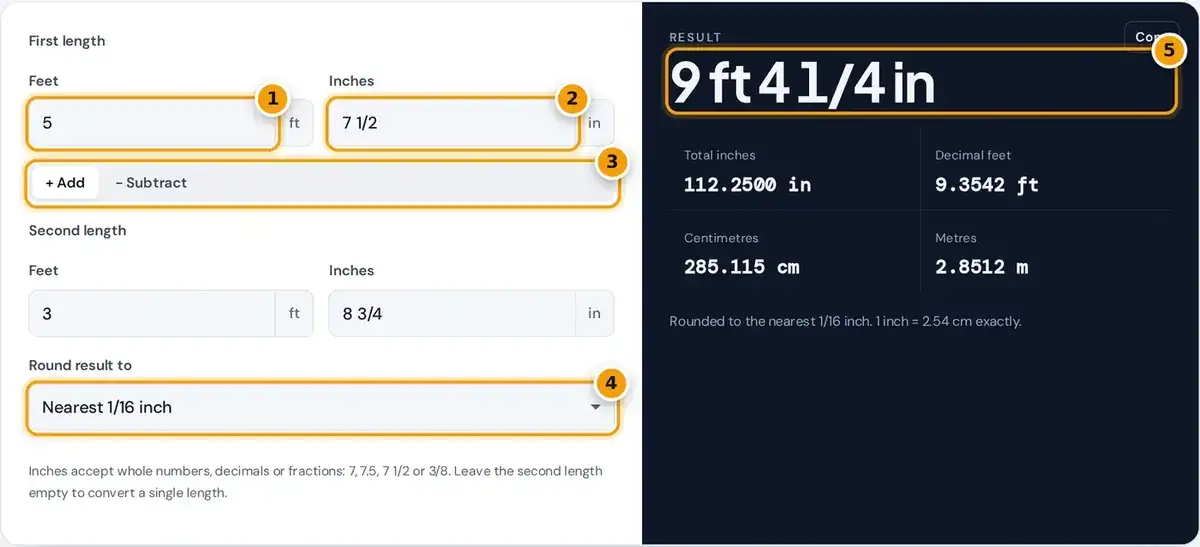
- Enter the feet of the first length.
- Enter the inches, using whole numbers, decimals or fractions like 7 1/2.
- Choose Add or Subtract.
- Set the rounding, from the nearest 1/2 to 1/32 inch.
- Read the result in feet and inches, with total inches, centimetres and metres.
Enter the feet and inches of the first length, choose Add or Subtract, then enter the second length. Inches can include a fraction, such as 7 1/2 or 3/8, as you read a tape measure.
Pick how finely to round the answer, from the nearest 1/2 inch down to the nearest 1/32 inch. To convert a single measurement, fill in the first length only and leave the second length blank.
This feet and inches calculator updates as you type. It shows the answer in feet and inches, plus total inches, decimal feet, centimeters and meters, and a Copy button saves the result for your notes.
The Feet and Inches Formula
Behind the scenes, both lengths become total inches: multiply the feet by 12, since 12 inches make one foot, then add the inches. Working in one single unit removes all carrying between feet and inches.
After adding or subtracting, divide by 12 to split the total back apart. The whole number is the feet, and the remainder is the inches. Dividing total inches by 12 without splitting gives decimal feet.
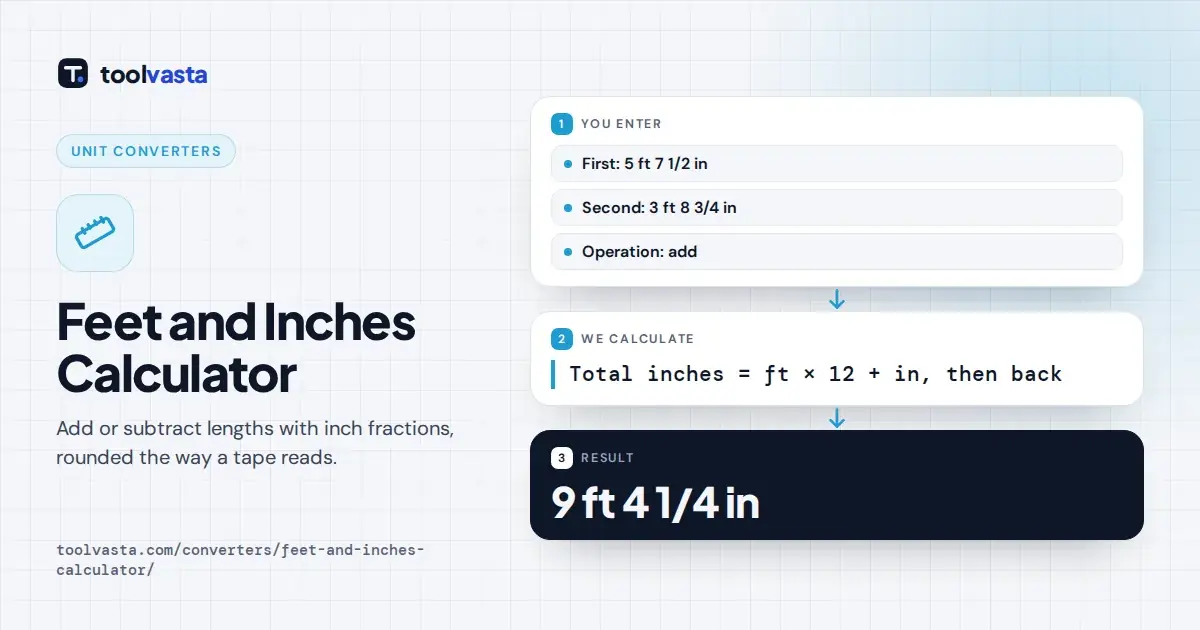
Worked example: 5 ft 7 1/2 in plus 3 ft 8 3/4 in is 67.5 plus 44.75, or 112.25 inches. That is 9 ft 4 1/4 in, which the formula also converts to 285.115 centimeters.
feet = floor(total ÷ 12), inches = total − feet × 12
cm = inches × 2.54
Subtracting Feet and Inches and Negative Results
To subtract 4 ft 9 1/4 in from 10 ft 2 in, convert to inches: 122 minus 57.25 is 64.75 inches, which is 5 ft 4 3/4 in once split back into feet and inches.
By hand you need borrowing, taking one foot as 12 inches because 2 inches is smaller than 9 1/4 inches. Working in total inches, as this inches calculator does, skips that step and avoids slips.
If the second length is longer, you get a negative result with a minus sign, such as -1 ft 2 in. That shows how much a board or cabinet is too long for the space.
Inch Fractions and Decimal Equivalents
Inch fractions follow the marks on a tape measure: halves, quarters, eighths and sixteenths, with 1/32 marks on finer rules. To turn any fraction into a decimal inch, simply divide the numerator by the denominator.
For example, 3/8 is 3 divided by 8, which is 0.375 inches. The table lists common fractions with their decimal inch values and the matching size in millimeters, exact because one inch is 25.4 millimeters.
The calculator accepts whole numbers, decimals and fractions in the inches box, so 7, 7.5 and 7 1/2 give the same answer. Results are reduced to the simplest fraction, so 8/16 always shows as 1/2.
| Fraction | Decimal inch | Millimeters |
|---|---|---|
| 1/16 | 0.0625 | 1.5875 |
| 1/8 | 0.125 | 3.175 |
| 1/4 | 0.25 | 6.35 |
| 3/8 | 0.375 | 9.525 |
| 1/2 | 0.5 | 12.7 |
| 5/8 | 0.625 | 15.875 |
| 3/4 | 0.75 | 19.05 |
| 7/8 | 0.875 | 22.225 |
Height Conversions in Feet, Inches and Metric
Height is a common reason to use a feet inches calculator. Many medical and travel forms ask for height in metric, while people in Canada and the United States often know their height in feet.
Enter your height as the first length and leave the second blank. For example, 5 ft 10 in is 70 inches, and 70 times 2.54 cm per inch gives 177.8 centimeters, or exactly 1.778 meters.
The table lists common heights with total inches and centimeters. For 5 ft 7 in, the calculator gives 67 inches and 170.18 centimeters, and it also shows decimal feet, handy for spreadsheets and design software.
| Feet and inches | Total inches | Centimeters |
|---|---|---|
| 5 ft 0 in | 60 | 152.4 |
| 5 ft 4 in | 64 | 162.56 |
| 5 ft 7 in | 67 | 170.18 |
| 5 ft 10 in | 70 | 177.8 |
| 6 ft 0 in | 72 | 182.88 |
| 6 ft 3 in | 75 | 190.5 |
Carpentry, Flooring and Everyday Uses
In carpentry and renovation, you often add several board lengths or subtract a cut from a stock length. Entering the tape measure readings directly avoids converting each one to decimals first, where mistakes creep in.
For flooring, baseboard and trim, add the length of each wall to find how much material to buy. Run the calculator once per pair of walls, then add the running total to the next wall.
Sewing and fabric projects use inches and fractions too. Whether you call it a feet inch calculator or a foot and inch calculator, the same method of total inches handles every one of these jobs.
- Carpentry: add board lengths or subtract a cut from a stock length.
- Flooring and trim: total several walls before buying baseboard.
- Height: convert 5 ft 10 in to 177.8 cm for a metric form.
- Fabric and crafts: combine inch fractions without converting to decimals.
Notation, Rounding and Precision
Feet are often written with a prime symbol and inches with a double prime, so 5 ft 7 in appears as 5′ 7″. Plans and drawings also join them with a hyphen, as in 5′-7″.
Rounding applies to the feet and inches answer. Total inches and metric values stay unrounded, and one inch is exactly 2.54 cm, the factor listed in NIST unit conversion resources, so conversions carry no error.
This tool adds and subtracts but does not multiply or divide. It uses the international foot of 0.3048 meters, the only foot in general use since NIST retired the U.S. survey foot in early 2023.
Frequently asked questions
How do I add feet and inches together?
Convert each length to inches by multiplying the feet by 12 and adding the inches. Add the two totals, then divide by 12. The whole number is feet and the remainder is inches.
How many centimeters is 5 feet 7 inches?
5 ft 7 in is 67 inches, because 5 times 12 is 60, plus 7. Multiply 67 by 2.54 to get 170.18 centimeters, or about 1.70 meters.
Can I enter fractions of an inch?
Yes. Type values such as 7 1/2, 3/8 or 7.5 in the inches box. The result is rounded to the fraction you choose, from 1/2 inch down to 1/32 inch, and simplified.
How do I convert inches to feet and inches?
Enter 0 feet and the total inches in the first length, and leave the second length empty. For example, 100 inches is 8 ft 4 in, because 8 times 12 is 96 with 4 left.
How do you subtract feet and inches?
Convert both lengths to total inches, subtract, then divide by 12 to split the answer back into feet and inches. This avoids borrowing 12 inches from the feet column when subtracting by hand.
What is 5 feet 10 inches in decimal feet?
5 feet 10 inches is 70 inches. Divide 70 by 12 to get about 5.8333 decimal feet. The calculator shows decimal feet alongside total inches for every result.