How to Use the Grams to Cups Converter
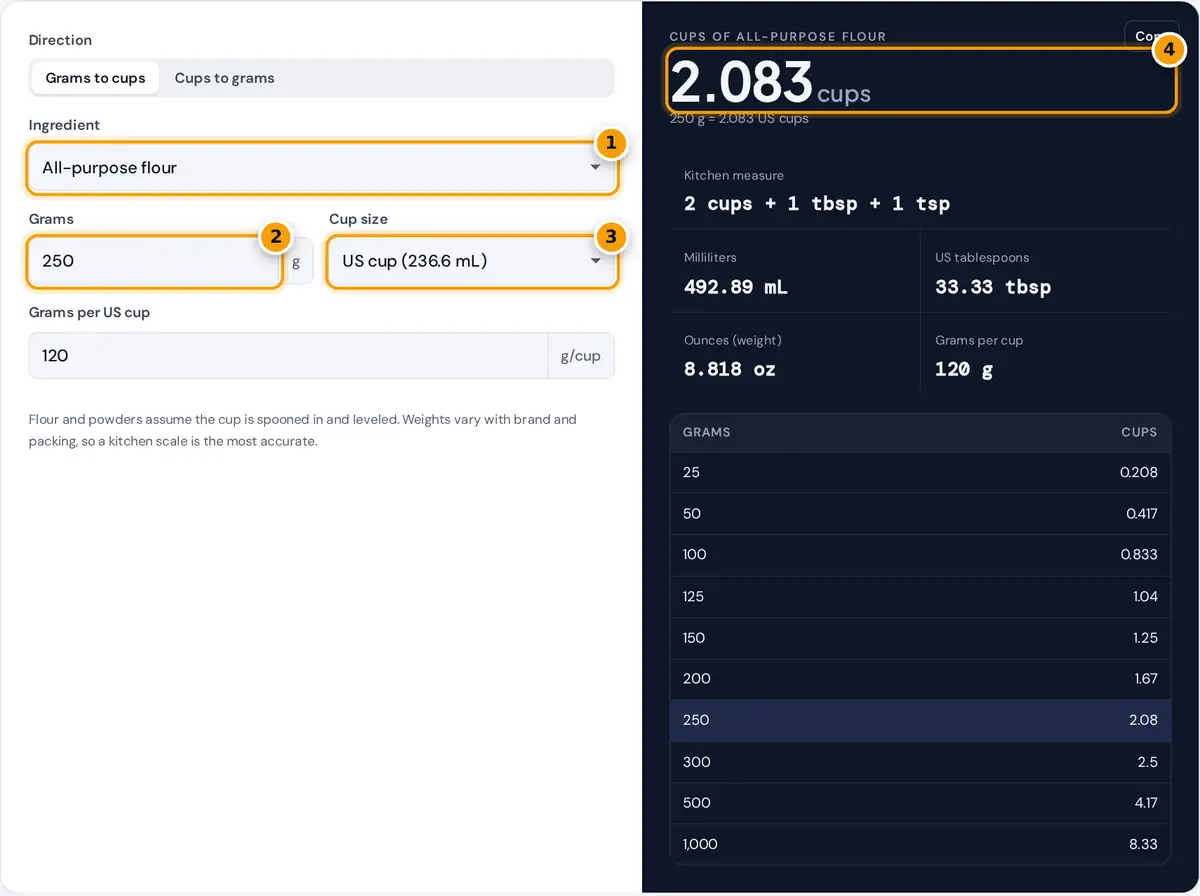
- Choose the ingredient, such as flour, sugar or butter, or pick Other for your own.
- Type the weight in grams, or switch direction to enter cups.
- Pick the cup size: US, metric 250 mL, US legal or UK.
- Read the cups, with a cups plus tablespoons measure and a grams chart below.
Choose the ingredient from the list, type the weight in grams and pick the cup size your recipe uses. The result shows the volume in cups, a practical kitchen measure made of cups, tablespoons and teaspoons you can scoop with a standard set, and the same amount in milliliters and ounces. The table under the result lists common gram weights for that ingredient.
To convert the other way, switch the direction to Cups to grams and type cups as a decimal or fraction, such as 3/4 or 1 1/2. If your ingredient is not listed, choose Other and enter how many grams one US cup weighs, which you can find by weighing a leveled cup once.
The Grams to Cups Formula
Grams measure mass and cups measure volume, so the conversion uses the ingredient’s density, expressed here as grams per US cup.
cups = grams ÷ density ÷ cup size in mL
grams = cups × cup size in mL × density
Cup sizes are exact definitions: the US customary cup is 236.5882365 mL (half a US pint), the metric cup used in Canada, Australia and New Zealand is 250 mL, the US legal cup on nutrition labels is 240 mL, and the old UK cup is 284.130625 mL (half an imperial pint).
Worked Example
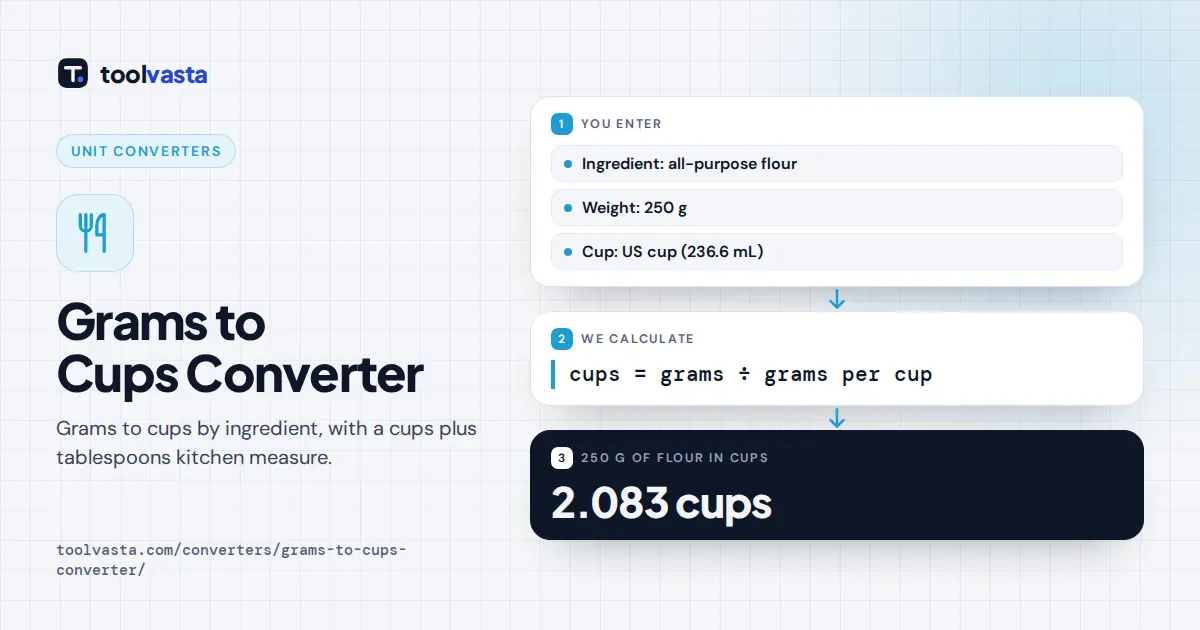
A recipe calls for 250 g of all-purpose flour. One US cup of spooned and leveled flour weighs about 120 g, so 250 ÷ 120 = 2.083 cups. In a kitchen that is 2 cups plus 1 tablespoon plus 1 teaspoon, because 0.083 cup is 4 teaspoons. With 250 mL metric cups the same flour is 1.972 cups, a little under 2.
Going the other way, 3/4 cup of granulated sugar at 200 g per cup is 0.75 × 200 = 150 g.
Grams per Cup Chart
| Ingredient | 1 US cup | ½ cup | ¼ cup | 100 g in cups |
|---|---|---|---|---|
| All-purpose flour | 120 g | 60 g | 30 g | 0.83 |
| Whole wheat flour | 113 g | 56.5 g | 28.3 g | 0.88 |
| Granulated sugar | 200 g | 100 g | 50 g | 0.5 |
| Brown sugar, packed | 213 g | 106.5 g | 53.3 g | 0.47 |
| Powdered sugar | 120 g | 60 g | 30 g | 0.83 |
| Butter | 227 g | 113.5 g | 56.8 g | 0.44 |
| Cocoa powder | 86 g | 43 g | 21.5 g | 1.16 |
| Rolled oats | 90 g | 45 g | 22.5 g | 1.11 |
| Honey | 339 g | 169.5 g | 84.8 g | 0.29 |
| Milk | 244 g | 122 g | 61 g | 0.41 |
| Water | 236.6 g | 118.3 g | 59.1 g | 0.42 |
Why Cup Weights Vary
How you fill the cup changes the weight more than anything else. Flour scooped straight from the bag can weigh 140 g or more per cup because it packs down, while flour spooned in and leveled weighs about 120 g. Brown sugar is pressed firmly into the cup by convention. Humidity, brand and grind also matter. The values here are typical published kitchen figures, so for bread, macarons and other precise baking, weigh your ingredients on a scale.
Tips
- One stick of butter is 1/2 US cup, or about 113 g.
- Canadian recipes written in metric usually mean 250 mL cups. American recipes mean 236.6 mL cups. The difference is about 6%.
- For liquids such as milk and oil, measuring in milliliters with a clear jug is more accurate than cups.
Measuring Without a Scale
If you do not have a kitchen scale, the spoon-and-level method gets you closest to the weights used here. Stir the flour or powder to loosen it, spoon it into a dry measuring cup until it mounds over the top, then sweep the excess off with a straight edge. Do not tap or shake the cup. For brown sugar, press it firmly until it holds the cup’s shape when turned out. Use clear liquid measuring cups for milk, water and oil and read them at eye level. For small amounts, the tablespoon figure in the result is often easier to measure than a fraction of a cup.
Frequently asked questions
How many cups is 250 grams of flour?
About 2.08 US cups of all-purpose flour, using 120 grams per spooned and leveled cup. In a kitchen that is 2 cups plus 1 tablespoon and 1 teaspoon. With 250 mL metric cups it is about 1.97 cups.
How many grams are in a cup of sugar?
One US cup of granulated sugar weighs about 200 grams. Packed brown sugar is about 213 grams per cup and unsifted powdered sugar about 120 grams, so always pick the exact sugar you are using.
How many cups is 100 grams of butter?
About 0.44 US cups, since one cup of butter weighs about 227 grams. That is just under 1/2 cup, or about 7 tablespoons. One North American stick of butter is 113 grams.
Is a Canadian cup the same as a US cup?
Canadian metric recipes use a 250 mL cup, while US recipes use a 236.6 mL cup. The metric cup is about 6% larger. Older Canadian recipes may use the 227 mL Canadian cup, so check the source.
Why do grams to cups charts disagree?
Cup weights depend on how the cup is filled, the brand and the moisture in the ingredient. Scooped flour packs more tightly than spooned flour. Published charts use different methods, so small differences of 5 to 10% are normal.
How do I convert cups to grams?
Multiply the number of cups by the weight of one cup of that ingredient. For example, 1 1/2 cups of all-purpose flour at 120 grams per cup is 180 grams. Switch the converter to Cups to grams to do this.