How to Use the Watts per kg Calculator
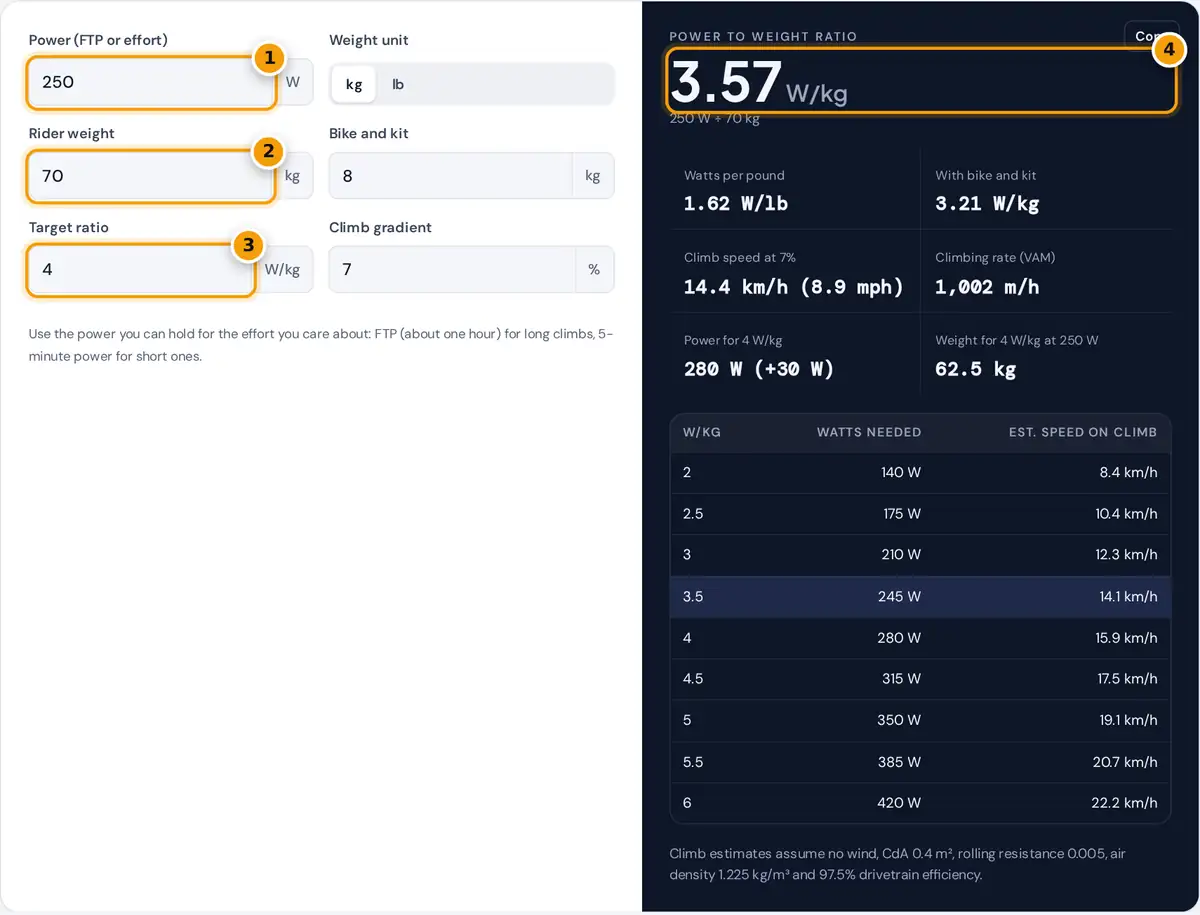
- Enter your power in watts, such as FTP or a 5-minute best.
- Enter your body weight, in kg or lb using the unit switch.
- Set a target ratio to see the watts or weight you would need.
- Read your W/kg, with W/lb, system W/kg and a climbing speed estimate below.
Enter a power figure in watts and your body weight. The headline result is your power to weight ratio in watts per kilogram (W/kg), the figure coaches, training apps and race categories use to compare riders of different sizes. Choose kg or lb; the tool converts your weights when you switch.
Add the weight of your bike, shoes, bottles and clothing to see the ratio for the whole system, which is what gravity actually pulls uphill. Set a target ratio to see how many watts you need at your current weight, or what you would need to weigh at your current power. The gradient box drives a physics-based estimate of climbing speed and VAM, and the table shows watts and speed for a range of ratios.
The Formula
W/lb = power (W) ÷ body weight (lb)
watts for a target = target W/kg × body weight (kg)
1 lb = 0.45359237 kg exactly
The climbing estimate balances your power at the wheel against gravity, rolling resistance and air drag: power × 0.975 = v × (m × g × (sin θ + 0.005 × cos θ) + ½ × 1.225 × 0.4 × v²), solved for speed v. VAM, the vertical meters climbed per hour, is v × sin θ × 3,600.
Worked Example
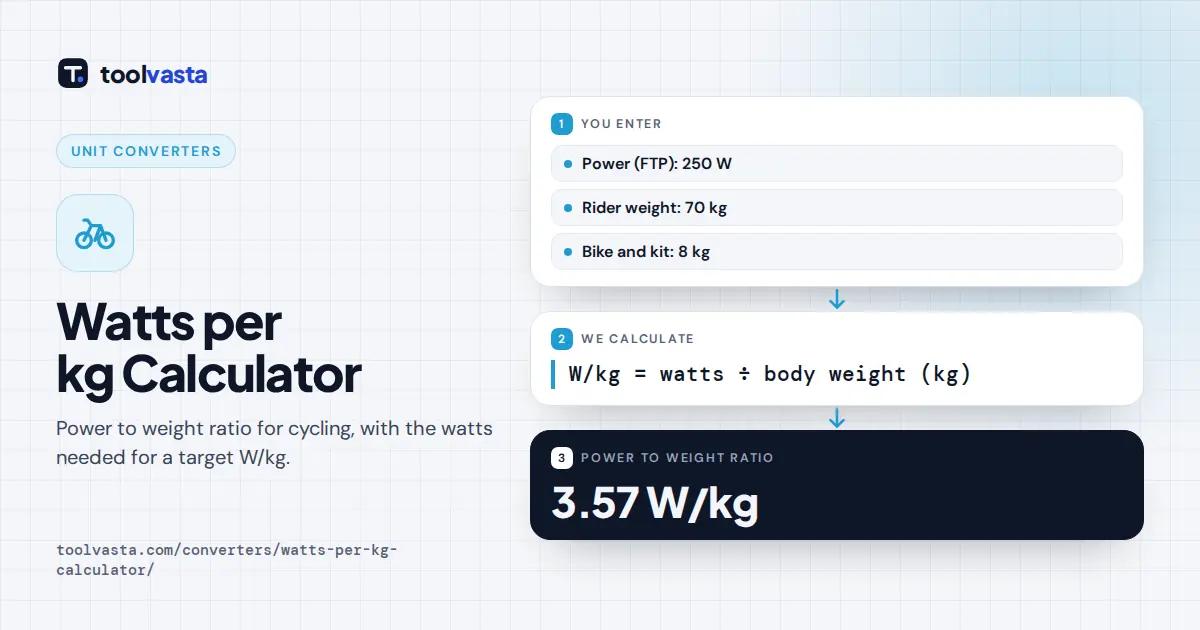
A rider with an FTP of 250 W who weighs 70 kg has 250 ÷ 70 = 3.57 W/kg. In pounds, 70 kg is 154.3 lb, so the ratio is 1.62 W/lb. With an 8 kg bike and kit the system ratio is 250 ÷ 78 = 3.21 W/kg.
To reach 4.0 W/kg at the same weight the rider needs 4.0 × 70 = 280 W, an extra 30 W. Alternatively, at 250 W they would need to weigh 250 ÷ 4.0 = 62.5 kg. On a steady 7% climb the model estimates about 14.4 km/h for the current 250 W, a VAM of about 1,000 m/h.
Power Needed by Weight
| Rider weight | 2.5 W/kg | 3.0 W/kg | 3.5 W/kg | 4.0 W/kg | 4.5 W/kg |
|---|---|---|---|---|---|
| 55 kg (121 lb) | 138 W | 165 W | 193 W | 220 W | 248 W |
| 60 kg (132 lb) | 150 W | 180 W | 210 W | 240 W | 270 W |
| 70 kg (154 lb) | 175 W | 210 W | 245 W | 280 W | 315 W |
| 80 kg (176 lb) | 200 W | 240 W | 280 W | 320 W | 360 W |
| 90 kg (198 lb) | 225 W | 270 W | 315 W | 360 W | 405 W |
| 100 kg (220 lb) | 250 W | 300 W | 350 W | 400 W | 450 W |
Why W/kg Matters More on Climbs
On a steep climb most of your power goes into lifting your mass against gravity, so a lighter rider with the same watts goes faster. On flat roads air resistance dominates, and air drag depends on your frontal area, not your weight, so absolute watts matter more there. That is why heavier riders often excel on flat time trials while lighter riders shine in the mountains. Many indoor racing platforms also sort riders into categories using W/kg.
Ways to Improve Your Ratio
- Raise power with structured training such as threshold and VO2 max intervals.
- Measure power and weight consistently: same power meter, weigh-ins at the same time of day.
- Lighter equipment helps the system ratio, but a kilogram off the bike changes the result far less than 10 watts of extra power for most riders.
Limits
The speed estimate assumes a smooth road, no wind, an upright climbing position and steady power. Real speeds vary with surface, drafting, altitude and pacing. Weight loss for performance should be gradual and supported by a health professional; this calculator is not a nutrition or medical tool.
Measuring Your FTP
Functional threshold power is the highest average power you can sustain for about an hour. Most riders estimate it from a shorter test, commonly 95% of their best 20-minute average power, using a power meter or smart trainer. Test when rested, on the same equipment each time, and weigh yourself the same morning so the ratio reflects one consistent day.
Frequently asked questions
How do I calculate watts per kg?
Divide your power in watts by your body weight in kilograms. A rider producing 250 watts who weighs 70 kg has 250 divided by 70, which is 3.57 W/kg. Use FTP for a sustained ratio.
What is a good watts per kg?
It depends on the duration and your goals. For one-hour power, many recreational riders sit between about 2 and 3.5 W/kg, while professional climbers exceed 6. Compare yourself with riders in your own group or category.
Should I include bike weight in W/kg?
The standard ratio uses body weight only, so riders can compare fairly. For climbing speed, gravity acts on the whole system, so the calculator also shows power divided by rider plus bike and kit weight.
How do I convert W/kg to W/lb?
Divide W/kg by 2.2046, because one kilogram is about 2.2046 pounds. So 3.57 W/kg equals about 1.62 W/lb. The calculator shows both values for any power and weight you enter.
How many watts do I need for 4 W/kg?
Multiply 4 by your weight in kilograms. A 70 kg rider needs 280 watts, an 80 kg rider needs 320 watts, and a 60 kg rider needs 240 watts. Enter your weight and target to see the gap.
Is W/kg important on flat roads?
Less so. On the flat, most power fights air drag, which depends on frontal area and position rather than weight. Absolute watts and aerodynamics matter more there, while W/kg decides climbing speed.