How to Use the Belt Length Calculator
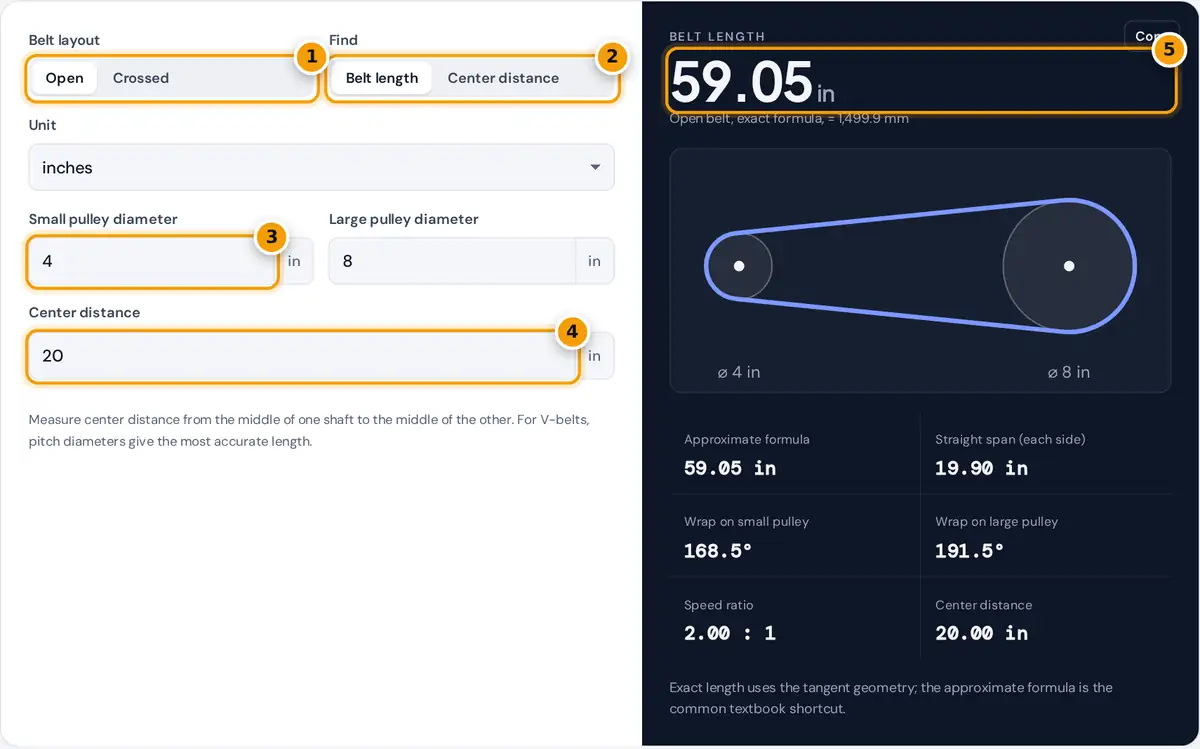
- Choose an open or crossed belt.
- Choose to find the belt length or the center distance.
- Enter the small and large pulley diameters.
- Enter the center distance between the shafts.
- Read the belt length, with wrap angles and straight span length.
Choose an open belt, where both pulleys turn the same way, or a crossed belt, which forms an X between the pulleys and reverses the direction of the driven shaft. Pick inches, millimeters or centimeters, enter the two pulley diameters and the center distance between the shafts, and read the belt length. The diagram is drawn to scale so you can check the layout.
To work backward, choose Center distance and enter the length of a belt you already have. The calculator finds the shaft spacing that fits it, which helps when you are mounting a motor on an adjustable base.
Belt Length Formulas
Open belt, approximate: L ≈ 2C + π(D₁ + D₂) ÷ 2 + (D₂ − D₁)² ÷ 4C
Crossed belt, exact: L = 2C cos φ + (π + 2φ)(D₁ + D₂) ÷ 2, with sin φ = (D₁ + D₂) ÷ 2C
Wrap angles (open): small = 180° − 2φ, large = 180° + 2φ
The exact formulas add the two straight spans between the tangent points to the arcs of belt wrapped around each pulley. The approximate open belt formula is accurate when the center distance is large compared with the difference in diameters, which is why handbooks often quote it. The calculator shows both.
Worked Example
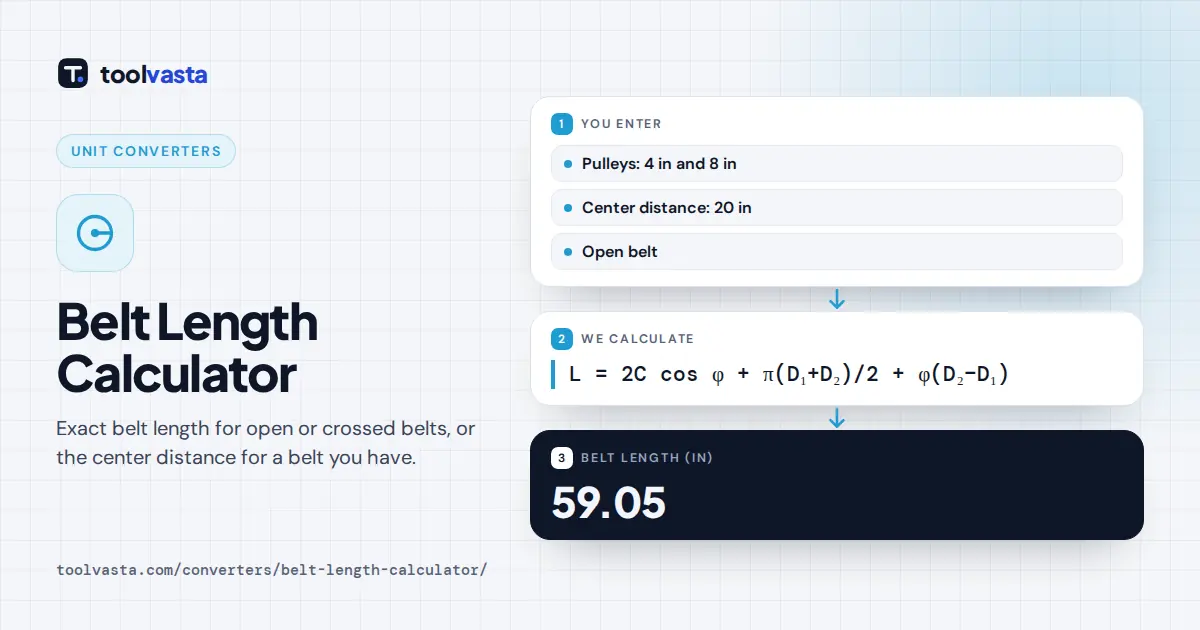
Two pulleys of 4 and 8 inches sit 20 inches apart. For an open belt, sin φ = (8 − 4) ÷ 40 = 0.1, so φ = 0.10017 radians. The length is 2 × 20 × 0.99499 + π × 12 ÷ 2 + 0.10017 × 4 = 39.80 + 18.85 + 0.40 = 59.05 inches. The belt wraps 168.5° of the small pulley and 191.5° of the large one, and each straight span is 19.90 inches.
With a crossed belt the same pulleys need 60.66 inches, and the belt wraps 214.9° of each pulley. In metric, 100 mm and 200 mm pulleys 500 mm apart need an open belt of 1,476.24 mm.
Working backward, a 60 inch open belt on the 4 and 8 inch pulleys needs a center distance of 20.48 inches.
Open Belt Lengths for 4 in and 8 in Pulleys
| Center distance | Exact length | Small pulley wrap |
|---|---|---|
| 10 in | 39.25 in | 156.9° |
| 15 in | 49.12 in | 164.7° |
| 20 in | 59.05 in | 168.5° |
| 25 in | 69.01 in | 170.8° |
| 30 in | 78.98 in | 172.4° |
Measuring Pulleys and Center Distance
Measure each pulley across its widest point with calipers, then estimate the pitch diameter for V-belt sheaves from the catalog or by subtracting the groove depth allowance the maker publishes. Measure center distance with the motor in the middle of its adjustment range, so you can tighten or loosen the belt later. If you are replacing a worn belt, measuring the old belt can mislead, because belts stretch with use; calculating from the pulleys gives a truer figure.
Choosing a Belt Size
V-belts and timing belts are sold in standard lengths, so you rarely find one that matches the calculated length exactly. Choose the nearest available size and adjust the center distance to suit, using the center distance mode to check how far the motor must move. Leave room for tensioning: most drives need some adjustment to fit the belt over the pulleys and to take up stretch as it wears in. V-belt length codes may refer to the inside, outside or pitch length depending on the belt section, so compare like with like when reading a catalog.
Tips and Limits
- Use pitch diameters for V-belts and timing belts. Outside diameters overstate the belt length slightly.
- Keep at least 120° of wrap on the small pulley to avoid slip. Short center distances with very different pulley sizes reduce wrap.
- Crossed belts work only with flat or round belts that can twist. V-belts and toothed belts are not designed to run crossed.
Frequently asked questions
How do I calculate belt length for two pulleys?
For an open belt, a good approximation is twice the center distance, plus π times the sum of the diameters divided by 2, plus the squared difference of the diameters divided by four times the center distance. The calculator also gives the exact value.
What is the belt length for 4 and 8 inch pulleys 20 inches apart?
An open belt needs about 59.05 inches, using the exact tangent formula. A crossed belt around the same pulleys needs about 60.66 inches because it wraps further around each pulley.
How do I find the center distance for a belt?
Choose the center distance mode and enter the belt length. The calculator solves the exact belt formula for the shaft spacing. A 60 inch open belt on 4 and 8 inch pulleys needs about 20.48 inches.
What is the difference between an open and a crossed belt?
An open belt runs around the outside of both pulleys, which turn in the same direction. A crossed belt forms an X between them, reverses the driven pulley's direction and wraps more of each pulley.
What is the wrap angle of a belt?
It is the angle of the pulley's circumference in contact with the belt. More wrap means more grip. For open belts the small pulley gets less than 180 degrees, so keep it above about 120 degrees.
Should I use the inside or outside diameter of a V-belt pulley?
Use the pitch diameter, where the belt's neutral layer runs, if the manufacturer lists it. The outside diameter is a little larger, so it gives a slightly longer belt length than you need.