How to Use the Gas Mark to Celsius Converter
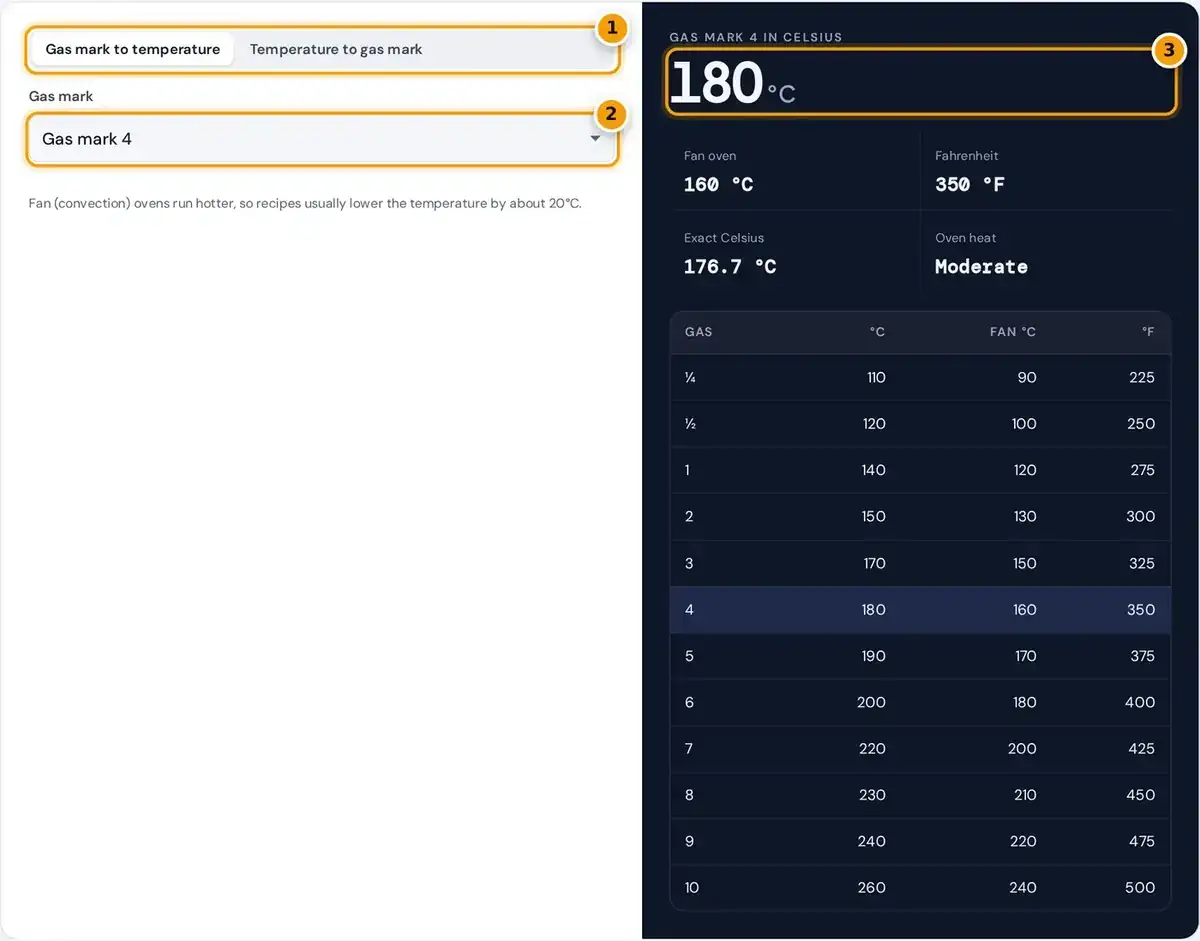
- Choose gas mark to temperature, or temperature to gas mark.
- Pick the gas mark from your recipe, from ¼ to 10.
- Read the Celsius temperature, with the fan oven setting and Fahrenheit below.
Pick the gas mark from your recipe and the converter shows the oven temperature in degrees Celsius, the lower setting for a fan oven, the Fahrenheit value, the exact Celsius figure and a short description.
To go the other way, switch to Temperature to gas mark, type a number and choose °C, °C fan or °F. The tool returns the nearest gas mark plus its exact position on the scale.
The matching row lights up in the conversion chart below the result, so you can quickly compare the neighboring settings at a glance. Any oven temperature between 50°C and 320°C is accepted in reverse mode.
The Gas Mark Formula
From gas mark 1 upward, each step adds 25°F, starting at 275°F. That is about 14°C for each step on the dial. Gas marks ¼ and ½ sit just below the scale at 225°F and 250°F respectively.
°C = (°F − 32) × 5 / 9
gas mark = (°F − 250) / 25
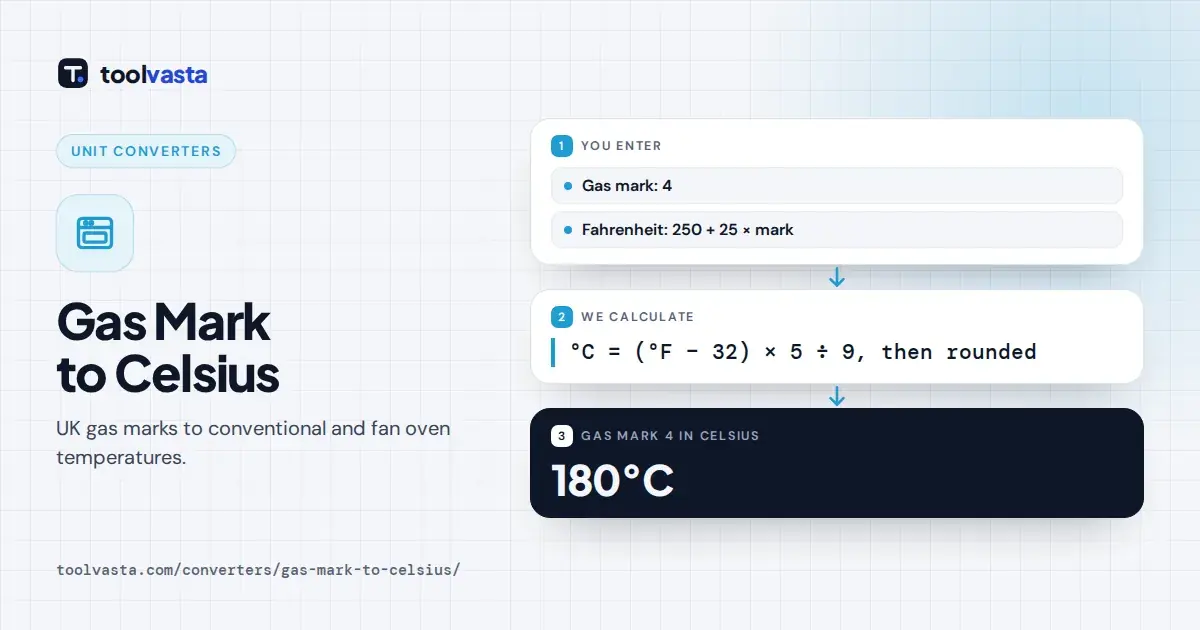
Here is a worked example: gas mark 4 is 250 + 25 × 4 = 350°F. The standard temperature conversion then gives (350 − 32) × 5 / 9 = 176.7°C, which most printed recipes round to 180°C for a conventional oven.
Going backward, 350°F gives (350 − 250) / 25 = gas mark 4 exactly. A temperature of 400°F, or 204.4°C, lands on gas mark 6, and the reverse tool always shows the exact decimal value before any rounding.
Gas Mark Conversion Chart
Recipe values are rounded to the nearest ten degrees, and published charts do not always agree. Gas mark 3 appears as 160°C in some books and 170°C in others, because its exact value is 162.8°C.
| Gas mark | °C (recipe) | °C fan | °F | Exact °C | Description |
|---|---|---|---|---|---|
| ¼ | 110 | 90 | 225 | 107.2 | Very cool |
| ½ | 120 | 100 | 250 | 121.1 | Very cool |
| 1 | 140 | 120 | 275 | 135.0 | Cool |
| 2 | 150 | 130 | 300 | 148.9 | Cool |
| 3 | 170 | 150 | 325 | 162.8 | Warm |
| 4 | 180 | 160 | 350 | 176.7 | Moderate |
| 5 | 190 | 170 | 375 | 190.6 | Moderately hot |
| 6 | 200 | 180 | 400 | 204.4 | Fairly hot |
| 7 | 220 | 200 | 425 | 218.3 | Hot |
| 8 | 230 | 210 | 450 | 232.2 | Very hot |
| 9 | 240 | 220 | 475 | 246.1 | Very hot |
| 10 | 260 | 240 | 500 | 260.0 | Extremely hot |
The descriptions follow traditional British cookbooks. Very cool and cool settings suit meringues and slow drying, moderate suits most cakes and biscuits, and moderately hot, fairly hot and very hot suit bread, pastry and roasts.
Extremely hot, gas mark 10, is rarely used in home recipes. If a recipe gives only words, such as a moderate oven, match the description in the chart to find the gas mark and temperature.
What Gas Mark Is 180°C or 200°C?
180°C is gas mark 4, which equals 350°F and is the most common everyday baking temperature for cakes, cookies and casseroles. In a fan oven the same recipe usually needs about 160°C instead of 180°C.
200°C is gas mark 6, or 400°F, a typical hot roasting temperature for vegetables and chicken pieces. For a fan oven, set 180°C, which people sometimes confuse with gas mark 4 when reading recipes quickly.
Other frequent settings are 150°C for gas mark 2, 190°C for gas mark 5 and 220°C for gas mark 7. Select any of them in the tool above to confirm the fan and Fahrenheit values.
Fan Ovens and Convection Settings
A fan-assisted oven circulates hot air around the food, so heat reaches it faster and more evenly than in a conventional oven. The usual rule is simply to set the fan oven about 20°C lower.
North American recipes for a convection oven often reduce the temperature by 25°F instead, which is very close to the same adjustment. Some cooks keep the original temperature and simply shorten the cooking time instead.
Gas ovens with a fan are commonly turned down by one gas mark. Whatever the method, check the food a few minutes early the first time, because fan strength and oven size vary between models.
Checking Your Oven's Accuracy
Many home ovens run hotter or cooler than the dial shows, and the thermostat can drift with age. A converted temperature is only useful if the oven actually reaches it, so test your oven occasionally.
Place an inexpensive oven thermometer in the center, preheat for at least 15 minutes and compare the reading with the setting. Move the thermometer to other shelves to find any hot spots near the walls.
Avoid opening the oven door too often, because every opening lets heat escape. For meat, oven settings are only a guide: check the internal temperature with a probe against the Health Canada safe cooking temperatures.
Where Gas Marks Come From
Gas marks date from the 1920s, when British gas cookers gained the Regulo, an automatic thermostat with a numbered dial. The numbers stuck, and the same scale is still printed on many gas cookers today.
The scale is used mainly in the United Kingdom, Ireland and some Commonwealth countries. Other countries created their own dials, such as the German Stufe settings, so older European recipes may need separate conversion charts.
Celsius and Fahrenheit are defined exactly, as the NIST temperature guide shows. The gas mark scale only covers ¼ to 10, so an electric oven temperature outside that range simply has no equivalent gas mark setting.
Frequently asked questions
What is gas mark 4 in Celsius?
Gas mark 4 is 350°F, which is exactly 176.7°C. Recipes round it to 180°C for a conventional oven, or about 160°C for a fan oven. It is the most common baking setting.
What gas mark is 180°C?
180°C is gas mark 4. If the recipe says 180°C fan, that matches about 200°C in a conventional oven, which is gas mark 6, so check which oven type the recipe assumes.
What gas mark is 200°C?
200°C is gas mark 6, which equals 400°F and is described as fairly hot. In a fan oven, set about 180°C instead to get the same cooking result.
What gas mark is 350°F?
350°F is exactly gas mark 4, because each gas mark from 1 upward adds 25°F to 250°F. In Celsius, 350°F is 176.7°C, usually rounded to 180°C.
Do I need to adjust for a fan oven?
Yes. Reduce the conventional Celsius temperature by about 20°C, or by 25°F for a convection oven, and check the food a little early. Fan-assisted gas ovens are often turned down one gas mark.
What is gas mark 6 in Celsius?
Gas mark 6 is 400°F, which is 204.4°C exactly. Recipes round it to 200°C for a conventional oven, or 180°C in a fan oven, and use it for roasting.