How to Use the Volumetric Weight Calculator
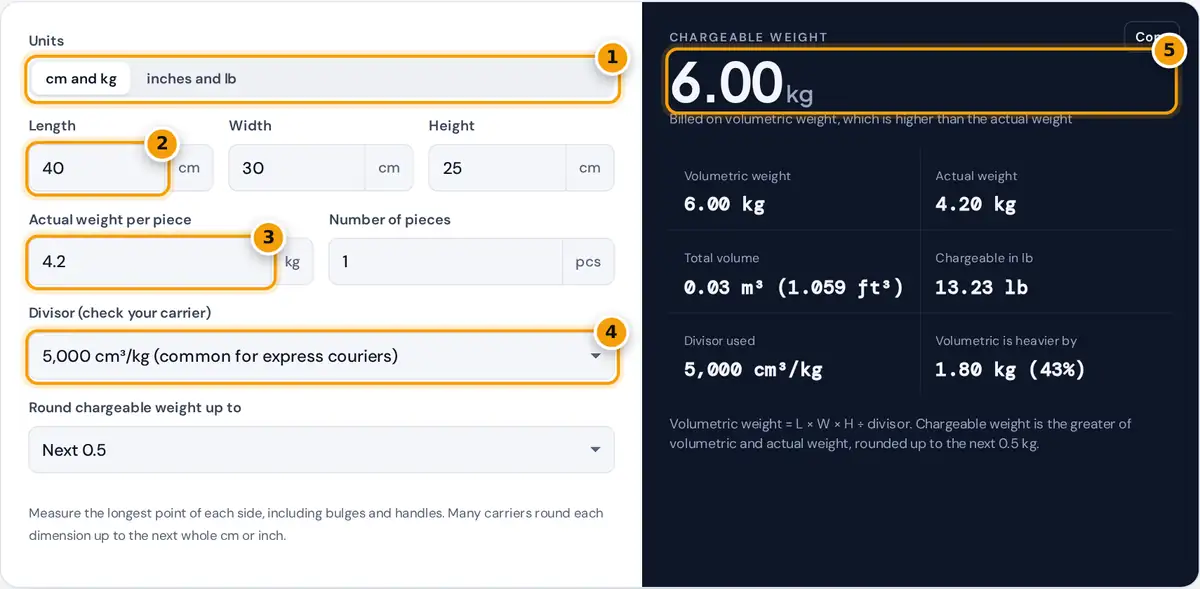
- Choose cm and kg or inches and lb.
- Enter the length, width and height of the box at its widest points.
- Enter the actual weight per piece and the number of identical pieces.
- Pick the divisor your carrier uses, or choose a custom divisor.
- Read the chargeable weight, with volumetric weight, actual weight and volume.
Choose metric (centimeters and kilograms) or imperial (inches and pounds). Enter the length, width and height of the package, its actual weight and the number of identical pieces. Then pick the divisor your carrier uses, or choose Custom divisor and type the figure from your carrier’s rate guide.
The result shows the chargeable weight, which is the figure most couriers and airlines bill on, plus the volumetric weight, the actual weight, the total volume in cubic meters and cubic feet, and how much heavier one weight is than the other. Choose a rounding rule to match your carrier, since many round up to the next half kilogram or whole pound.
What Volumetric Weight Is
Volumetric weight, also called dimensional weight or DIM weight, is a pricing weight based on the space a parcel takes up in a van, container or aircraft hold. A large box of pillows weighs little but fills as much space as a box of books. Carriers charge for whichever is greater, the real weight or the volumetric weight, so light but bulky shipments pay for their size.
Volumetric weight (lb) = L (in) × W (in) × H (in) ÷ divisor
Chargeable weight = the greater of actual weight and volumetric weight
Common Divisors
The divisor is set by each carrier and service, and it can change, so treat the presets as starting points and confirm the figure in your carrier’s current rate guide or account terms.
| Divisor | Units | Where it is commonly used |
|---|---|---|
| 5,000 | cm³ per kg | International express and many courier services |
| 6,000 | cm³ per kg | Air freight and some domestic services |
| 4,000 | cm³ per kg | Some road and economy services |
| 1,000 | cm³ per kg | Sea freight (1 m³ is treated as 1,000 kg) |
| 139 | in³ per lb | Common for US parcel services |
| 166 | in³ per lb | Some retail and domestic rates |
A smaller divisor produces a higher volumetric weight, so a divisor of 4,000 is less favorable to the shipper than 6,000.
Worked Example
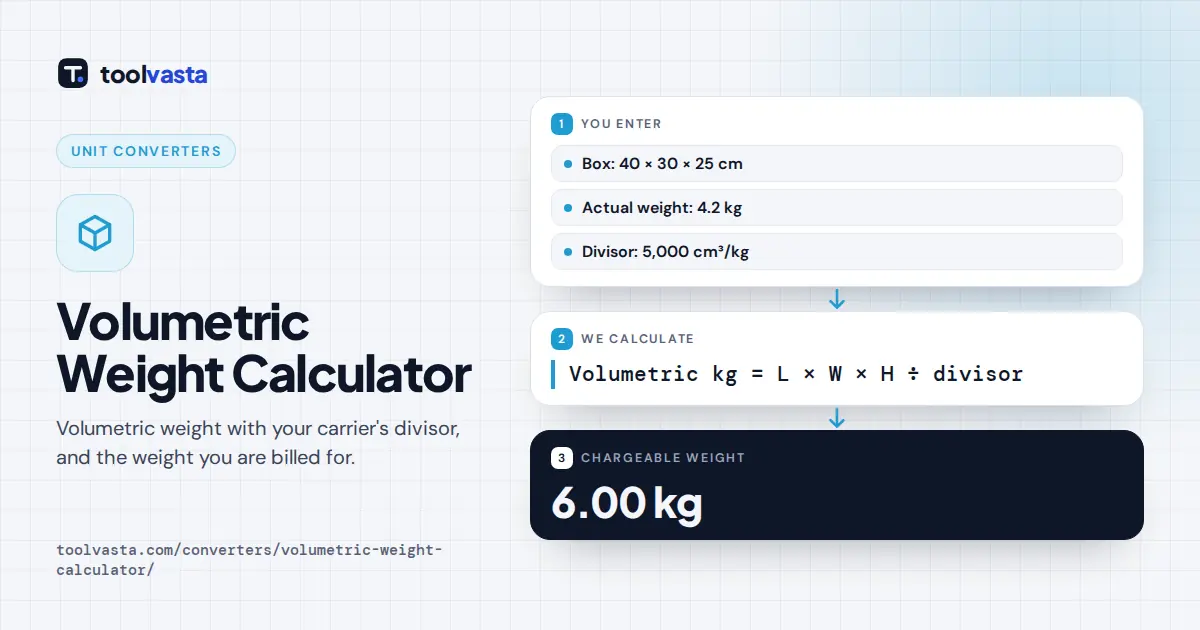
A box measures 40 × 30 × 25 cm and weighs 4.2 kg. Its volume is 30,000 cm³, or 0.03 m³. With a divisor of 5,000 the volumetric weight is 30,000 ÷ 5,000 = 6 kg. That is 1.8 kg more than the actual weight, so the chargeable weight is 6 kg. With a divisor of 6,000 it would be 5 kg.
In imperial units, a 16 × 12 × 10 inch box has a volume of 1,920 in³. Divided by 139 that is 13.81 lb, which rounds up to 14 lb when the carrier bills in whole pounds. If the box weighs 9 lb on the scale, you pay for 14 lb.
How to Lower Volumetric Weight
- Use the smallest box that protects the item. Removing 5 cm from each side of the 40 × 30 × 25 cm box cuts the volume from 30,000 to 14,000 cm³ and the volumetric weight from 6 kg to 2.8 kg at a divisor of 5,000.
- Replace loose fill with fitted inserts so the box can be smaller.
- Ship soft goods such as clothing in poly mailers, which compress to their contents.
- Combine several small items into one carton only if the combined box is not mostly empty space.
Things to Check With Your Carrier
Carriers differ in how they measure and round. Some round each dimension to the nearest or next whole unit before multiplying, some round the final weight to the next 0.5 kg or whole pound, and some apply volumetric pricing only above a certain package size. Pallets, irregular shapes and oversize items may have separate rules and surcharges. This calculator gives the standard calculation; your invoice follows the carrier’s published terms.
Frequently asked questions
How do I calculate volumetric weight?
Multiply length, width and height, then divide by your carrier's divisor. In centimeters with a divisor of 5,000, a 40 by 30 by 25 cm box has a volumetric weight of 30,000 divided by 5,000, which is 6 kg.
What is chargeable weight?
Chargeable weight is the weight a carrier bills you for. It is the greater of the actual weight on the scale and the volumetric weight. A 4.2 kg box with a 6 kg volumetric weight is billed at 6 kg.
Is the divisor 5000 or 6000?
It depends on the carrier and service. Express couriers commonly use 5,000 cubic centimeters per kilogram and air freight commonly uses 6,000. Check your carrier's current rate guide, because divisors can change.
What divisor is used for inches and pounds?
A divisor of 139 cubic inches per pound is common for US parcel services, with 166 used for some services. A 16 by 12 by 10 inch box divided by 139 gives a dimensional weight of 13.81 lb.
Is dimensional weight the same as volumetric weight?
Yes. Dimensional weight, DIM weight and volumetric weight all describe the same idea: a billing weight based on package size. North American carriers often say dimensional weight, while international couriers often say volumetric.
How is sea freight volume charged?
Less than container load sea freight is often priced per cubic meter or per 1,000 kg, whichever is greater. That equals a divisor of 1,000 cubic centimeters per kilogram, which you can select in the calculator.