How to Use the Amps to kW Converter
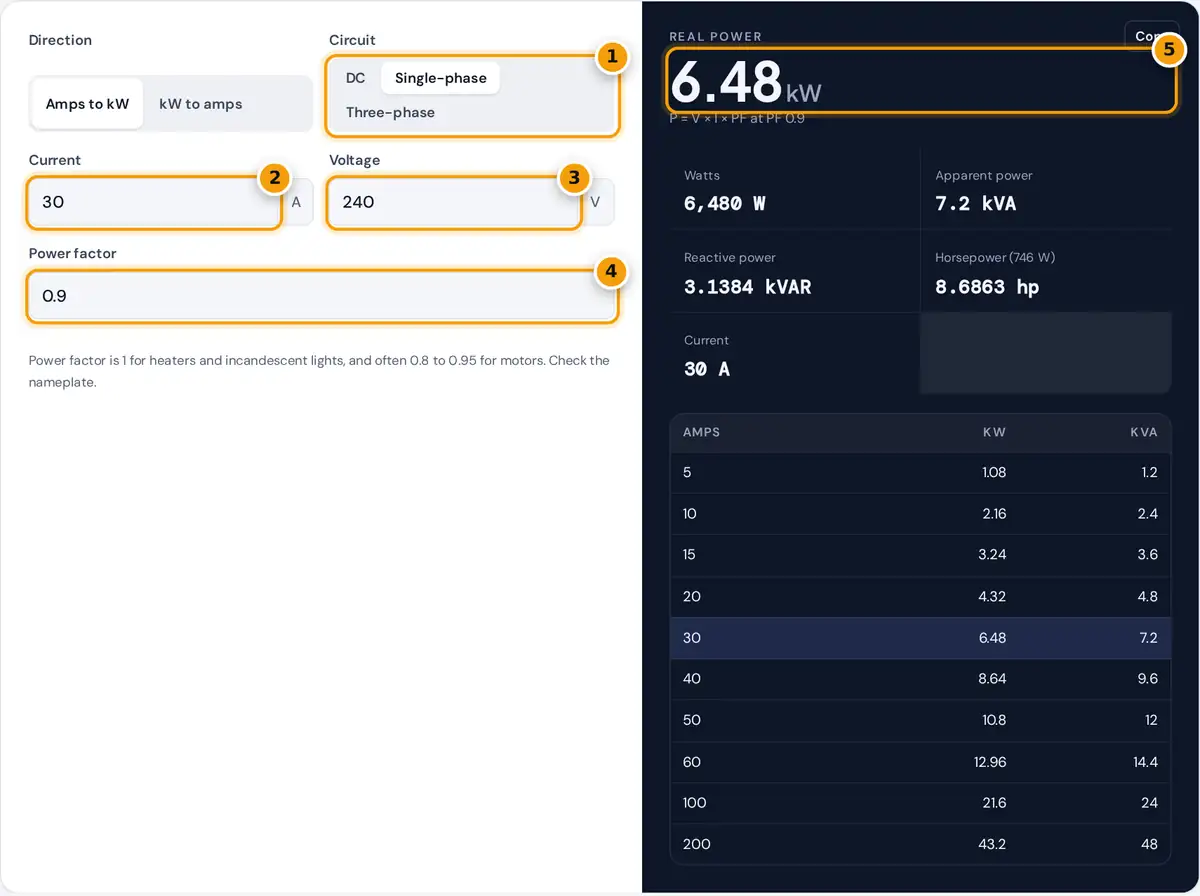
- Choose DC, single-phase or three-phase.
- Enter the current in amps, or switch direction to enter kW.
- Enter the voltage, such as 120, 240, 208 or 480 V.
- Set the power factor: 1 for heaters, about 0.8 to 0.9 for motors.
- Read the power in kW, with kVA, kVAR, watts and horsepower below.
Choose the circuit type first. DC covers batteries, solar strings and vehicle systems. Single-phase covers household circuits such as 120 V and 240 V in Canada and the US, or 230 V in Europe. Three-phase covers commercial and industrial supplies such as 208 V, 400 V, 480 V and 600 V. Then enter the current, the voltage and the power factor of the load.
For three-phase systems, say whether your voltage is measured line to line (the usual nameplate figure, such as 480 V) or line to neutral (such as 277 V on a 480 V system). Switch the direction to kW to amps to find the current a load will draw. The table below the result repeats the calculation for common currents at your settings.
Amps to kW Formulas
Real power in kilowatts depends on the voltage, the current and, for AC circuits, the power factor, which is the share of the current that does useful work.
Single-phase AC: kW = V × I × PF ÷ 1,000
Three-phase AC (line to line): kW = √3 × V × I × PF ÷ 1,000
Three-phase AC (line to neutral): kW = 3 × V × I × PF ÷ 1,000
kVA = kW ÷ PF
To go from kW to amps, rearrange: I = kW × 1,000 ÷ (V × PF), with √3 or 3 in the divisor for three-phase.
Worked Examples
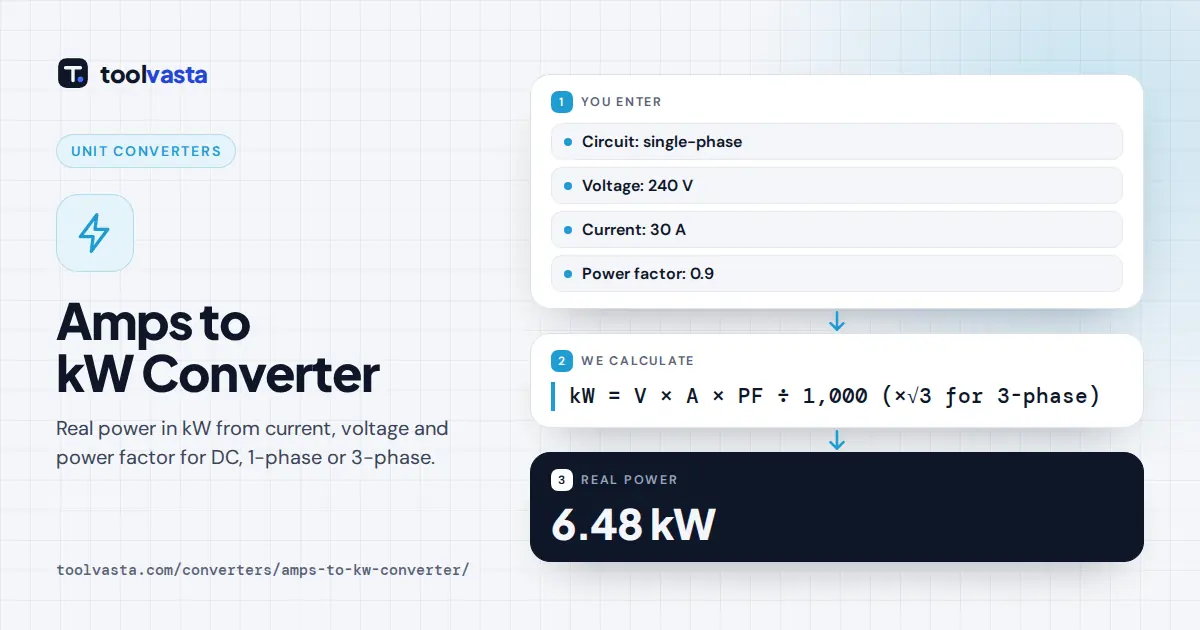
Single-phase. A 30 A load on a 240 V circuit with a power factor of 0.9 uses 240 × 30 × 0.9 ÷ 1,000 = 6.48 kW. Its apparent power is 240 × 30 ÷ 1,000 = 7.2 kVA.
Three-phase. A motor drawing 100 A per line on a 480 V three-phase supply at PF 0.85 uses 1.7321 × 480 × 100 × 0.85 ÷ 1,000 = 70.67 kW, or 83.14 kVA.
DC. A 48 V battery bank supplying 50 A delivers 48 × 50 ÷ 1,000 = 2.4 kW.
Amps to kW Table
Values at power factor 1. Multiply by your power factor for inductive loads.
| Amps | 120 V 1-phase | 240 V 1-phase | 208 V 3-phase | 480 V 3-phase | 600 V 3-phase |
|---|---|---|---|---|---|
| 10 | 1.2 kW | 2.4 kW | 3.6 kW | 8.31 kW | 10.39 kW |
| 15 | 1.8 kW | 3.6 kW | 5.4 kW | 12.47 kW | 15.59 kW |
| 20 | 2.4 kW | 4.8 kW | 7.21 kW | 16.63 kW | 20.78 kW |
| 30 | 3.6 kW | 7.2 kW | 10.81 kW | 24.94 kW | 31.18 kW |
| 50 | 6 kW | 12 kW | 18.01 kW | 41.57 kW | 51.96 kW |
| 100 | 12 kW | 24 kW | 36.03 kW | 83.14 kW | 103.92 kW |
| 200 | 24 kW | 48 kW | 72.05 kW | 166.28 kW | 207.85 kW |
What Power Factor to Use
Resistive loads such as baseboard heaters, kettles, water heater elements and incandescent bulbs have a power factor of 1, so kW equals kVA. Induction motors, compressors, transformers and some LED drivers draw extra reactive current, which lowers the power factor. A motor nameplate often lists the value at full load. If you only know the apparent power, size cables and breakers from kVA and amps, not from kW.
Limits
- The formulas assume a balanced three-phase load, where each line carries the same current.
- Horsepower uses the electrical definition of 746 W. Motor output is lower than electrical input because of efficiency losses.
- This is a conversion tool, not a design tool. Breaker sizing, conductor sizing and continuous load rules come from the Canadian Electrical Code or the NEC, so ask a licensed electrician for real installations.
Single-Phase or Three-Phase?
Homes in Canada and the US are normally fed by a single-phase 120/240 V service: lights and outlets use 120 V, and large appliances such as ranges, dryers and EV chargers use 240 V. Commercial buildings often have three-phase 120/208 V, and industrial sites use 277/480 V or, in Canada, 347/600 V. The higher number in each pair is the line-to-line voltage and the lower one is line to neutral. A three-phase supply delivers the same power with less current per conductor, which is why large motors and heaters are usually three-phase.
Frequently asked questions
How do I convert amps to kW?
Multiply volts by amps and by the power factor, then divide by 1,000. For three-phase, also multiply by 1.732. For example, 30 A at 240 V single-phase with a power factor of 0.9 is 6.48 kW.
How many kW is 100 amps at 480 volts three-phase?
At a power factor of 1 it is 1.732 times 480 times 100 divided by 1,000, which is 83.14 kW. At a power factor of 0.85 the real power falls to about 70.67 kW.
How many amps is 10 kW?
It depends on the voltage. At 240 V single-phase with a power factor of 1 it is about 41.7 A. At 208 V three-phase it is about 27.8 A, and at 600 V three-phase about 9.6 A.
What is the difference between kW and kVA?
kW is real power that does useful work. kVA is apparent power, voltage times current, which includes reactive power. They are equal only when the power factor is 1. kVA equals kW divided by power factor.
Why multiply by the square root of 3 for three-phase?
In a three-phase system the line-to-line voltage is the square root of 3 times the line-to-neutral voltage. Total power is three times the per-phase power, which simplifies to 1.732 times line-to-line voltage times current.
What power factor should I use if I do not know it?
Use 1 for heaters, kettles and other resistive loads. For motors, the nameplate usually lists the full-load value, often 0.8 to 0.9. If unknown, size equipment using kVA rather than kW to stay safe.