How to Use the CFM to m³/h Converter
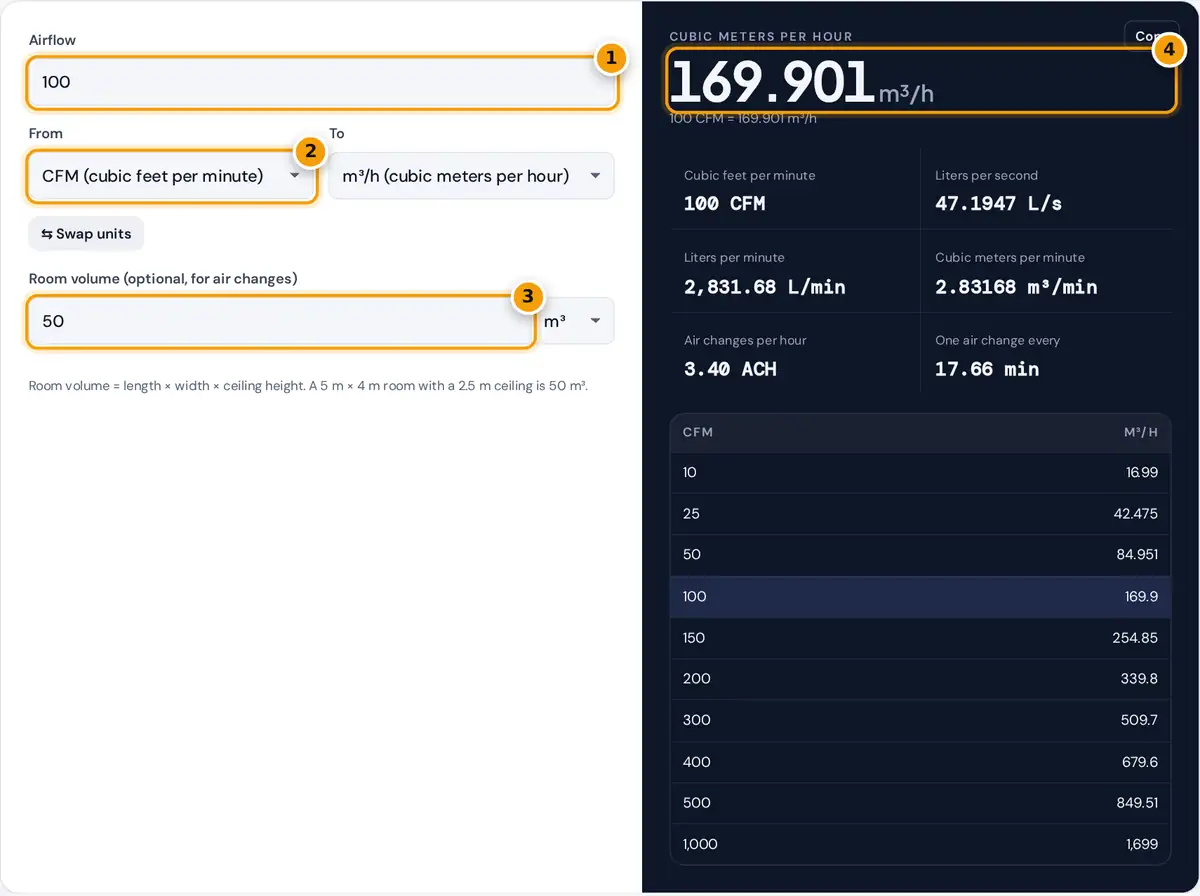
- Type the airflow rating from the fan, hood or purifier.
- Choose its unit, such as CFM.
- Optionally enter the room volume to get air changes per hour.
- Read the airflow in m³/h, with L/s, L/min and ACH below.
Type an airflow value and choose its unit under From, then pick the unit you need under To. North American fans, range hoods and furnaces are rated in CFM, while European and Asian equipment usually lists m³/h, and ventilation codes often use liters per second. The result shows your chosen unit in large type with the others underneath, plus a table of common airflow values.
Enter the room volume to turn airflow into air changes per hour (ACH), the number of times the fan moves a volume of air equal to the whole room each hour. Leave the box empty if you only need the unit conversion.
CFM to m³/h Formula
One cubic foot is exactly 0.028316846592 m³, since the foot is defined as 0.3048 m. An hour has 60 minutes, so the factor between CFM and m³/h is exact.
CFM = m³/h ÷ 1.6990108 = m³/h × 0.5885778
L/s = CFM × 0.4719474
ACH = airflow (m³/h) ÷ room volume (m³)
Worked Example
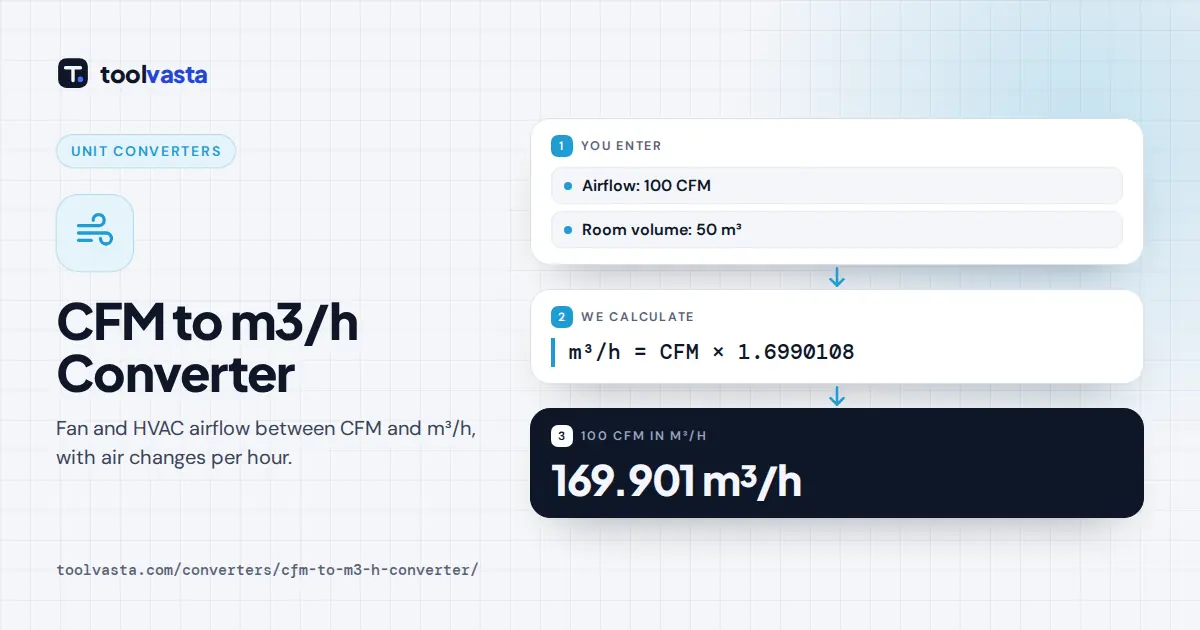
A bathroom fan rated at 100 CFM moves 100 × 1.6990108 = 169.90 m³/h, or 47.19 L/s. In a 50 m³ room that is 169.90 ÷ 50 = 3.40 air changes per hour, one complete change about every 17.7 minutes. Going the other way, a European range hood rated at 600 m³/h moves 600 ÷ 1.6990108 = 353.15 CFM.
CFM to m³/h Table
| CFM | m³/h | L/s | m³/min |
|---|---|---|---|
| 50 | 84.95 | 23.60 | 1.416 |
| 80 | 135.92 | 37.76 | 2.265 |
| 100 | 169.90 | 47.19 | 2.832 |
| 150 | 254.85 | 70.79 | 4.248 |
| 200 | 339.80 | 94.39 | 5.663 |
| 300 | 509.70 | 141.58 | 8.495 |
| 400 | 679.60 | 188.78 | 11.327 |
| 500 | 849.51 | 235.97 | 14.158 |
| 1,000 | 1,699.01 | 471.95 | 28.317 |
| 2,000 | 3,398.02 | 943.89 | 56.634 |
Understanding Air Changes per Hour
ACH is a simple way to compare ventilation or filtration across rooms of different sizes. It assumes the incoming air mixes fully, so the real dilution of smoke, steam or airborne particles is lower than the number suggests. For air purifiers, manufacturers often quote a clean air delivery rate (CADR) in CFM; convert it here and divide by your room volume to compare models. Recommended ACH values depend on the room and on local building codes, so check the code or standard that applies to your project.
Tips and Limits
- Fan ratings are measured at a stated static pressure. Long or narrow ducts reduce the real airflow, sometimes by a third or more.
- For a range hood, check the rating at the speed you will actually use, not only at maximum.
- Standard CFM (SCFM) for compressed air refers to air at reference conditions. This tool converts volume flow at the same conditions and does not correct for pressure or temperature.
- For room volume in cubic feet, multiply length, width and height in feet, then choose cu ft.
Sizing a Fan from Room Volume
To choose a fan or air purifier, start from the air changes per hour you want and work backward. The airflow you need equals the room volume times the target ACH, divided by 60 for CFM or used directly for m³/h.
m³/h needed = room volume (m³) × ACH
For a 12 ft by 10 ft room with an 8 ft ceiling, the volume is 960 cubic feet. At 5 air changes per hour you need 960 × 5 ÷ 60 = 80 CFM, which is about 136 m³/h. Required ventilation rates for bathrooms, kitchens and occupied spaces are set by building codes and standards, so use those figures where they apply and treat ACH as a planning tool.
As a quick check, remember that 1 m³/h is about 0.59 CFM and 1 CFM is about 1.7 m³/h. Fans sold in Canada often list both values on the box, so the converter helps when only one is shown or when comparing models from different markets.
Frequently asked questions
How do I convert CFM to m³/h?
Multiply cubic feet per minute by 1.6990108. For example, 100 CFM is about 169.9 m³/h. The factor comes from one cubic foot being exactly 0.028316846592 cubic meters, multiplied by 60 minutes in an hour.
How do I convert m³/h to CFM?
Divide cubic meters per hour by 1.6990108, or multiply by 0.5885778. A range hood rated at 600 m³/h moves about 353 CFM, and a 300 m³/h fan moves about 176.6 CFM.
How many L/s is 1 CFM?
One CFM is about 0.4719 liters per second, and one liter per second is about 2.1189 CFM. Building ventilation rates in Canada are often given in L/s, so this conversion is common in HVAC work.
What are air changes per hour?
Air changes per hour, or ACH, is the airflow per hour divided by the room volume. It tells you how many times a room's volume of air passes through the fan or purifier each hour.
How many CFM do I need for a room?
Multiply the room volume in cubic feet by the target air changes per hour and divide by 60. For a 1,500 cubic foot room at 4 ACH you need about 100 CFM. Check local codes for required rates.
Does duct length affect CFM?
Yes. Fans are rated at a specific static pressure, and every meter of duct, bend and grille adds resistance. Long or narrow runs can cut real airflow significantly below the rated CFM, so size the fan with some margin.