How to Use the Knots to MPH Converter
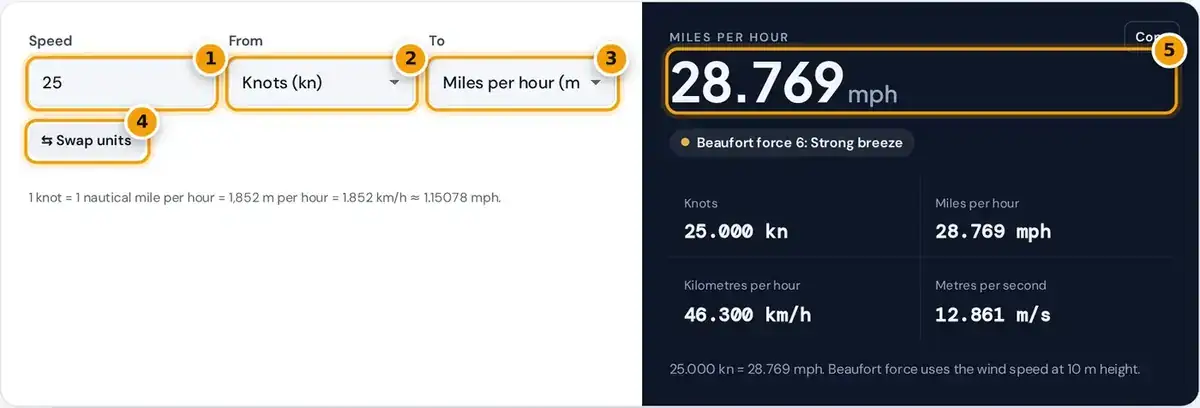
- Enter the speed you want to convert.
- Choose the unit you are converting from, such as knots.
- Choose the unit you want, such as miles per hour.
- Tap Swap units to convert mph to knots instead.
- Read the result, plus km/h, m/s and the Beaufort wind force.
Type a speed into the first box. The converter starts on knots to mph, so a value such as 25 knots instantly shows 28.769 miles per hour, with every other unit listed neatly underneath it.
Use the From and To menus to pick knots, miles per hour, kilometers per hour or meters per second. The swap units button flips the direction, which turns it into an mph to knots converter.
A badge names the Beaufort force for the speed entered, which helps when reading a wind forecast. Press copy to grab the full result line, ready to paste into a log, message or trip plan.
The Knots to MPH Formula
A knot is one nautical mile per hour. The international nautical mile is exactly 1,852 meters, while the statute mile used on roads is exactly 1,609.344 meters, so the two units differ by about 15%.
km/h = knots × 1.852
m/s = knots × 0.514444
Dividing 1,852 by 1,609.344 gives the conversion factor 1.150779. Because both lengths are exact by definition, the factor is exact too, and any tiny error you might see comes only from rounding the displayed result.
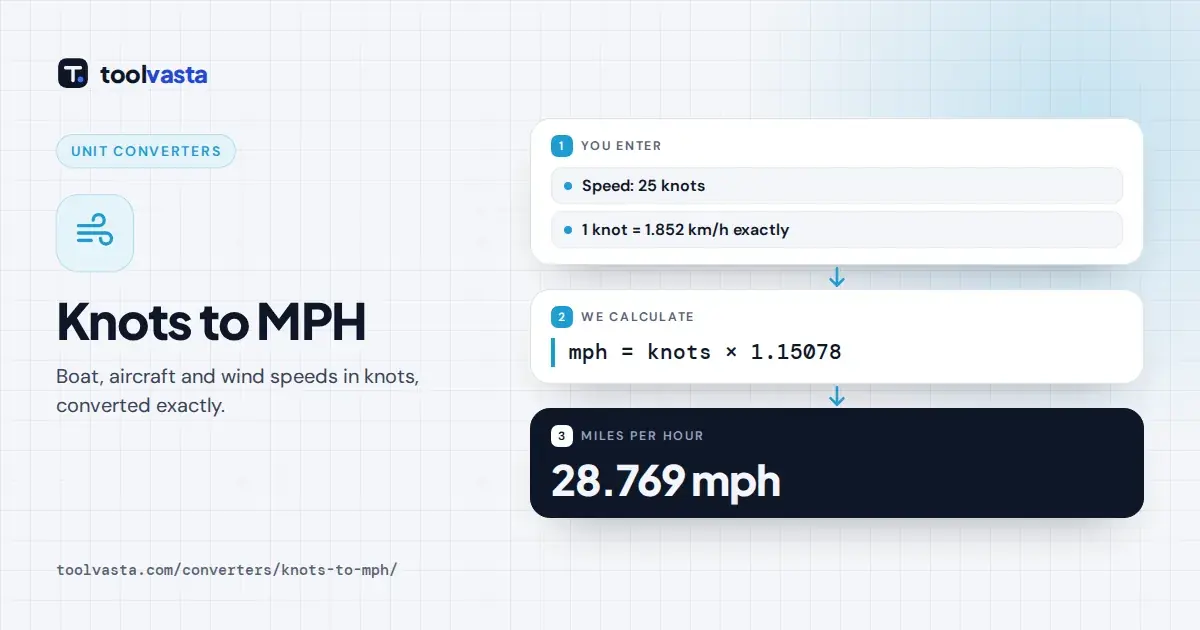
Example: a 25 knot sailing forecast is 25 × 1.150779 = 28.769 mph, or 46.3 km/h, or 12.861 m/s. The converter also labels that wind speed as Beaufort force 6, a strong breeze, on its colored badge.
How to Convert MPH to Knots
For mph to knots, divide by 1.150779, or multiply by 0.868976, which is the same thing. A car traveling at 60 mph is moving at 52.139 knots, a smaller number since each knot is longer.
For km/h to knots, divide by 1.852. So 100 km/h is 53.996 knots, which is just under 54 knots. To go from meters per second to knots, divide by 0.514444, or multiply by roughly 1.944.
Pick the unit you have in the From menu and knots in the To menu, and the converter handles the division for you. All four units update together, so one entry gives the complete picture.
Knots Conversion Table
This conversion table covers common boating, wind and aviation speeds. Values are rounded to three decimals, the same precision the converter displays, and every single row was calculated directly from the exact 1.852 km/h definition.
| Knots | mph | km/h | m/s |
|---|---|---|---|
| 1 | 1.151 | 1.852 | 0.514 |
| 5 | 5.754 | 9.26 | 2.572 |
| 10 | 11.508 | 18.52 | 5.144 |
| 15 | 17.262 | 27.78 | 7.717 |
| 20 | 23.016 | 37.04 | 10.289 |
| 30 | 34.523 | 55.56 | 15.433 |
| 50 | 57.539 | 92.6 | 25.722 |
| 100 | 115.078 | 185.2 | 51.444 |
| 250 | 287.695 | 463 | 128.611 |
A few rows are worth remembering. 20 knots, a typical cruise ship speed, is about 23 mph. 30 knots is about 34.5 mph, and 100 knots is 115 mph, a figure worth knowing in aviation.
For any value not listed, type it into the converter above. It accepts decimals, so 12.5 knots or 0.8 knots of current work just as well as whole numbers, and negative speeds are simply rejected.
Knots and the Beaufort Wind Scale
The Beaufort scale groups wind speed in knots into forces from 0 to 12. The converter uses the same bands as the Met Office Beaufort guide, with wind measured at 10 m height above ground.
| Force | Knots | Description |
|---|---|---|
| 0 | Under 1 | Calm |
| 3 | 7 to 10 | Gentle breeze |
| 5 | 17 to 21 | Fresh breeze |
| 6 | 22 to 27 | Strong breeze |
| 7 | 28 to 33 | Near gale |
| 8 | 34 to 40 | Gale |
| 10 | 48 to 55 | Storm |
| 12 | 64 and above | Hurricane force |
Force 6, a strong breeze, starts at 22 knots, about 25 mph. Force 7, a near gale, begins at 28 knots, and gale force 8 covers 34 to 40 knots, roughly 39 to 46 mph.
Hurricane force starts at 64 knots, about 74 mph. The badge turns amber from force 6 and red from force 8, a visual warning when you check a marine or coastal forecast before heading out.
Why Ships and Aircraft Use Knots
A nautical mile equals one minute of latitude, so navigators can measure distance straight from the side scale of nautical charts. Speed in knots then converts directly to distance per hour without any extra arithmetic.
The name comes from the chip log. Sailors let out a line with knots tied at regular intervals and counted how many passed during a timed sand glass. Saying knots per hour is therefore incorrect.
Aviation adopted the same unit, so airspeed, wind aloft and runway winds are given in knots worldwide. The NIST guide to SI units lists the knot among the units accepted for navigation alongside the SI.
Where You See Knots
Marine forecasts in Canada, the US and the UK give wind speed in knots, while public forecasts for land usually use km/h or mph. Recreational boaters therefore convert between units often, especially near the coast.
In aviation, METAR and TAF weather reports give wind in knots, and pilots read airspeed in knots. Tidal streams and ocean currents are also given in knots on charts and in pilot books and almanacs.
Boat speed on a GPS or chartplotter is usually set to knots, and some waterways post limits in knots. A cruise ship usually sails at about 20 to 22 knots, or 23 to 25 mph.
Rounding and Quick Mental Math
The converter keeps full precision internally and shows three decimals, switching to one decimal above 1,000. Because every factor is exact, rounding the displayed result is the only possible source of any difference you notice.
For mental math, a rule of thumb is to add 15% to knots to get mph. For km/h, double the knots and subtract about 7%. For meters per second, you can simply halve the knots.
A nautical mile is about 6,076 feet, compared with 5,280 feet in a statute mile. That gap explains why a 35 knot wind, about 40 mph, is stronger than it might first sound to drivers.
Frequently asked questions
How many mph is 1 knot?
One knot is about 1.150779 mph. The exact value is 1.852 divided by 1.609344, because a nautical mile is 1,852 meters and a statute mile is 1,609.344 meters.
Is a knot faster than a mile per hour?
Yes. A knot is about 15% faster than one mile per hour, because a nautical mile of 1,852 meters is longer than a statute mile of 1,609.344 meters.
How do I convert knots to km/h?
Multiply by 1.852. This factor is exact because a nautical mile is defined as 1,852 meters, so 20 knots is exactly 37.04 km/h and 30 knots is exactly 55.56 km/h.
What is 30 knots in mph?
30 knots is about 34.52 mph, or 55.56 km/h. On the Beaufort scale that wind speed is force 7, a near gale, which is rough for small boats.
Why is it called a knot?
Sailors once measured speed with a chip log: a rope with knots tied at regular intervals, let out behind the ship while a sand glass ran. The number of knots that passed gave the speed.
How do I convert wind speed from knots to mph?
Multiply the wind speed in knots by 1.150779, or roughly add 15%. A 20 knot wind is about 23 mph, and a 40 knot gale is about 46 mph.