How to Use the Cubic Feet Calculator
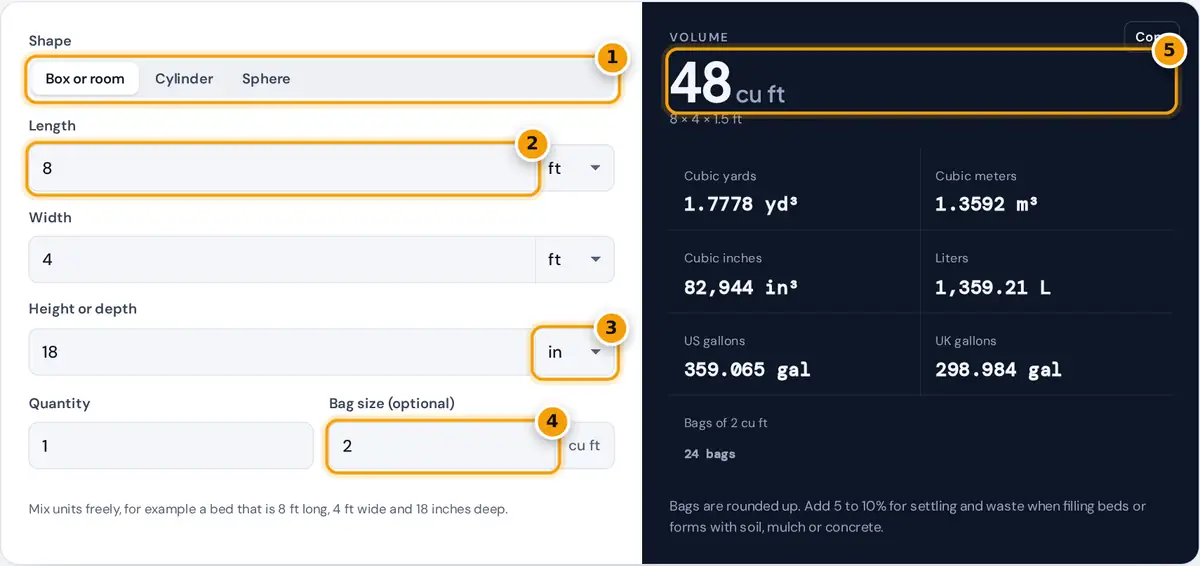
- Pick the shape: box or room, cylinder, or sphere.
- Enter the length and choose its unit from the menu beside it.
- Set each dimension's unit separately, for example inches for the depth.
- Optionally enter the bag size to see how many bags of soil or mulch to buy.
- Read the volume in cubic feet, with cubic yards, m³, liters and gallons below.
Choose a shape: Box or room for anything with straight sides, Cylinder for round tanks, pipes, tubes and post holes, or Sphere for balls and round vessels. Type each measurement and pick its unit from the menu next to it. Every dimension can use a different unit, so a garden bed measured as 8 ft by 4 ft by 18 inches needs no manual conversion.
Set Quantity if you have several identical items, such as six planters or twelve boxes. Enter the bag size printed on a bag of soil, mulch or gravel and the tool tells you how many bags to buy, rounded up.
Cubic Feet Formulas
All measurements are first converted to feet using exact definitions: 1 inch = 1/12 ft, 1 yard = 3 ft, and 1 ft = 0.3048 m exactly, so 1 m = 3.28084 ft.
Cylinder: cu ft = π × radius² × height
Sphere: cu ft = 4/3 × π × radius³
cu ft from inches = (L × W × H in inches) ÷ 1,728
Worked Example
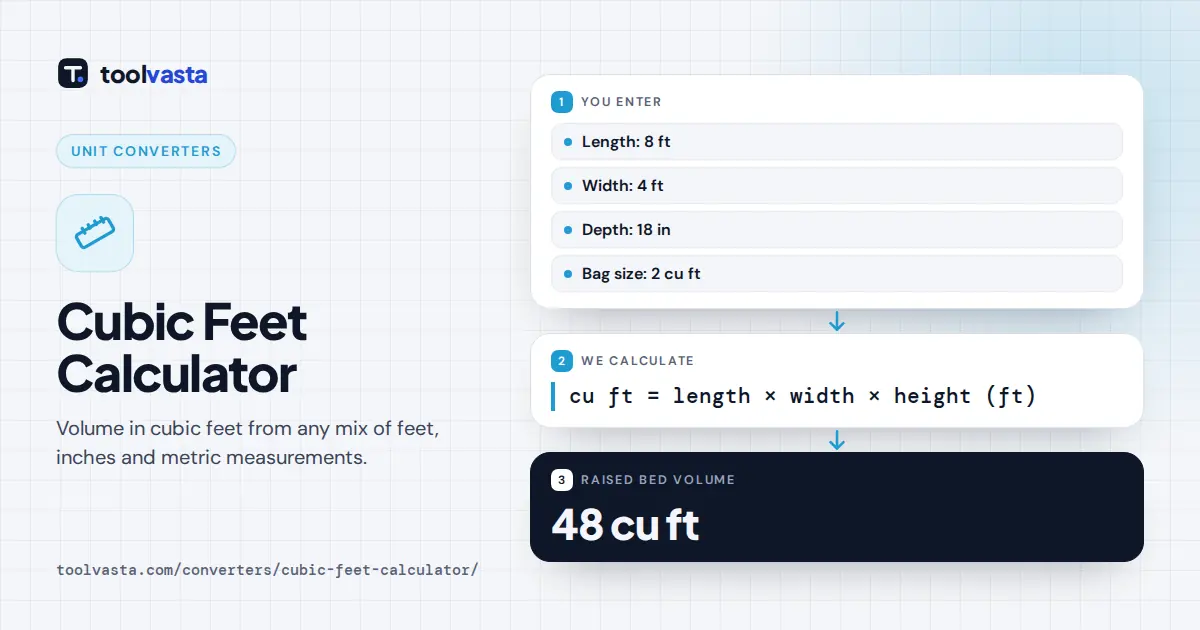
A raised garden bed is 8 ft long, 4 ft wide and 18 inches deep. 18 inches is 1.5 ft, so the volume is 8 × 4 × 1.5 = 48 cubic feet. That equals 48 ÷ 27 = 1.778 cubic yards, or 48 × 0.0283168 = 1.359 m³. Bagged soil sold in 2 cu ft bags would need 24 bags.
A round water tank 3 ft across and 4 ft tall holds π × 1.5² × 4 = 28.274 cu ft, which is 211.5 US gallons.
Cubic Feet Conversion Table
| Cubic feet | Cubic yards | Cubic meters | Liters | US gallons |
|---|---|---|---|---|
| 1 | 0.037 | 0.0283 | 28.317 | 7.481 |
| 2 | 0.074 | 0.0566 | 56.634 | 14.961 |
| 10 | 0.370 | 0.2832 | 283.17 | 74.805 |
| 27 | 1 | 0.7646 | 764.55 | 201.97 |
| 35.315 | 1.308 | 1 | 1,000 | 264.17 |
| 100 | 3.704 | 2.8317 | 2,831.7 | 748.05 |
Common Uses
- Soil, mulch and compost: bags are sold by the cubic foot in Canada and the US, while bulk deliveries are priced by the cubic yard.
- Moving and storage: truck and storage unit capacity is often quoted in cubic feet.
- Appliances: refrigerators, freezers and washers list their capacity in cu ft.
- Shipping: carriers use box volume to check dimensional weight. Measure the outside of the box.
- Heating and air flow: a room’s cubic feet is the starting point for sizing a fan or air purifier in CFM.
Tips for Accurate Results
- Measure inside dimensions for capacity (how much fits in) and outside dimensions for space taken up.
- For an irregular space, split it into boxes, calculate each one and add the results.
- Loose materials settle. Order 5 to 10% extra soil or mulch, and more for compacted gravel.
- A gallon here is the US liquid gallon of 231 cubic inches. The UK gallon is larger at 4.54609 liters.
Rooms, Appliances and Irregular Shapes
To find the cubic feet of a room, multiply the floor length by the width and by the ceiling height. A bedroom 12 ft by 10 ft with an 8 ft ceiling holds 960 cubic feet, a figure used when choosing an air purifier, dehumidifier or bathroom fan. For an L-shaped room, split it into two boxes and add them. A sloped ceiling or a wedge-shaped bed can be treated as a box using the average height, which gives the same answer as the exact prism formula when the slope is straight.
Capacity labels on freezers and fridges are measured inside the cabinet, so they include shelves and door bins. Because cubic measurements grow with the cube of the length, small measuring errors add up: being 1 inch off on each side of a 2 ft box changes the volume by roughly 13%. Measure twice, in the same place each time, and round only the final answer.
For shipping, carriers in Canada and the US round each box dimension to the nearest whole inch before calculating.
Frequently asked questions
How do I calculate cubic feet?
Multiply length by width by height, with all three measured in feet. A box 3 ft by 2 ft by 2 ft holds 12 cubic feet. If you measured in inches, multiply the three numbers and divide by 1,728.
How many cubic feet are in a cubic yard?
There are exactly 27 cubic feet in one cubic yard, because a yard is 3 feet and 3 × 3 × 3 = 27. Divide cubic feet by 27 to get cubic yards for bulk soil or concrete orders.
How do I convert inches to cubic feet?
Multiply length, width and height in inches, then divide by 1,728, the number of cubic inches in a cubic foot. A box 24 by 18 by 12 inches is 5,184 cubic inches, or 3 cubic feet.
How many gallons are in a cubic foot?
One cubic foot holds about 7.48 US gallons, since a US gallon is exactly 231 cubic inches and a cubic foot is 1,728 cubic inches. It holds about 6.23 UK gallons or 28.32 liters.
How many bags of soil do I need?
Find the bed volume in cubic feet and divide by the bag size printed on the bag, then round up. A 48 cubic foot bed needs 24 bags of 2 cubic feet, plus a few extra for settling.
How do I find the cubic feet of a cylinder?
Multiply pi by the radius squared and by the height, all in feet. A tank 3 ft across has a radius of 1.5 ft, so at 4 ft tall it holds about 28.27 cubic feet.