How to Use the Bar to PSI Converter
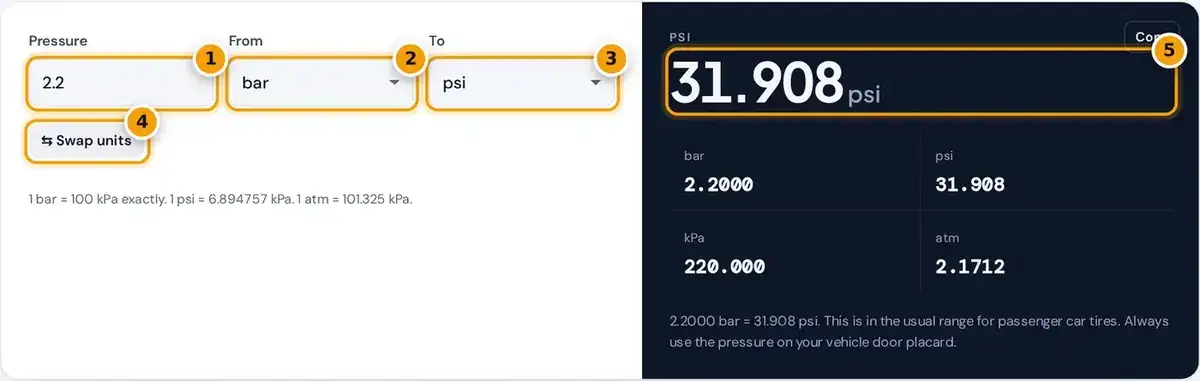
- Enter the pressure reading you want to convert.
- Choose the unit you are converting from, such as bar.
- Choose the unit you want, such as psi.
- Tap Swap units to convert psi to bar instead.
- Read the result, with bar, psi, kPa and atm listed together.
Type a pressure value into the box, then choose the unit you are converting from and the unit you want. The converter handles bar, psi, kPa, MPa and atm, and it updates as you type.
The large figure shows the result in your chosen unit, while the panel below lists the same pressure in bar, psi, kPa and atm at once. That makes comparing a placard with a gauge easy.
Press swap units to reverse a bar to psi conversion into psi to bar. The copy button places the full line, such as 2.2 bar = 31.91 psi, on your clipboard for notes, forms or messages.
The Bar to PSI Formula
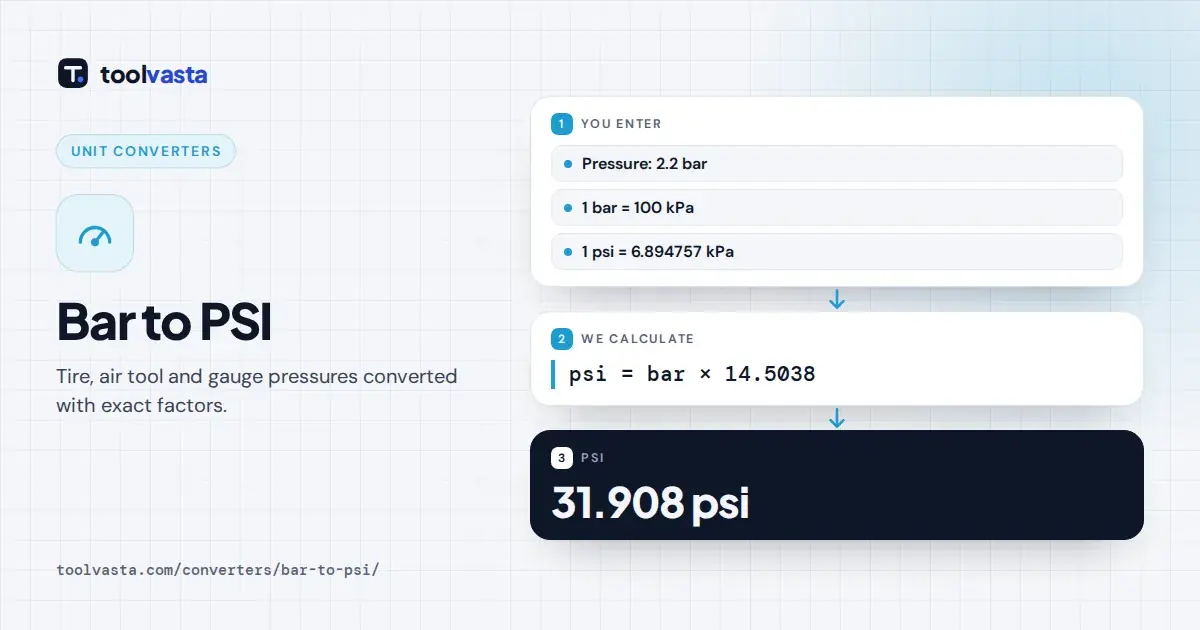
One bar is defined as exactly 100,000 pascals. One pound-force per square inch is 6,894.757 pascals, so dividing one by the other gives the standard conversion factor of 14.5037738 psi in every bar of pressure.
bar = psi ÷ 14.5037738 = psi × 0.0689476
kPa = bar × 100 atm = bar ÷ 1.01325
To convert bar to psi, multiply by 14.5037738. To go the other way, from psi to bar, divide by the same number, or multiply by 0.0689476, which is the number of bar in one psi.
For quick mental maths, 14.5 is close enough for most tire and tool readings. The error from that rounding is under 0.03%, which is far smaller than the accuracy of a typical handheld pressure gauge.
Worked Examples
A European car owner's manual might list 2.2 bar for the front tires. To find the psi value, multiply 2.2 by 14.5037738, which equals 31.91 psi, or 220 kPa on a typical Canadian door label.
Going the other way, a North American gauge reading of 32 psi divided by 14.5037738 equals 2.206 bar. That is close enough to 2.2 bar that the two settings are effectively the same in practice.
At higher pressures exactly the same factor applies. For example, 45 bar is 45 times 14.5037738, or about 652.67 psi, a figure you might see on hydraulic fittings or on a small industrial air compressor.
Tire Pressure Conversion Chart
This conversion chart covers the usual range for passenger cars and light trucks. Values are rounded to one decimal place in psi, which is already finer than most handheld tire gauges can actually display clearly.
| bar | psi | kPa |
|---|---|---|
| 1.8 | 26.1 | 180 |
| 2.0 | 29.0 | 200 |
| 2.1 | 30.5 | 210 |
| 2.2 | 31.9 | 220 |
| 2.3 | 33.4 | 230 |
| 2.4 | 34.8 | 240 |
| 2.5 | 36.3 | 250 |
| 2.8 | 40.6 | 280 |
| 3.0 | 43.5 | 300 |
| 3.5 | 50.8 | 350 |
Canadian vehicles usually show tire pressure in both kPa and psi on the door placard. Inflate to that placard value or the one in the owner's manual, not the maximum printed on the tire sidewall.
Check the pressure when tires are cold, meaning the car has not been driven for at least three hours, as the NHTSA tire safety guide recommends to get accurate readings. Warm tires read artificially high.
Gauge Pressure and Absolute Pressure
A tire gauge reads pressure above the surrounding air, called gauge pressure. It is often written as psig or as barg. A flat tire reads zero even though the air inside is at atmospheric pressure.
Absolute pressure adds atmospheric pressure, about 1.013 bar or 14.7 psi at sea level. It is written psia or bara, and it appears in engineering steam tables, scuba diving physics, gas laws and weather science.
This converter changes units only. A gauge value stays a gauge value and an absolute value stays absolute, so do not add or subtract 14.7 psi unless your source or instructions specifically ask you to.
Common Uses for Bar and PSI
European cars and many bicycle tires list pressure in bar, while most North American gauges and pumps read psi. Air compressor tanks and air tools are often rated in both units on the same label.
Pressure washer brochures often quote bar for European models and psi for North American ones. Converting both to the same unit is the only fair way to compare the cleaning power of two different machines.
Divers see both units constantly: a scuba tank filled to 207 bar holds about 3,000 psi. Espresso machines advertise 9 bar of brew pressure, which works out to roughly 130.5 psi at the group head.
Other Pressure Units
The pascal is the SI unit of pressure, and the kilopascal, equal to 1,000 pascals, appears on Canadian placards. One bar equals exactly 100 kPa, which makes switching between them a simple two-place decimal shift.
The megapascal, or one million pascals, is common in industrial hydraulics and gas cylinder ratings, and 1 MPa equals 10 bar. The standard atmosphere is exactly 101,325 pascals, which is slightly more than one bar.
Weather maps and forecasts use the millibar or its equal, the hectopascal, where standard sea level pressure is 1,013.25 of either unit. The NIST Guide for the Use of the SI lists these conversion factors.
Altitude, Temperature and Precision
Atmospheric pressure drops with altitude, from about 1.013 bar at sea level to about 0.89 bar at Calgary's elevation. Tire gauges measure against surrounding air, so readings shift slightly as you climb into the mountains.
Temperature matters much more here. Tire pressure falls by about 1 psi, or 0.07 bar, for every 5.6°C drop, so check your tires more often through a Canadian winter and after any sudden cold snaps.
The psi factor comes from the exact definitions of the pound and the inch, and results are rounded to three or four decimal places for display. For safety-critical equipment, always follow the manufacturer's rated pressure.
Frequently asked questions
How many psi is 1 bar?
One bar is 14.5037738 psi, usually rounded to 14.5 psi. That factor comes from one bar being exactly 100,000 pascals and one psi being about 6,894.757 pascals.
What is 2.2 bar in psi?
2.2 bar is about 31.91 psi, or 220 kPa. Multiply 2.2 by 14.5037738 to get the psi value, which is a common front tire pressure for European cars.
What is 35 psi in bar?
35 psi is about 2.41 bar, or 241.3 kPa. Divide 35 by 14.5037738, or multiply it by 0.0689476, to convert the reading from psi to bar.
How many bar is 1 psi?
One psi equals 0.0689476 bar, or about 6.895 kPa. So 10 psi is roughly 0.69 bar, and 100 psi is roughly 6.89 bar on a metric gauge.
Is bar the same as atmosphere?
Almost. One standard atmosphere is 1.01325 bar, or exactly 101,325 pascals, so the two units differ by about 1.3%. For rough tire and tool readings, they are nearly interchangeable.
Should I use the pressure on the tire sidewall?
No. The sidewall shows the maximum pressure the tire can hold. Inflate to the pressure on your vehicle door placard or in the owner's manual, and check it when the tires are cold.