How to Use the Celsius to Fahrenheit Converter
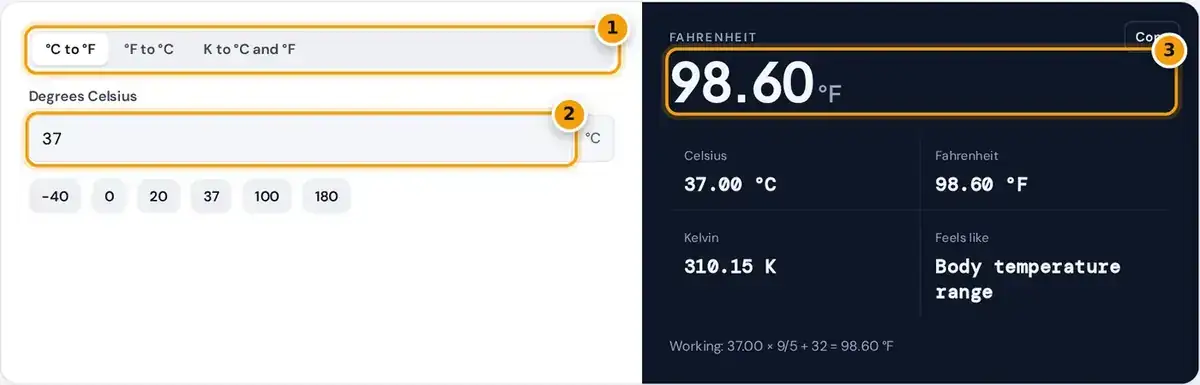
- Choose °C to °F, °F to °C, or Kelvin.
- Enter the temperature in degrees Celsius, or tap a common value below.
- Read the Fahrenheit result, with Kelvin and the step-by-step working.
Choose a direction at the top: degrees Celsius to degrees Fahrenheit, the reverse, or Kelvin to both scales. Then type a temperature, including negative values such as -5, and the result updates as you type.
The quick buttons fill common values like freezing, room temperature, body temperature, boiling and oven heat. Under the result you see all three scales, a feels like label and the working steps for the conversion.
Press Copy to save a line such as 37 °C = 98.6 °F for a recipe or a report. Values below absolute zero are rejected with a message, because no real temperature can go that low.
Celsius to Fahrenheit Formula
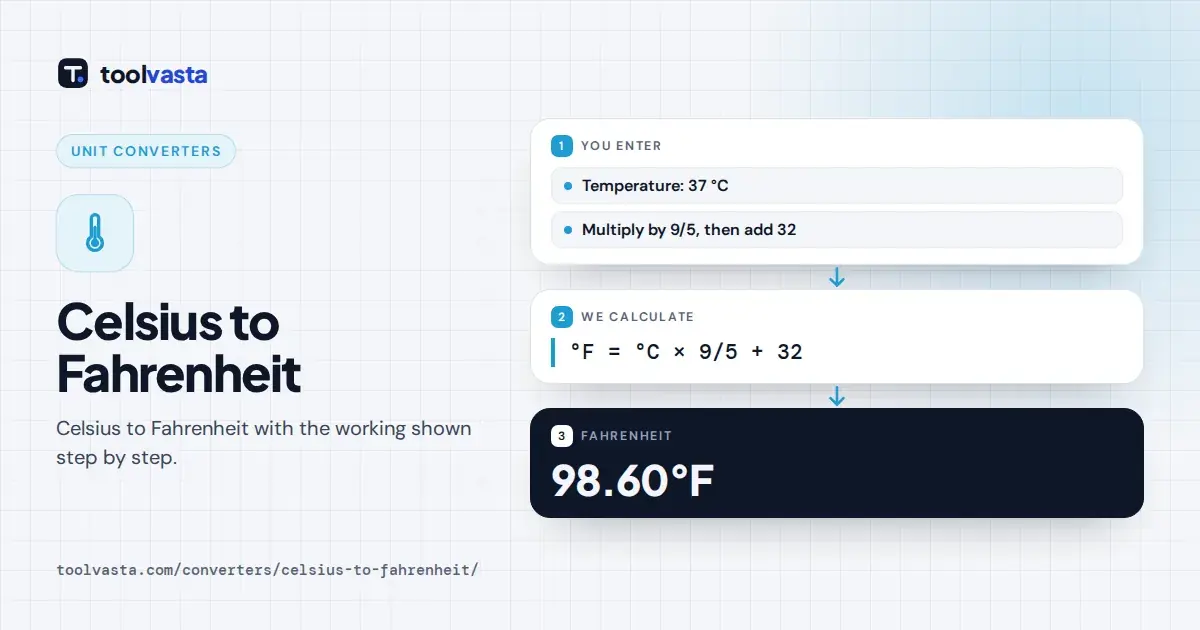
To convert Celsius to Fahrenheit, multiply by 9/5, which is 1.8, and then add 32. Both steps are needed: multiplying adjusts the size of each degree, and adding 32 then moves the zero starting point.
°C = (°F − 32) × 5/9
K = °C + 273.15
To go the other way, subtract 32 from the Fahrenheit value first, then multiply by 5/9. Doing the steps in the wrong order is the most common mistake people make when converting temperatures by hand.
The relationship is linear, so a graph of one scale against the other is a straight line. Kelvin is simpler still: add 273.15 to a Celsius value, because both scales use the same degree size.
Worked Conversion Examples
Normal human body temperature is often given as 37°C. In Fahrenheit that is 37 times 1.8, which is 66.6, plus 32, giving 98.6°F. The same value expressed on the Kelvin scale is exactly 310.15 K.
A recipe asking for 350°F needs 350 minus 32, which is 318, times 5/9. That gives 176.67°C, which most ovens round to 180°C, a normal setting for baking cakes, muffins and casseroles at home today.
A thermostat set to 72°F is 72 minus 32, or 40, times 5/9, which is 22.2°C. Just pick the °F to °C button above, and the converter then shows these working steps under the result.
Common Temperatures in Celsius and Fahrenheit
The table lists useful reference points worth remembering. The freezing point of water is 0°C or 32°F, and the boiling point at sea level is 100°C or 212°F, so those two points anchor both scales.
| °C | °F | Reference point |
|---|---|---|
| −40 | −40 | The two scales are equal |
| −18 | −0.4 | Home freezer |
| 0 | 32 | Water freezes |
| 4 | 39.2 | Refrigerator |
| 20 | 68 | Room temperature |
| 30 | 86 | Hot summer day |
| 37 | 98.6 | Typical body temperature |
| 100 | 212 | Water boils at sea level |
| 180 | 356 | Moderate oven |
| 220 | 428 | Hot oven |
Everyday values sit somewhere in between. A home freezer runs at about -18°C, a refrigerator at about 4°C, and comfortable room temperature is about 20°C, which equals 68°F on the Fahrenheit scale used across America.
Oven settings are where people most often need a conversion. A moderate oven at 180°C is 356°F, and a hot oven at 220°C is 428°F, although most recipes usually round these to 350°F and 425°F.
A Quick Mental Math Shortcut
For weather, a mental math trick works well: double the Celsius value and add 30. For 15°C that gives 60°F, close to the exact answer of 59°F, which is good enough to choose a jacket.
The reverse shortcut subtracts 30 from Fahrenheit and then halves the result. For 80°F that gives 25°C, while the exact answer is 26.7°C, so the approximation stays within a couple of degrees in this band.
The error grows larger at extreme values. At 30°C the shortcut gives 90°F against an exact 86°F, so always use the exact formula for cooking, science and health readings where a few degrees really matter.
Who Uses Celsius and Fahrenheit
Daniel Gabriel Fahrenheit proposed his scale in 1724, and Anders Celsius proposed his in 1742. The Celsius scale was long called centigrade, because it divides the range between freezing and boiling into 100 equal steps.
The United States uses Fahrenheit for daily life, while most of the world, including Canada, uses Celsius as part of the metric system. Science uses Celsius and Kelvin everywhere, regardless of local custom or language.
Canadians still meet Fahrenheit on ovens, in American recipes and in pool or hot tub settings. A converter that handles all three scales prevents mistakes when a recipe, a weather app and a manual disagree.
Why the Formula Uses 9/5 and 32
Water freezes at 0°C and 32°F and boils at 100°C and 212°F at sea level. The Celsius scale covers that gap in 100 degrees, while the Fahrenheit scale covers the same gap in 180 degrees.
So each Celsius interval equals 180 divided by 100, or 1.8 Fahrenheit degrees, which is exactly where the 9/5 comes from. Multiply first to change the degree size, then add 32 to line up zero.
The 32 is needed simply because the two scales start at different points. The Fahrenheit zero sits 32 degrees below the freezing point of water, while the Celsius zero sits exactly at the freezing point.
Body Temperature and Fever
A typical body temperature is about 37°C or 98.6°F, but normal readings vary by person, time of day, activity and measuring method. Temperatures tend to be lower in the morning and higher in the evening.
According to MedlinePlus medical encyclopedia from the NIH, an adult probably has a fever when an oral reading is above 37.2°C to 37.5°C, which is 99°F to 99.5°F, depending on the time of day taken.
For children, a rectal reading of 38°C, or 100.4°F, counts as a fever. These figures are only general guidance for families, so ask a health professional about symptoms rather than relying on a converted number.
Kelvin and Absolute Zero
Absolute zero is the coldest possible temperature: 0 K, which equals -273.15°C or -459.67°F. No temperature can ever be lower, so the converter rejects any value typed below that point with a clear error message.
The kelvin is the SI base unit of temperature, as explained by National Institute of Standards and Technology. One kelvin step equals one Celsius degree, so converting between them only needs a shift of 273.15.
Kelvin is written without a degree sign, so room temperature is about 293 K, not 293°K. Scientists prefer it because it never goes below zero, which makes gas laws and energy equations simpler to apply.
Frequently asked questions
What is the formula for Celsius to Fahrenheit?
Multiply the Celsius temperature by 9/5, which is 1.8, then add 32. Written as a formula, °F = °C × 1.8 + 32. For example, 20°C × 1.8 + 32 = 68°F.
What is 37 C in Fahrenheit?
37°C is 98.6°F. Multiply 37 by 1.8 to get 66.6, then add 32. It is the figure most often quoted as typical human body temperature, although normal readings vary slightly.
At what temperature are Celsius and Fahrenheit equal?
The two scales meet at -40. A reading of -40°C is exactly -40°F, which you can check by multiplying -40 by 1.8 and adding 32. It is the only point where they match.
How do I convert Fahrenheit to Celsius?
Subtract 32, then multiply by 5/9. For example, 68°F minus 32 is 36, and 36 times 5/9 is 20°C. Always subtract before you multiply, or the answer will be wrong.
What is 180 C in Fahrenheit?
180°C is 356°F. Many recipes round this oven temperature to 350°F, which is about 177°C, so either setting works for most cakes, cookies and casseroles.
Is 20 degrees Celsius hot or cold?
20°C is 68°F, which most people find mild and comfortable. It is a common indoor room temperature. Weather around 25°C, or 77°F, starts to feel warm for many people.