Quick answer: To convert liters to US gallons, divide by 3.785411784, the exact number of liters in a US gallon, or multiply by 0.264172. For imperial gallons, divide by 4.54609. For example, a 60 liter fuel tank holds about 15.85 US gallons. The liters to gallons converter shows US gallons, imperial gallons and US quarts side by side.
How Do You Turn Liters into US and Imperial Gallons?
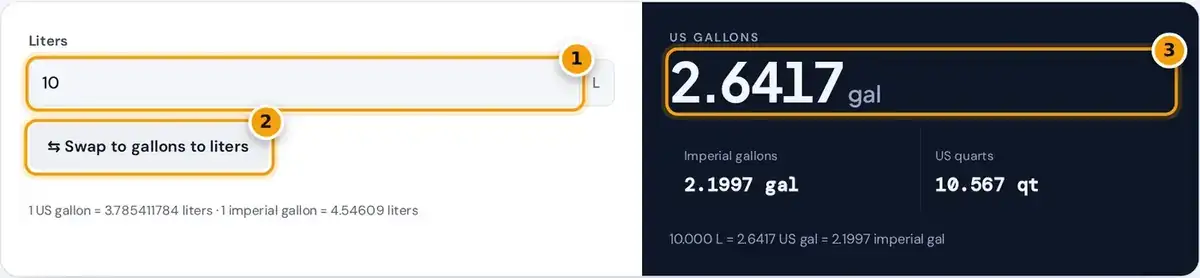
- Type the number of liters you want to convert.
- Tap Swap to convert gallons to liters instead.
- Read the US gallons, with imperial gallons and US quarts listed underneath.
Type a number of liters into the box. The converter instantly shows the volume in US gallons, imperial gallons and US quarts, rounded to four decimal places, with a one-line summary of the conversion underneath.
Need the opposite direction? Press the swap button and the input switches to gallons. A toggle then lets you choose US or imperial gallons, and the results then show liters, milliliters and the other gallon.
Swapping carries your number across with the gallon type that is selected, so 10 imperial gallons becomes 45.4609 liters, not the 37.8541 liters of 10 US gallons. A negative entry is rejected, because a volume cannot be below zero.
What Is the Liters to Gallons Formula?
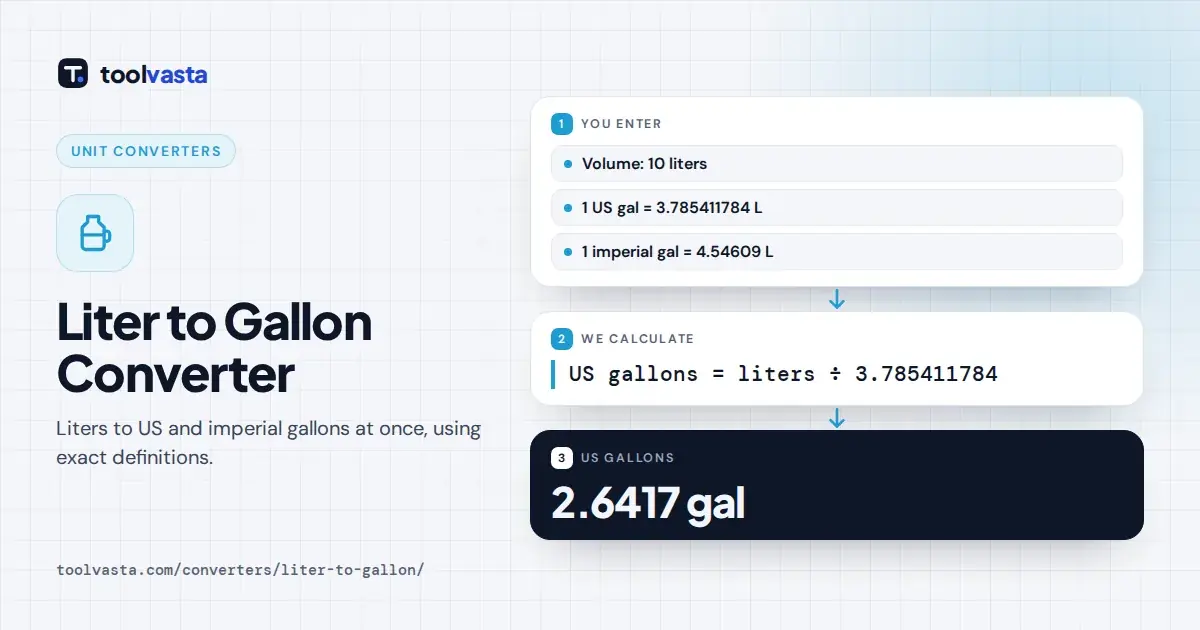
To get US gallons, divide by 3.785411784, the exact number of liters in one US gallon. You can also multiply by 0.264172 for the same answer, because that conversion factor is one divided by 3.785411784.
Imperial gallons = liters ÷ 4.54609
For imperial gallons, divide by 4.54609 liters, which is also an exact definition. As a worked example, a typical 60 liter fuel tank holds 60 ÷ 3.785411784 = 15.8503 US gallons, or 60 ÷ 4.54609 = 13.1982 imperial gallons.
Keep full precision until the very last step and round only the final answer. Rounding the factor to 3.8, as some quick guides do, makes a 1,000 liter result about one full gallon too small.
Liters to Gallons Conversion Table
This conversion table covers common container and tank sizes. Values are rounded to four decimal places, and each row was produced with the same exact factors the converter uses, so the numbers match the tool.
| Liters | US gallons | Imperial gallons |
|---|---|---|
| 1 L | 0.2642 | 0.2200 |
| 2 L | 0.5283 | 0.4399 |
| 4 L | 1.0567 | 0.8799 |
| 5 L | 1.3209 | 1.0998 |
| 7 L | 1.8492 | 1.5398 |
| 10 L | 2.6417 | 2.1997 |
| 20 L | 5.2834 | 4.3994 |
| 25 L | 6.6043 | 5.4992 |
| 45 L | 11.8877 | 9.8986 |
| 50 L | 13.2086 | 10.9985 |
| 60 L | 15.8503 | 13.1982 |
| 75 L | 19.8129 | 16.4977 |
| 100 L | 26.4172 | 21.9969 |
| 200 L | 52.8344 | 43.9938 |
| 1,000 L | 264.1721 | 219.9692 |
Two rows are especially worth remembering. 1 liter is 0.2642 US gallons, roughly a quarter of a gallon. Twenty liters, the standard size of many bottled water jugs and jerry cans, equals 5.2834 US gallons.
For larger volumes, scale the table: 100 liters is 26.4172 US gallons and 1,000 liters, one cubic meter, is 264.1721 US gallons. Imperial figures are always smaller because each imperial gallon holds noticeably more liquid.
How Does the US Gallon Differ From the Imperial Gallon?
The US liquid gallon is defined as exactly 231 cubic inches, which equals 3.785411784 liters. It is the gallon used for gasoline, milk and paint in the United States and in American recipes and manuals.
The imperial gallon is 4.54609 liters, about 20% larger. It comes from the United Kingdom and is still defined in Canada's Weights and Measures Act, so older Canadian manuals and boat specifications quote imperial gallons.
A third unit, the US dry gallon of about 4.405 liters, was used for grain and produce and is rarely seen today. When a source simply says gallons, check its country before converting any volume.
What Is a Liter and What Is a Gallon?
A liter (litre) is the metric system unit of volume accepted for use with SI. It equals one cubic decimeter, a cube 10 centimeters on each side, which is 1,000 cubic centimeters or 1,000 milliliters.
A US gallon belongs to the US customary system. It divides into 4 quarts, 8 pints, 16 cups or 128 fluid ounces, so one liter is about 33.8 US fluid ounces or 1.0567 US quarts.
In the United States, the National Institute of Standards and Technology publishes the conversion factors for customary units. Those exact values are what this converter uses, so results agree with laboratory, trade and legal measurement.
How Do You Convert Gallons to Liters?
Going from gallons to liters, multiply by 3.785411784 for US gallons or by 4.54609 for imperial gallons. In everyday terms, a US gallon is about 3.785 liters and an imperial gallon is about 4.546 liters.
| Gallons | Liters (US gallon) | Liters (imperial gallon) |
|---|---|---|
| 1 | 3.7854 | 4.5461 |
| 2 | 7.5708 | 9.0922 |
| 3 | 11.3562 | 13.6383 |
| 5 | 18.9271 | 22.7305 |
| 10 | 37.8541 | 45.4609 |
So 3 US gallons equals 11.3562 liters, and 5 imperial gallons equals 22.7305 liters. Use the swap button in the converter above, pick the correct gallon type, and convert any other amount you need instantly.
A handy check: one imperial gallon is about 1.2 US gallons, and one US gallon is about 0.83 imperial gallons. If your two answers differ by that ratio, you have mixed up the gallon types.
Everyday Liter to Gallon Conversions
A car's fuel tank is listed in liters in Canada and in gallons in the United States. A 60 liter tank holds about 15.85 US gallons, useful when comparing fuel economy figures across the border.
The familiar 4 liter milk jug in Canada is 1.0567 US gallons, slightly more than an American gallon jug. A 20 liter water jug holds 5.28 US gallons, and a 200 liter drum holds 52.83.
Aquarium sizes, paint cans and recipes often mix the two systems. Convert once with full precision, write the result down, and use the same gallon type throughout a project to avoid small errors adding up.
How Many Gallons Is 1, 10, 200 or 1,000 Liters?
The table above covers common container sizes. These extra values answer the amounts people check most often, from a single bottle to a large storage tank, in both US and imperial gallons.
Small amounts: 1 to 10 liters
| Liters | US gallons | Imperial gallons |
|---|---|---|
| 1 L | 0.26 | 0.22 |
| 2 L | 0.53 | 0.44 |
| 3 L | 0.79 | 0.66 |
| 4 L | 1.06 | 0.88 |
| 5 L | 1.32 | 1.10 |
| 8 L | 2.11 | 1.76 |
| 10 L | 2.64 | 2.20 |
Large tanks: 100 to 1,000 liters
| Liters | US gallons | Imperial gallons |
|---|---|---|
| 100 L | 26.42 | 22.00 |
| 150 L | 39.63 | 33.00 |
| 200 L | 52.83 | 43.99 |
| 250 L | 66.04 | 54.99 |
| 300 L | 79.25 | 65.99 |
| 500 L | 132.09 | 109.98 |
| 750 L | 198.13 | 164.98 |
| 1,000 L | 264.17 | 219.97 |
A standard 55 US gallon drum holds about 208 liters, so a 200 liter drum is slightly smaller at 52.83 US gallons. A 1,000 liter IBC tote holds 264.17 US gallons.
Liters per 100 km and miles per gallon
Fuel economy uses the same units in a different form. To turn liters per 100 kilometers into US miles per gallon, divide 235.21 by the L/100 km figure; for imperial mpg, divide 282.48 by it. A car using 6 L/100 km gets about 39.2 US mpg or 47.1 imperial mpg, and one using 8 L/100 km gets about 29.4 US mpg.
What Goes Wrong When Converting Liters to Gallons?
The division itself is simple. Errors come from using the wrong gallon, a rounded factor, or a container name that sounds like a gallon size but is not.
Where 3.785411784 comes from
The US liquid gallon is 231 cubic inches, and the inch is exactly 2.54 cm. One cubic inch is therefore 2.54 × 2.54 × 2.54 = 16.387064 mL, and 231 × 16.387064 = 3,785.411784 mL. No rounding is involved, which is why the factor stops after nine decimal places. The imperial gallon is defined directly as 4.54609 liters.
How much does a rounded factor cost?
| Liters | Exact US gallons | Dividing by 3.8 | Multiplying by 0.26 |
|---|---|---|---|
| 10 L | 2.642 | 2.632 (0.010 short) | 2.60 (0.042 short) |
| 60 L | 15.850 | 15.789 (0.061 short) | 15.60 (0.250 short) |
| 200 L | 52.834 | 52.632 (0.203 short) | 52.00 (0.834 short) |
| 1,000 L | 264.172 | 263.158 (1.014 short) | 260.00 (4.172 short) |
Both shortcuts read low. On a 60 liter fuel tank the 0.26 shortcut is a full quart short, and on a 1,000 liter tank it loses more than 4 gallons.
A barrel is not a drum
An oil barrel, the unit used for crude oil prices, is 42 US gallons, which is 158.99 liters. A steel drum is usually 55 US gallons, which is 208.2 liters. A US 5 gallon water bottle is 18.93 liters, not 20. Convert from the stated gallon figure and do not assume a round metric size.
Fluid ounces and pints differ too
A US gallon is 128 US fluid ounces of 29.57 mL each. An imperial gallon is 160 imperial fluid ounces of 28.41 mL each. A US pint is 473.2 mL and an imperial pint is 568.3 mL, so a recipe or a beer glass quoted in pints carries the same gap of about 20% as the gallons do.
Price per liter to price per gallon
To compare fuel prices, multiply the price per liter by 3.785411784. A price of $1.50 per liter is 1.50 × 3.785411784 = $5.68 per US gallon in the same currency. Going the other way, $3.50 per US gallon is 3.50 ÷ 3.785411784 = $0.925 per liter. Convert the currency as a separate step.
For a trip budget, the fuel cost calculator accepts US mpg or L/100 km with a price per gallon or per liter. To find how many gallons a container holds from its dimensions, use the pool volume calculator or the box volume calculator. To weigh a liquid volume, the mL to grams converter applies the density of water, milk, oil and other liquids.
Frequently asked questions
How many liters are in a gallon?
A US gallon holds exactly 3.785411784 liters, usually rounded to 3.785 liters. An imperial gallon, used in the UK and in older Canadian sources, holds exactly 4.54609 liters, about 4.546 liters.
How many gallons is 1 liter?
One liter equals 0.2642 US gallons or 0.2200 imperial gallons. Put another way, a liter is a little more than a quarter of a US gallon and a little more than one US quart.
Is 1 gallon 4 liters?
Not quite. A US gallon is 3.785 liters, so 4 liters is 1.0567 US gallons. The common 4 liter milk jug in Canada therefore holds slightly more than an American one gallon jug.
How many gallons is 20 liters?
Twenty liters equals 5.2834 US gallons or 4.3994 imperial gallons. That is the size of a standard metric jerry can. A US 5 gallon water cooler bottle is slightly smaller, at 18.93 liters.
Is a dry gallon the same as a liquid gallon?
No. The US dry gallon is about 4.405 liters and was used for grain and produce. The US liquid gallon is 3.785 liters and is the one used for fuel, milk and most recipes.
Does Canada use US or imperial gallons?
Canada officially sells fuel and groceries in liters. Where gallons still appear, older Canadian sources usually mean imperial gallons, while American products, manuals and recipes use US gallons. Check the source before converting.
How many gallons is 4 liters?
4 liters is about 1.06 US gallons, or 0.88 imperial gallons. A US gallon holds 3.785 liters, so 4 liters is a little more than one gallon.
How many gallons is 1,000 liters?
1,000 liters is about 264.2 US gallons, or 220.0 imperial gallons. That is the size of a common IBC tote.
How many gallons is 200 liters?
200 liters is 52.83 US gallons or 43.99 imperial gallons. The common steel drum sold as 55 US gallons holds about 208 liters, so it is slightly larger than a 200 liter drum.
How do I convert L/100 km to mpg?
Divide 235.21 by the L/100 km figure for US mpg, or 282.48 for imperial mpg. For example, 6 L/100 km is about 39.2 US mpg.