How to Use the Nm to ft-lb Converter
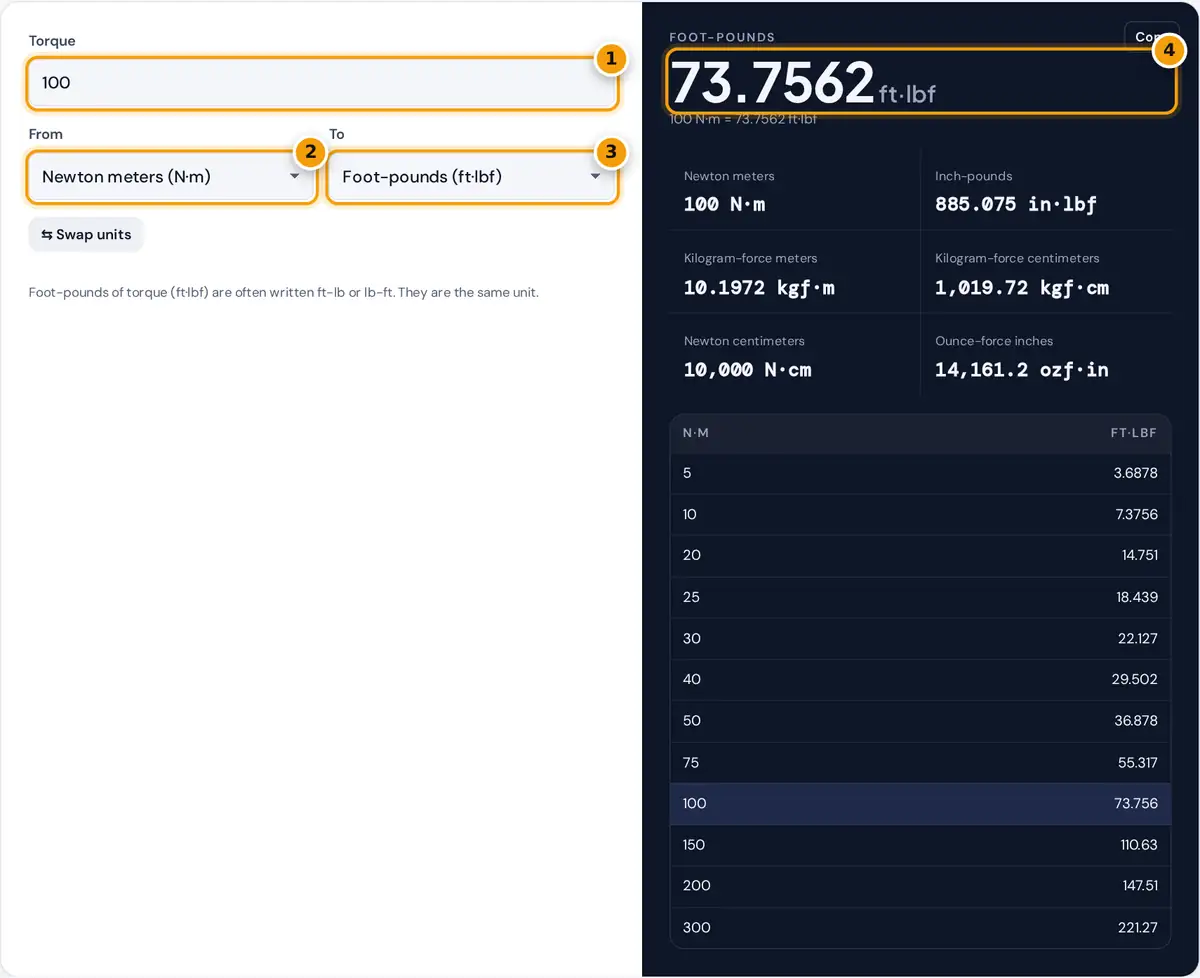
- Type the torque value from your manual or wrench.
- Choose the unit you have, such as newton meters.
- Choose the unit you need, such as foot-pounds or inch-pounds.
- Read the converted torque, with every other unit and a settings table below.
Type a torque value, choose the unit you have in From and the unit you need in To. The converted value appears in large type, every other torque unit is listed underneath, and a table converts a range of common settings so you can read off several bolts at once. Use Swap units to go from foot-pounds back to newton meters.
The converter covers the units found in service manuals and on torque wrenches: newton meters (N·m), foot-pounds (ft·lbf, also written ft-lb or lb-ft), inch-pounds (in·lbf), kilogram-force meters and centimeters used in older Japanese and European manuals, newton centimeters for small fasteners, and ounce-force inches for electronics and model work.
Torque Conversion Formula
The factors come from exact definitions published by NIST. One pound-force is exactly 4.4482216152605 N and one foot is exactly 0.3048 m, so one foot-pound of torque is their product.
ft·lbf = N·m ÷ 1.3558179483 = N·m × 0.7375621493
1 in·lbf = 0.1129848290 N·m, and 12 in·lbf = 1 ft·lbf
1 kgf·m = 9.80665 N·m exactly
Worked Example
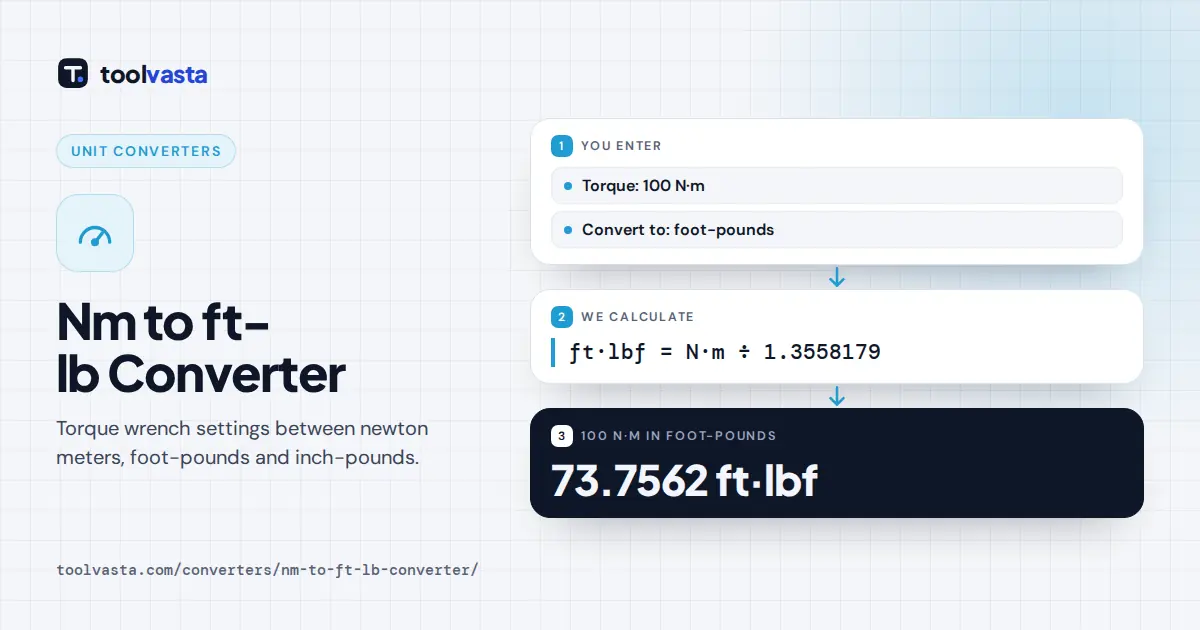
A wheel nut spec of 100 N·m is 100 × 0.7375621 = 73.756 ft·lbf, so a wrench marked in foot-pounds would be set to about 74. Going the other way, an 80 ft·lbf spec is 80 × 1.3558179 = 108.47 N·m. A spark plug torque of 25 N·m is 221.27 in·lbf, and an old manual that lists 10 kgf·m means 98.07 N·m or 72.33 ft·lbf.
Nm to ft-lb Table
| N·m | ft·lbf | in·lbf | kgf·m |
|---|---|---|---|
| 5 | 3.688 | 44.25 | 0.510 |
| 10 | 7.376 | 88.51 | 1.020 |
| 20 | 14.751 | 177.01 | 2.039 |
| 25 | 18.439 | 221.27 | 2.549 |
| 50 | 36.878 | 442.54 | 5.099 |
| 75 | 55.317 | 663.80 | 7.648 |
| 100 | 73.756 | 885.07 | 10.197 |
| 120 | 88.507 | 1,062.09 | 12.237 |
| 150 | 110.634 | 1,327.61 | 15.296 |
| 200 | 147.512 | 1,770.15 | 20.394 |
ft-lb, lb-ft and ft·lbf
All three names describe the same torque unit: a force of one pound-force acting at a distance of one foot. Engineers sometimes write lb-ft for torque to keep it separate from the foot-pound of work or energy, which has the same dimensions. Torque wrenches and car manuals in Canada and the US use either name. Newton meters are the SI unit, and most modern manuals list them first.
Torque Wrench Tips
- Always use the value from the manufacturer for your exact vehicle or part. This tool converts units; it does not provide specifications.
- Click-type wrenches are most accurate in the middle of their range, roughly 20 to 100% of full scale.
- Specs are usually for clean, dry threads. Lubricant or anti-seize can raise the actual clamping force for the same torque.
- Store click wrenches at their lowest setting so the spring keeps its calibration.
Small Fasteners: in-lb and N·cm
Bicycle components, electronics, firearm accessories and small engine parts often use low torque values, where inch-pounds and newton centimeters are easier to read than foot-pounds. A bicycle stem bolt rated 5 N·m is 44.25 in·lbf, or only 3.69 ft·lbf, a value most large wrenches cannot set accurately. That is why small torque wrenches and drivers are scaled in in·lbf or N·m. When converting a spec, keep the result in the unit your tool shows, and choose a wrench whose range puts the target near the middle of its scale.
Torque Is Not Power
Engine specs list both torque and power. Torque is the twisting force, in N·m or lb-ft. Power is how fast that work is done, so it depends on speed as well: horsepower = torque in lb-ft × rpm ÷ 5,252. A converter like this one changes torque units only. To compare two engines, convert both torques to the same unit and look at the rpm where each figure is reached.
If a manual gives a range such as 40 to 50 N·m, convert both ends and aim for the middle of the converted range.
Frequently asked questions
How do I convert Nm to ft-lb?
Multiply newton meters by 0.7375621, or divide by 1.3558179. For example, 100 N·m is 73.756 ft-lb. The factor is exact because the pound-force and the foot are both defined in SI units.
How many Nm is 1 ft-lb?
One foot-pound is 1.3558179483 newton meters. It comes from multiplying one pound-force, 4.4482216152605 newtons, by one foot, 0.3048 meters. So 50 ft-lb is about 67.79 N·m.
Are ft-lb and lb-ft the same?
Yes. Both describe one pound-force applied at one foot from the pivot. Some engineers prefer lb-ft for torque to distinguish it from foot-pounds of energy, but a wrench setting is the same either way.
How do I convert inch-pounds to Nm?
Multiply inch-pounds by 0.1129848. For example, 100 in-lb is 11.30 N·m. Twelve inch-pounds make one foot-pound, so you can also divide by 12 first and then convert foot-pounds.
What is kgf·m in Nm?
One kilogram-force meter is exactly 9.80665 newton meters, because standard gravity is defined as 9.80665 m/s². Older manuals listing 10 kgf·m mean about 98.07 N·m, or 72.33 ft-lb.
What torque should I use for lug nuts?
Use the figure in your vehicle owner manual or from the wheel maker, since it varies by vehicle and stud size. Convert it here if your wrench uses different units, and recheck after the first drive.