How to Use the Dew Point Calculator
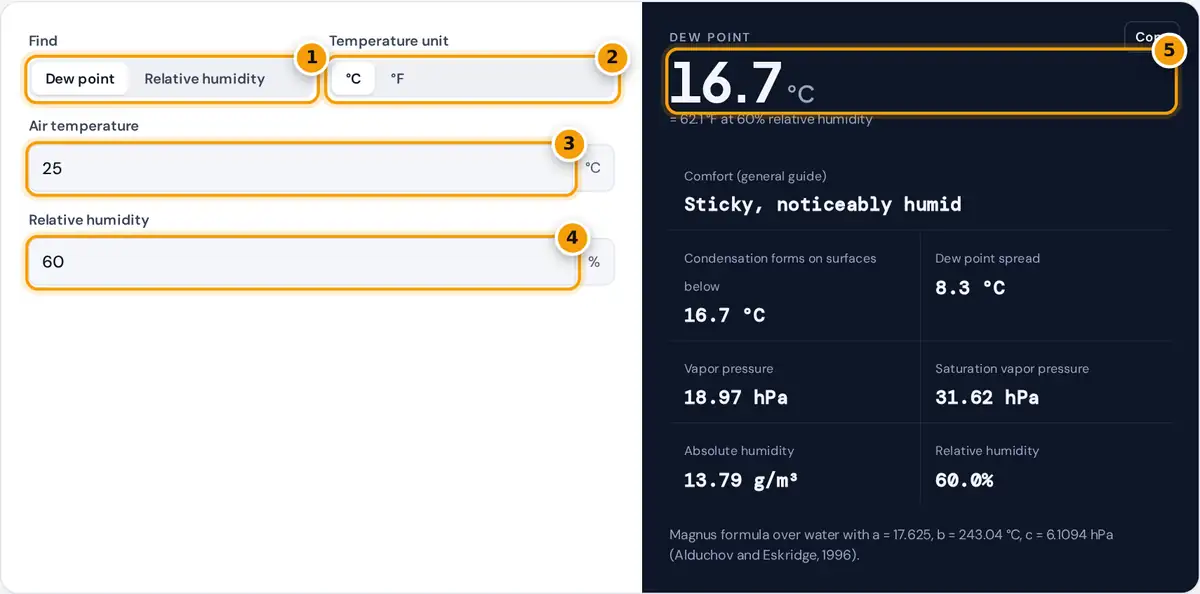
- Choose whether to find the dew point or the relative humidity.
- Pick Celsius or Fahrenheit; values you typed are converted.
- Enter the air temperature.
- Enter the relative humidity from your hygrometer or weather report.
- Read the dew point, with a comfort guide, vapor pressure and absolute humidity.
Choose whether you want the dew point or the relative humidity, and pick Celsius or Fahrenheit. To find the dew point, enter the air temperature and the relative humidity from a thermometer, hygrometer or weather report. To find relative humidity, enter the air temperature and the dew point instead. Switching units converts the numbers you already typed.
Along with the main answer, the result shows the temperature below which surfaces collect condensation, the dew point spread, the actual and saturation vapor pressure, the absolute humidity in grams of water per cubic meter, and a simple comfort guide.
What the Dew Point Tells You
The dew point is the temperature to which air must cool, at constant pressure and moisture content, for water vapor to start condensing. Unlike relative humidity, which changes as the air warms and cools during the day, the dew point measures the actual amount of moisture in the air. That makes it the better number for judging how muggy it feels, whether windows and pipes will sweat, and whether fog or frost is likely overnight.
The Magnus Formula
Dew point Td = b × γ ÷ (a − γ)
Relative humidity = 100 × es(Td) ÷ es(T)
es(T) = 6.1094 × exp(a × T ÷ (b + T)) hPa
a = 17.625, b = 243.04 °C
T is the air temperature in degrees Celsius and RH is relative humidity in percent. The constants are those recommended by Alduchov and Eskridge (1996), which keep the error very small between about −40 °C and 50 °C. Fahrenheit inputs are converted to Celsius first. Absolute humidity uses the ideal gas law with the gas constant for water vapor, 461.5 J/(kg·K).
Worked Example
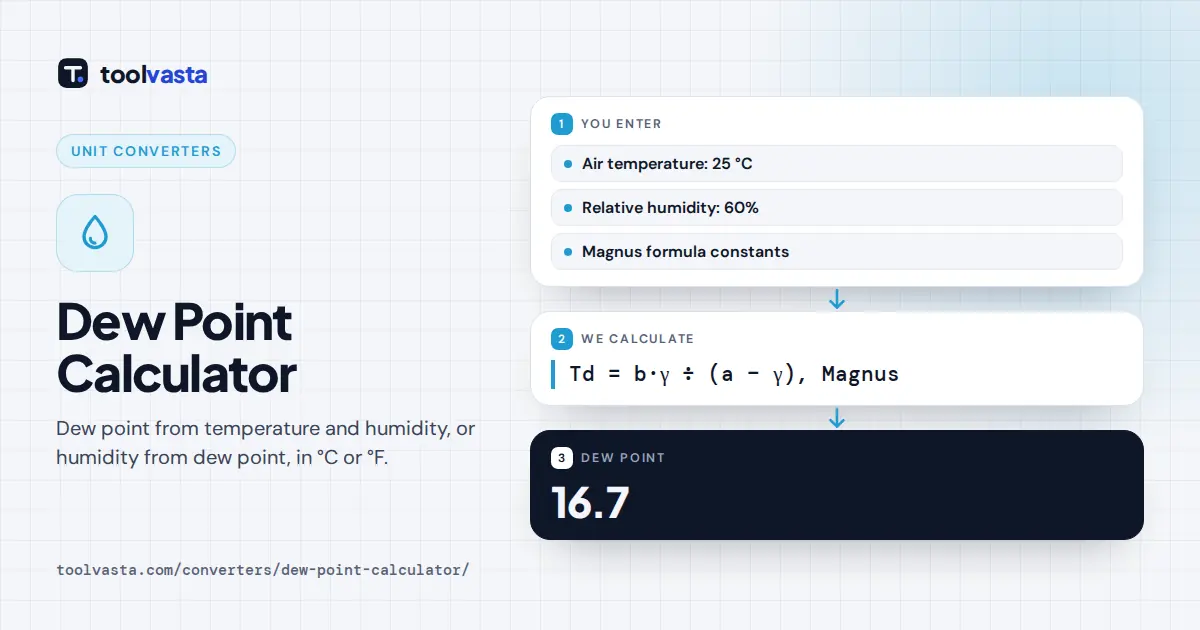
At 25 °C and 60% relative humidity, γ = ln(0.60) + 17.625 × 25 ÷ 268.04 = −0.5108 + 1.6439 = 1.1330. The dew point is 243.04 × 1.1330 ÷ (17.625 − 1.1330) = 16.7 °C, or 62.1 °F. Any surface colder than 16.7 °C, such as a cold water pipe or an air conditioned window, will collect condensation. The vapor pressure is 18.97 hPa and the air holds 13.79 g of water per cubic meter.
Going the other way, air at 25 °C with a dew point of 15 °C has a relative humidity of 53.8%.
Dew Point Comfort Guide
| Dew point | How it usually feels |
|---|---|
| Below 55 °F (12.8 °C) | Dry and comfortable |
| 55 to 65 °F (12.8 to 18.3 °C) | Sticky, noticeably humid |
| 65 °F (18.3 °C) and above | Oppressive, very humid |
This is a general guide used in weather forecasting. Comfort also depends on wind, sun, clothing, activity and what you are used to.
Practical Uses
- Homes and buildings: keep interior surfaces, such as windows, walls and ducts, above the dew point to avoid condensation and mold.
- Painting and coatings: many product data sheets ask for the surface to be a few degrees above the dew point while coating and curing.
- Weather: when the evening temperature falls to the dew point, expect dew, fog or, below freezing, frost.
- Compressed air and storage: the dew point shows how much drying is needed to prevent water in lines or on stored goods.
Limits
The formula assumes saturation over liquid water. Below 0 °C the frost point, the temperature at which ice forms, is slightly higher than the dew point. Readings from consumer hygrometers can be off by several percent, which shifts the dew point by about a degree, so treat results as estimates when your humidity reading is uncertain.
Indoors, a dew point that stays above about 16 °C (60 °F) for long periods often goes with damp, mold-prone rooms, while a dew point below freezing in winter means very dry air. A dehumidifier lowers the dew point by removing water; heating the air raises the temperature but leaves the dew point unchanged.
Frequently asked questions
How do I calculate dew point from temperature and humidity?
Use the Magnus formula: γ equals ln(RH ÷ 100) plus 17.625 × T ÷ (243.04 + T), and the dew point equals 243.04 × γ ÷ (17.625 − γ), with T in °C. At 25 °C and 60% humidity the dew point is 16.7 °C.
What is a comfortable dew point?
A dew point below about 55 °F, or 12.8 °C, usually feels dry and comfortable. Between 55 and 65 °F it starts to feel sticky, and above 65 °F, or 18.3 °C, most people find it oppressive.
What is the difference between dew point and relative humidity?
Relative humidity is the moisture in the air as a percentage of the maximum at the current temperature, so it changes as air warms and cools. Dew point measures the actual moisture, so it stays steady through the day.
Can the dew point be higher than the temperature?
No. When air cools to its dew point it becomes saturated at 100% relative humidity and extra moisture condenses. The dew point can equal the temperature, which happens in fog, but not exceed it.
Why do my windows sweat?
Condensation forms on any surface colder than the dew point of the air touching it. If your indoor dew point is 12 °C and the window glass is 8 °C, moisture condenses. Lower indoor humidity or warm the glass to stop it.
What is the dew point at 100% humidity?
At 100% relative humidity the dew point equals the air temperature. The air is saturated and cannot hold more water vapor without some of it condensing as dew, fog or cloud.