How to Use the Freight Class Calculator
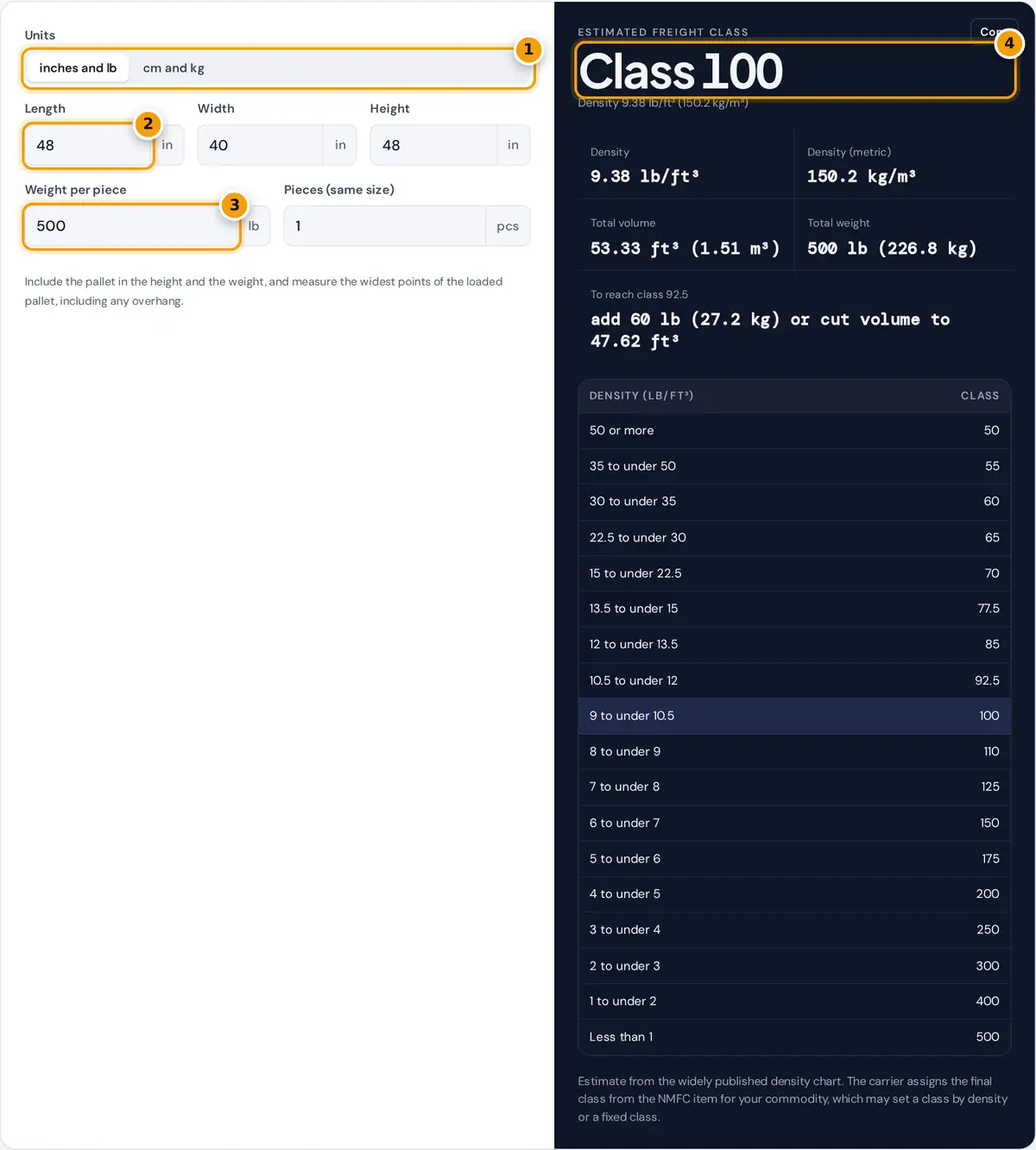
- Choose inches and pounds or centimeters and kilograms.
- Enter the pallet length, width and height, including the pallet itself.
- Enter the weight per piece and how many identical pieces ship.
- Read the estimated class, the density and how much weight reaches a lower class.
Choose inches and pounds or centimeters and kilograms. Enter the length, width and height of one loaded pallet or piece, its weight including the pallet, and how many identical pieces are in the shipment. The calculator returns the freight density, the total cubic feet and the estimated class from the density chart that many carriers and brokers publish. The highlighted row in the table shows where your shipment sits, and the last line tells you how much weight, or how much less volume, would move it into the next lower class.
What Freight Class Means
Less than truckload (LTL) carriers in North America price shipments partly by freight class, a number from 50 to 500 defined in the National Motor Freight Classification (NMFC). Lower classes are dense, durable and easy to handle, so they cost less per pound. Higher classes are light for their size, fragile or awkward. Density is the single biggest factor for most commodities, which is why a density estimate is the usual first step before requesting a quote.
The Density Formula
Density (lb/ft³) = total weight (lb) ÷ total cubic feet
Metric: 1 lb/ft³ = 16.0185 kg/m³
There are 1,728 cubic inches in a cubic foot (12 × 12 × 12). Metric inputs are converted to inches and pounds using the exact definitions 1 in = 2.54 cm and 1 lb = 0.45359237 kg.
Worked Example
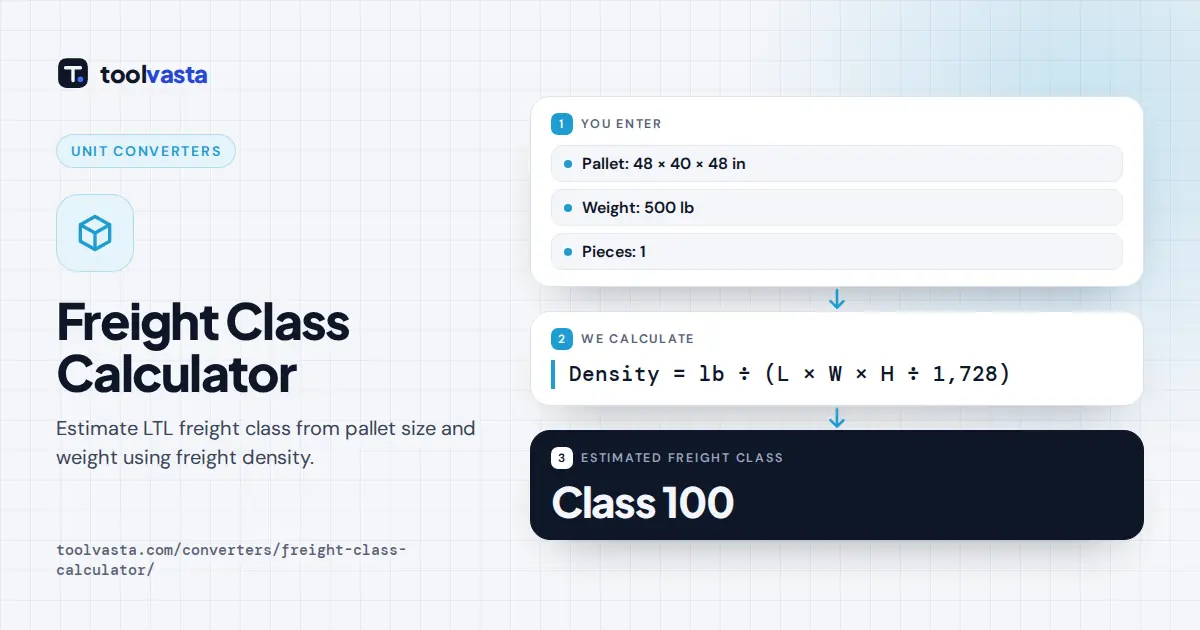
A standard 48 × 40 inch pallet stacked to 48 inches high weighs 500 lb. Its volume is 48 × 40 × 48 = 92,160 in³, and 92,160 ÷ 1,728 = 53.33 ft³. The density is 500 ÷ 53.33 = 9.38 lb/ft³, which falls in the 9 to 10.5 bracket, so the estimate is class 100. To reach class 92.5 the density must be at least 10.5 lb/ft³: either add 10.5 × 53.33 − 500 = 60 lb, or reduce the volume to 500 ÷ 10.5 = 47.62 ft³. If the same pallet is only 40 inches high, the volume drops to 44.44 ft³, the density rises to 11.25 lb/ft³ and the estimate becomes class 92.5.
Freight Class Density Chart
| Density (lb/ft³) | Class |
|---|---|
| 50 or more | 50 |
| 35 to under 50 | 55 |
| 30 to under 35 | 60 |
| 22.5 to under 30 | 65 |
| 15 to under 22.5 | 70 |
| 13.5 to under 15 | 77.5 |
| 12 to under 13.5 | 85 |
| 10.5 to under 12 | 92.5 |
| 9 to under 10.5 | 100 |
| 8 to under 9 | 110 |
| 7 to under 8 | 125 |
| 6 to under 7 | 150 |
| 5 to under 6 | 175 |
| 4 to under 5 | 200 |
| 3 to under 4 | 250 |
| 2 to under 3 | 300 |
| 1 to under 2 | 400 |
| Less than 1 | 500 |
This is the widely published density guideline used for quoting. It is a guide, not the tariff itself.
Limits of a Density Estimate
- The NMFC assigns classes to specific commodity items. Some items have a fixed class regardless of density, and others use density brackets that differ from this general chart.
- The NMFC is revised from time to time, including changes to how density is applied. Ask your carrier or broker which item number and class apply to your goods before you book.
- Carriers can reweigh and remeasure shipments. A wrong class on the bill of lading can lead to a reclassification fee and a higher rate.
- Stackability, handling, liability and value can also affect class for some commodities, which density alone cannot capture.
Tips for a Lower Class
Because class falls as density rises, the cheapest shipments are compact and well built. Stack cartons evenly so the pallet height is as low as possible, avoid overhang beyond the pallet edges, which adds to the measured footprint, and combine light items with heavier ones on the same pallet when they ship to the same place. Measure after wrapping, since stretch wrap and corner boards can add an inch or two that changes the result near a bracket boundary.
Frequently asked questions
How do I calculate freight class?
Find the density first: multiply length, width and height in inches, divide by 1,728 to get cubic feet, then divide the weight in pounds by the cubic feet. Match that density to the class chart, for example 9.38 lb/ft³ is class 100.
What freight class is a 48x40x48 pallet weighing 500 lb?
Its volume is 53.33 cubic feet and its density is 9.38 lb per cubic foot. On the common density chart that falls between 9 and 10.5, which is class 100.
Does a higher freight class cost more?
Usually yes. Higher classes cover light, bulky or fragile freight that takes more space or care, so the rate per hundredweight is higher. Class 50 is the densest bracket and generally the cheapest per pound.
Should I include the pallet in the weight and height?
Yes. Carriers measure and weigh the shipment as it is handed over, so include the pallet, packaging and wrap in the height and weight. Measure the widest points, including any overhang.
Is density the only thing that sets freight class?
No. Many commodities are classed by density, but the NMFC also considers handling, stowability and liability, and some items have a fixed class. Use this estimate for quotes and confirm the item number with your carrier.
How can I lower my freight class?
Increase density: use smaller packaging, stack lower and tighter, avoid overhang, and consolidate items. The calculator shows how much weight to add or volume to remove to reach the next lower class.