How to Use the Pulley Calculator
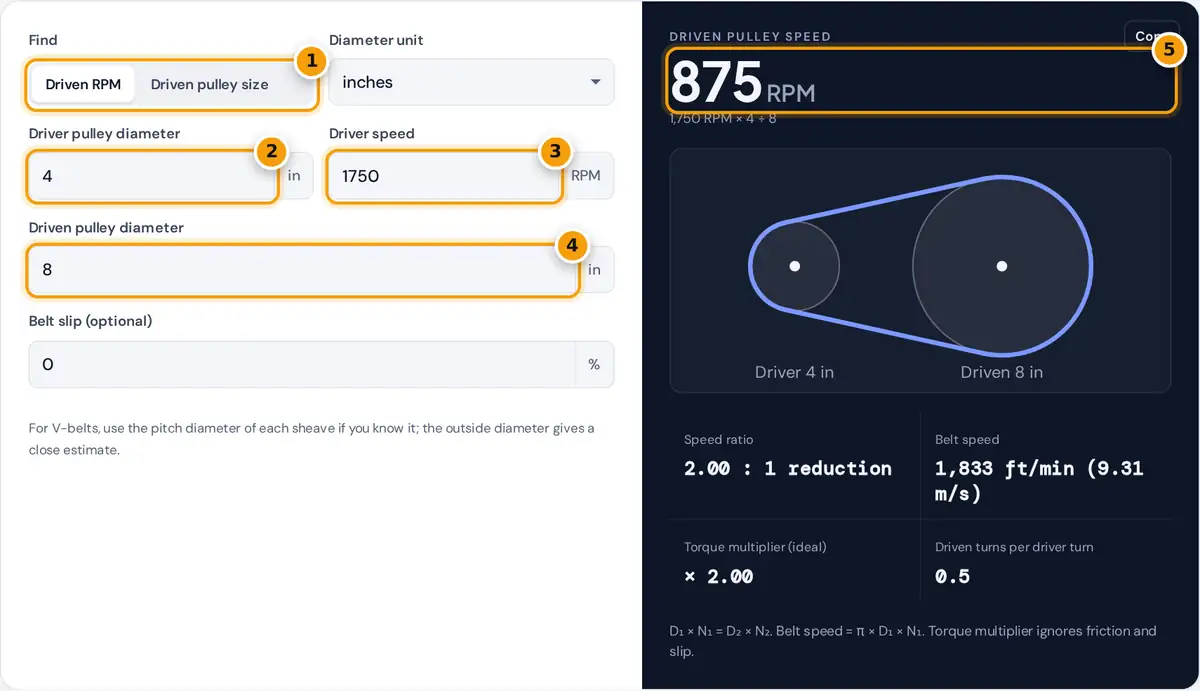
- Choose to find the driven RPM or the driven pulley size.
- Enter the driver pulley diameter.
- Enter the driver speed in RPM.
- Enter the driven pulley diameter.
- Read the driven RPM, with speed ratio, belt speed and torque factor.
Choose whether you want the speed of the driven pulley or the size of pulley you need. Enter the driver pulley diameter, which is the pulley on the motor or engine shaft, and its speed in revolutions per minute (RPM). Then enter the driven pulley diameter to get its speed, or a target speed to get the diameter that produces it. Pick inches or millimeters; switching converts the diameters you entered.
Add a belt slip percentage for a more realistic answer. Flat belts and V-belts typically slip 1% to 3% under load; toothed timing belts do not slip, so leave it at 0. The diagram shows the two pulleys to scale with an open belt.
The Pulley Formulas
Driven RPM N₂ = N₁ × D₁ ÷ D₂ × (1 − slip)
Driven diameter D₂ = D₁ × N₁ × (1 − slip) ÷ N₂
Belt speed = π × D₁ × N₁ (in ft/min: π × D in inches × RPM ÷ 12)
A belt moves at the same surface speed on both pulleys. The rim of each pulley travels its circumference, π times the diameter, every revolution, so a pulley twice the diameter turns at half the speed. Torque changes the opposite way: ignoring losses, halving the speed doubles the torque at the driven shaft.
Worked Example
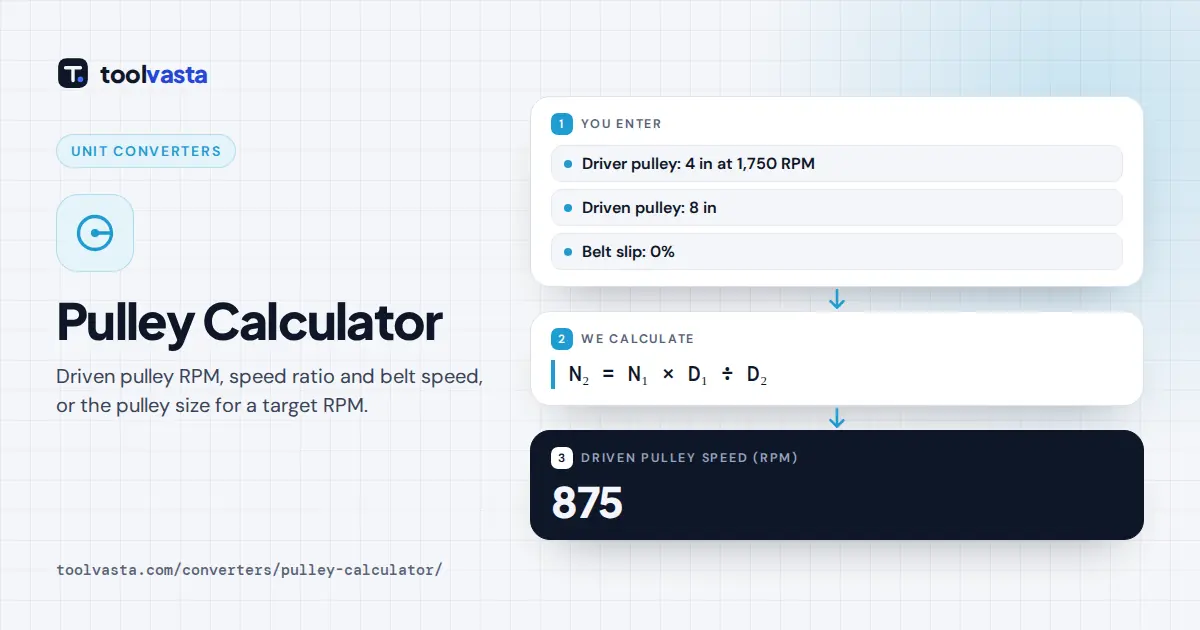
A 1,750 RPM motor carries a 4 inch pulley and drives an 8 inch pulley. The driven speed is 1,750 × 4 ÷ 8 = 875 RPM, a 2 : 1 reduction that ideally doubles the torque. The belt speed is π × 4 × 1,750 ÷ 12 = 1,833 ft/min, or 9.31 m/s. With 2% slip the driven pulley turns at 857.5 RPM.
To run a machine at 1,200 RPM from the same motor and 4 inch pulley, the driven pulley must be 4 × 1,750 ÷ 1,200 = 5.833 inches. In metric, a 100 mm pulley on a 1,450 RPM motor driving a 250 mm pulley gives 580 RPM with a belt speed of 7.59 m/s.
Driven RPM From a 1,750 RPM Motor
| Driver | Driven 4 in | Driven 6 in | Driven 8 in | Driven 10 in | Driven 12 in |
|---|---|---|---|---|---|
| 2 in | 875 | 583 | 438 | 350 | 292 |
| 3 in | 1,313 | 875 | 656 | 525 | 438 |
| 4 in | 1,750 | 1,167 | 875 | 700 | 583 |
| 5 in | 2,188 | 1,458 | 1,094 | 875 | 729 |
| 6 in | 2,625 | 1,750 | 1,313 | 1,050 | 875 |
Values ignore slip and are rounded to the nearest RPM.
Compound Drives
When one shaft carries two pulleys, such as a jackshaft, the speed ratios multiply. A 2 : 1 stage followed by a 3 : 1 stage gives 6 : 1 overall, so a 1,750 RPM motor ends up at 291.7 RPM. Work out the first stage here, then enter its driven speed as the driver speed of the second stage. Compound drives are common in drill presses, lathes, fans and agricultural machinery where a single pair of pulleys would need an impractically large driven pulley.
The same rules apply to sprockets and chains if you count teeth instead of measuring diameters, and to gears, where the gear ratio equals the number of teeth on the driven gear divided by the teeth on the driver.
Tips and Limits
- V-belts ride partly down in the groove, so the effective pitch diameter is smaller than the outside diameter. Manufacturer catalogs list pitch diameters for each sheave.
- Keep the belt wrap on the small pulley above about 120 degrees, or the belt can slip. Long center distances and similar pulley sizes help.
- Many standard V-belts and cast iron sheaves are limited to belt speeds of roughly 6,500 ft/min. Check the ratings before running at high speed.
- Use the belt length calculator to find the belt size for your two pulleys and center distance.
Frequently asked questions
How do I calculate pulley RPM?
Multiply the driver speed by the driver diameter and divide by the driven diameter. A 1,750 RPM motor with a 4 inch pulley driving an 8 inch pulley turns the driven shaft at 1,750 times 4 divided by 8, which is 875 RPM.
How do I find the pulley size for a target speed?
Multiply the driver diameter by the driver RPM and divide by the target RPM. To get 1,200 RPM from a 4 inch pulley on a 1,750 RPM motor, you need a 5.833 inch driven pulley.
What is a pulley ratio?
The pulley ratio is the driven diameter divided by the driver diameter. An 8 inch driven pulley with a 4 inch driver is a 2 to 1 ratio: the driven shaft turns at half the speed with about twice the torque.
How do I calculate belt speed?
Multiply π by the pulley diameter and by its RPM. In inches, divide by 12 to get feet per minute. A 4 inch pulley at 1,750 RPM gives a belt speed of about 1,833 ft/min, or 9.31 m/s.
Does a bigger pulley increase speed?
A bigger driver pulley increases the driven speed, while a bigger driven pulley reduces it. Speed changes in proportion to the diameter ratio, and torque changes in the opposite direction.
How much do belts slip?
V-belts and flat belts typically slip about 1% to 3% under load, so the driven pulley turns slightly slower than the formula predicts. Toothed timing belts and chains do not slip.