How to Use the Parallel Circuit Calculator
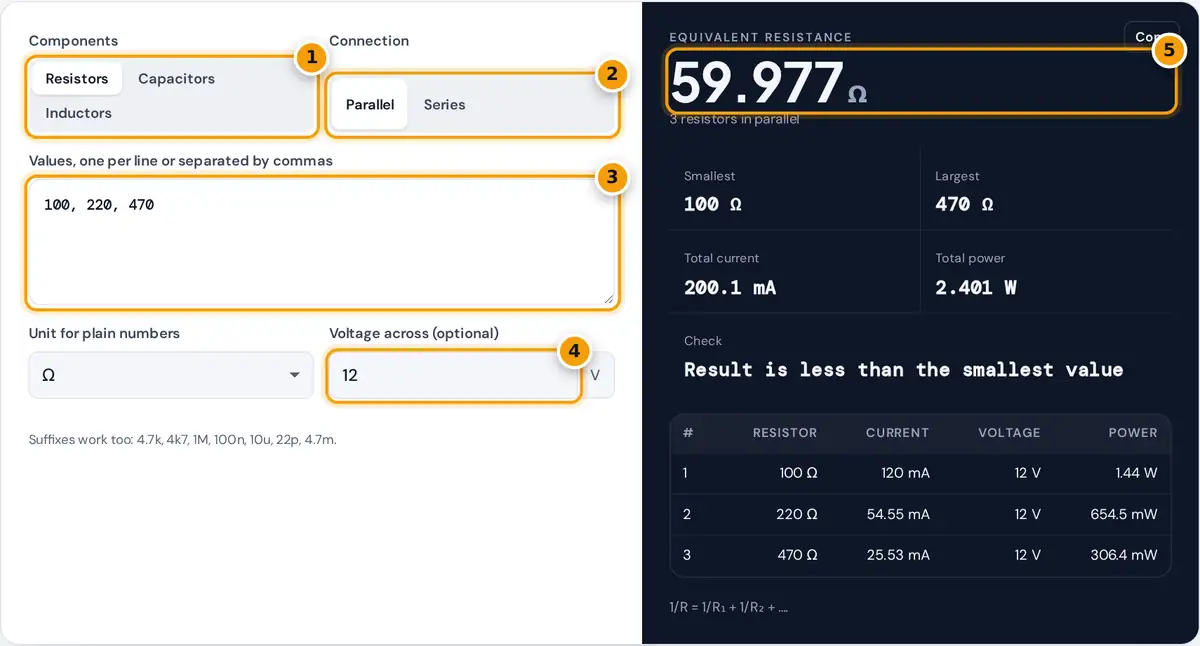
- Choose resistors, capacitors or inductors.
- Choose parallel or series.
- Type the values, one per line or comma separated, with suffixes like 4.7k or 100n.
- For resistors, enter the voltage to see current and power per resistor.
- Read the equivalent value, then the per-component table.
Choose resistors, capacitors or inductors, and choose parallel or series. Type the values into the box, one per line or separated by commas. Plain numbers use the unit in the menu, and you can also type engineering suffixes: 4.7k or 4k7 for 4,700 Ω, 1M for one million, 100n for 100 nanofarads, 10u for 10 microfarads and 4.7m for 4.7 millihenries.
For resistors, enter the voltage across the network to see the total current and power and, in the table, the current, voltage drop and power for each resistor. For capacitors and inductors the table shows how much each part contributes to the total.
Parallel and Series Formulas
Resistors in series: R = R₁ + R₂ + …
Capacitors in parallel: C = C₁ + C₂ + …
Capacitors in series: 1/C = 1/C₁ + 1/C₂ + …
Inductors follow the resistor rules (no mutual coupling)
Two in parallel: R = R₁ × R₂ ÷ (R₁ + R₂)
Resistors and inductors add directly in series. In parallel, their reciprocals add, so the result is always smaller than the smallest part. Capacitors work the other way round: parallel capacitors add their plate area and simply sum, while series capacitors combine like parallel resistors.
Worked Example
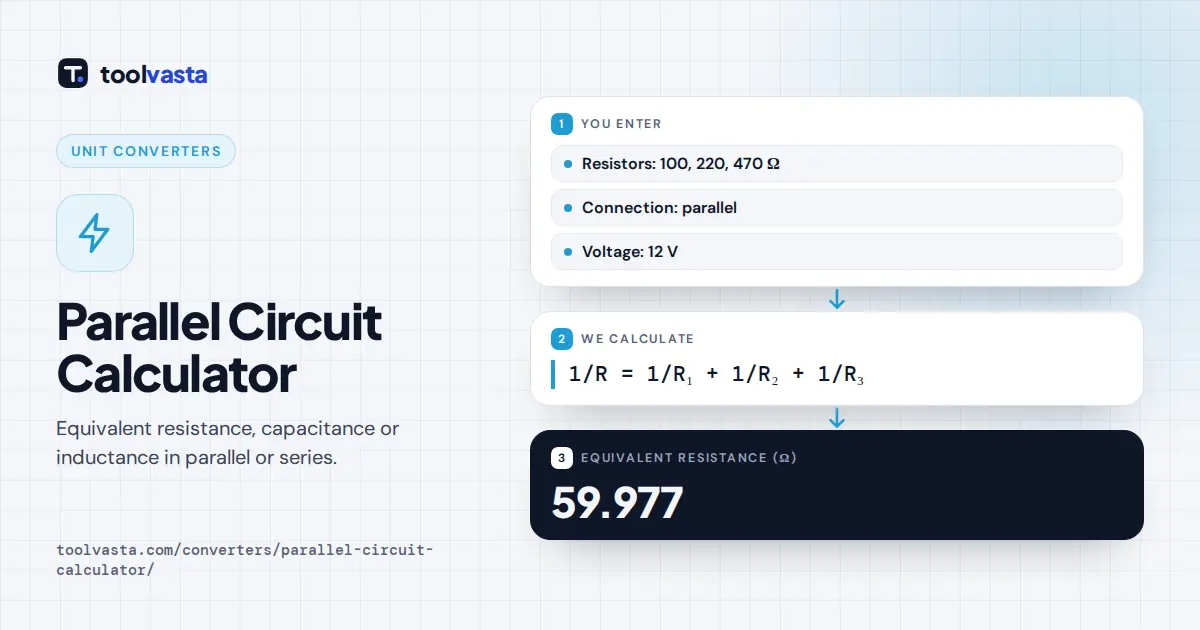
Three resistors of 100 Ω, 220 Ω and 470 Ω in parallel: 1/100 + 1/220 + 1/470 = 0.01 + 0.004545 + 0.002128 = 0.016673, so the equivalent resistance is 1 ÷ 0.016673 = 59.977 Ω. Across 12 V the total current is 12 ÷ 59.977 = 200.1 mA. Each branch has the full 12 V: the 100 Ω resistor carries 120 mA and dissipates 1.44 W, the 220 Ω carries 54.55 mA (654.5 mW) and the 470 Ω carries 25.53 mA (306.4 mW).
The same three resistors in series add to 790 Ω. At 12 V the current is 15.19 mA, and the voltage divides in proportion to resistance: 1.519 V, 3.342 V and 7.139 V.
For capacitors, 10, 22 and 47 µF in parallel give 79 µF, and in series give 5.998 µF.
Quick Reference
| Combination | Parallel | Series |
|---|---|---|
| Two equal resistors R | R ÷ 2 | 2R |
| n equal resistors R | R ÷ n | nR |
| Two equal capacitors C | 2C | C ÷ 2 |
| Two equal inductors L | L ÷ 2 | 2L |
| Voltage across each part | Same for all | Divides by value |
| Current through each part | Divides by value | Same for all |
Current and Voltage Dividers
Parallel resistors form a current divider: each branch carries a share of the total current in inverse proportion to its resistance, so the branch with half the resistance carries twice the current. Series resistors form a voltage divider: each resistor drops a share of the supply voltage in proportion to its resistance. The table in the result shows both. For example, 10 kΩ and 20 kΩ in series across 9 V drop 3 V and 6 V, which is the basis of sensor and reference circuits.
Practical Uses
- Make a value you do not have in stock: two 1 kΩ resistors in parallel give 500 Ω, and a 10 kΩ with a 15 kΩ gives 6 kΩ.
- Share power: resistors in parallel split the heat, so two 1/4 W resistors of twice the resistance can replace one 1/2 W resistor in many cases.
- Raise voltage rating: capacitors in series share the voltage, although balancing resistors are often needed to keep the split even.
- Bulk capacitance: parallel capacitors add up, which is how power supplies combine several small capacitors for low impedance.
Limits
The formulas assume ideal parts. Real resistors have tolerances of 1% to 10%, electrolytic capacitors often −20% to +20% or wider, and inductors placed close together can couple magnetically, which changes their combined inductance. Check power ratings against the per-resistor power column, and leave a safety margin.
Frequently asked questions
How do I calculate resistors in parallel?
Add the reciprocals of each resistance and take the reciprocal of the sum. For 100, 220 and 470 ohms, 1/100 plus 1/220 plus 1/470 equals 0.016673, so the total is about 59.98 ohms.
What is the formula for two resistors in parallel?
Multiply the two resistances and divide by their sum. A 10 kΩ and a 15 kΩ resistor in parallel give 150 divided by 25, which is 6 kΩ. The result is always smaller than the smaller resistor.
How do capacitors add in series and parallel?
Capacitors in parallel simply add, so 10 µF and 22 µF give 32 µF. In series their reciprocals add, the same way resistors combine in parallel, so the total is smaller than the smallest capacitor.
Is the voltage the same in a parallel circuit?
Yes. Every branch of a parallel circuit has the same voltage across it. The current divides between branches in inverse proportion to resistance, so the smallest resistor carries the most current.
How do inductors combine?
Inductors without magnetic coupling combine like resistors: they add in series, and their reciprocals add in parallel. If inductors are close together or share a core, mutual inductance changes the result.
What values can I type into the calculator?
Plain numbers use the unit in the menu. You can also add suffixes p, n, u, m, k and M, or the resistor code style 4k7. Separate values with commas, semicolons or new lines.