How to Use the Transformer Calculator
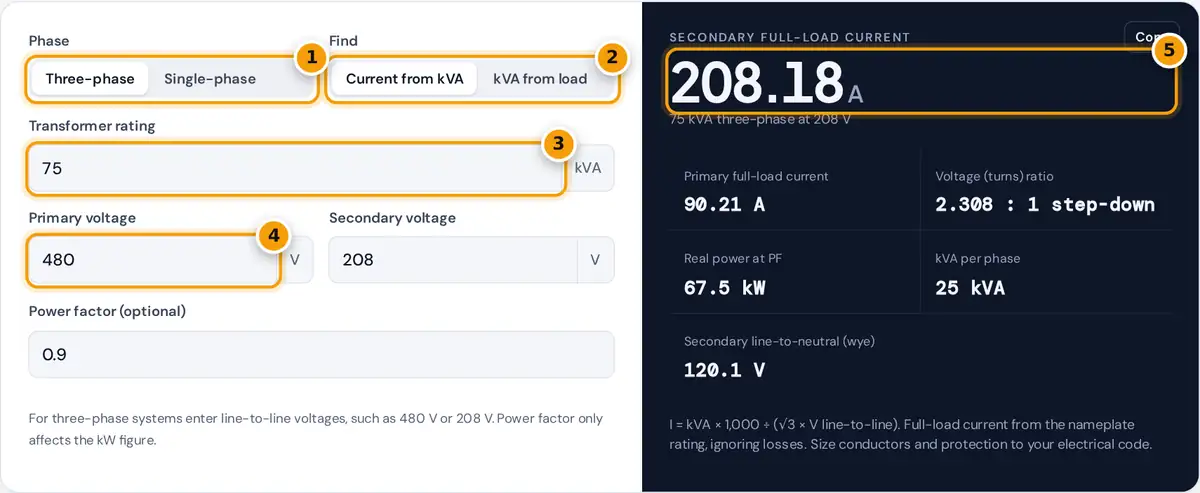
- Choose three-phase or single-phase.
- Choose current from kVA, or kVA from a load.
- Enter the transformer rating in kVA.
- Enter the primary and secondary voltages, line to line for three-phase.
- Read the secondary full-load current, with primary current and ratio below.
Choose three-phase or single-phase, then pick what you want to find. Current from kVA takes the transformer’s nameplate rating and its primary and secondary voltages, and returns the full-load current on each winding, the voltage ratio and, if you enter a power factor, the real power in kW. kVA from load works the other way: enter the load current and voltage to get the apparent power, add a spare capacity margin, and see the next common standard transformer size.
For three-phase systems always use line-to-line voltages such as 480 V, 600 V or 208 V. Switching phase loads a typical example for that system.
The Formulas
Three-phase: kVA = √3 × VLL × I ÷ 1,000 I = kVA × 1,000 ÷ (√3 × VLL)
kW = kVA × power factor
Voltage ratio = Vprimary ÷ Vsecondary ≈ turns ratio
Transformers are rated in kilovolt-amperes (kVA), apparent power, because their heating depends on current and voltage regardless of the load’s power factor. The factor √3 (about 1.732) appears in three-phase formulas because line-to-line voltage is √3 times the phase voltage of a balanced wye system.
Worked Examples
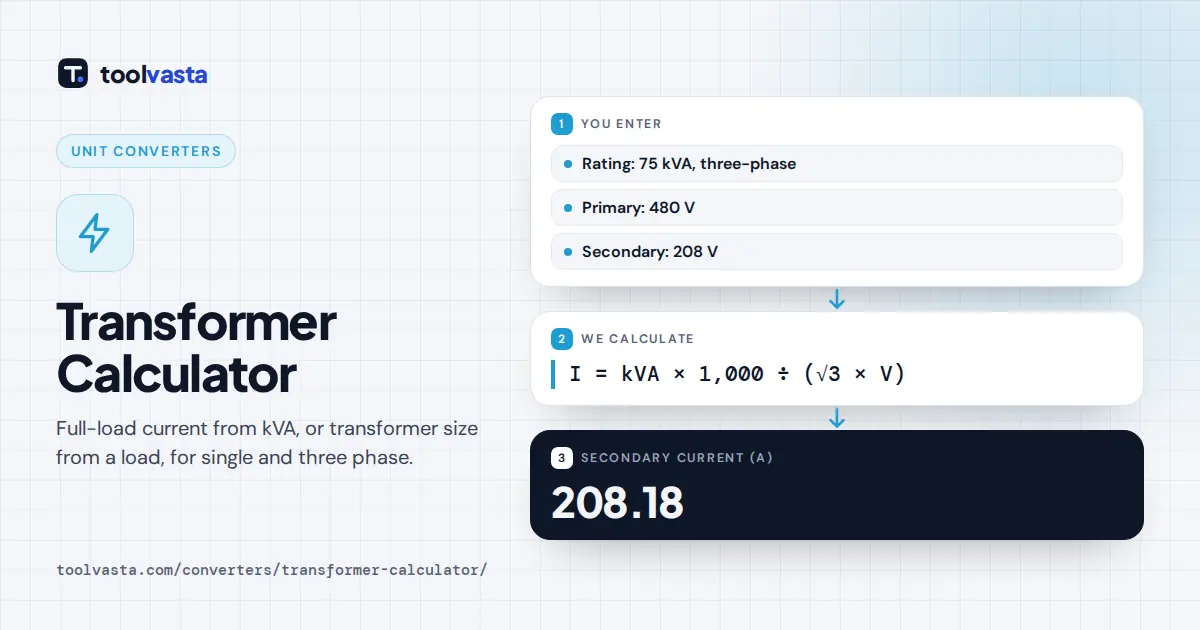
Three-phase. A 75 kVA transformer steps 480 V down to 208Y/120 V. The primary full-load current is 75,000 ÷ (1.732 × 480) = 90.21 A, and the secondary current is 75,000 ÷ (1.732 × 208) = 208.18 A. The voltage ratio is 2.308 to 1, and at a power factor of 0.9 the transformer can deliver 67.5 kW.
Sizing. A three-phase load draws 150 A at 208 V: √3 × 208 × 150 ÷ 1,000 = 54.04 kVA. With a 20% margin you need 64.85 kVA, so the next common size is 75 kVA, which runs at 72.1% of its rating.
Single-phase. A 25 kVA pole transformer with a 7,200 V primary and 240 V secondary carries 25,000 ÷ 7,200 = 3.47 A on the primary and 25,000 ÷ 240 = 104.17 A on the secondary.
Delta and Wye Connections
Three-phase transformers are commonly connected delta on the primary and wye on the secondary. A wye secondary such as 208Y/120 V provides 208 V between lines and 120 V from each line to neutral, which suits mixed lighting, receptacle and motor loads. The line current formula in this calculator applies to both delta and wye, as long as you use the line-to-line voltage. Single-phase loads on a three-phase transformer should be balanced across the phases so no single winding is overloaded.
Full-Load Current for Common Three-Phase Sizes
| kVA | 208 V | 240 V | 480 V | 600 V |
|---|---|---|---|---|
| 15 | 41.6 A | 36.1 A | 18.0 A | 14.4 A |
| 30 | 83.3 A | 72.2 A | 36.1 A | 28.9 A |
| 45 | 124.9 A | 108.3 A | 54.1 A | 43.3 A |
| 75 | 208.2 A | 180.4 A | 90.2 A | 72.2 A |
| 112.5 | 312.3 A | 270.6 A | 135.3 A | 108.3 A |
| 150 | 416.4 A | 360.8 A | 180.4 A | 144.3 A |
| 300 | 832.7 A | 721.7 A | 360.8 A | 288.7 A |
Choosing a Transformer Size
Add up the connected and expected loads in kVA, apply any demand factors your electrical code allows, and add a margin for future growth. The calculator lists common standard ratings: for three-phase dry-type units these include 15, 30, 45, 75, 112.5, 150, 225 and 300 kVA, and for single-phase units 10, 15, 25, 37.5, 50, 75 and 100 kVA. Manufacturers and utilities may offer other sizes.
Limits and Safety
- Full-load current is a rating, not a measurement. Actual current depends on the connected load.
- Harmonic-rich loads, high ambient temperatures, altitude and large motor starts can require a larger or specially rated transformer.
- Conductor sizing, overcurrent protection and grounding must follow the electrical code that applies to you, such as the Canadian Electrical Code or the NEC. Have a licensed electrician or engineer design and inspect the installation.
Frequently asked questions
How do I calculate three-phase transformer current?
Divide the kVA times 1,000 by the square root of 3 times the line-to-line voltage. A 75 kVA transformer at 208 V carries 75,000 divided by 360.3, which is about 208.2 A at full load.
How do I convert kVA to amps for single-phase?
Multiply the kVA by 1,000 and divide by the voltage. A 25 kVA single-phase transformer at 240 V delivers 25,000 divided by 240, which is 104.17 A at full load.
How do I size a transformer in kVA?
For three-phase, multiply the line-to-line voltage by the load current and by 1.732, then divide by 1,000. Add a spare capacity margin and round up to the next standard size, for example 75 kVA.
What is the difference between kVA and kW?
kVA is apparent power, voltage times current. kW is the real power that does work, equal to kVA times the power factor. Transformers are rated in kVA because their heating depends on current, not power factor.
What is the turns ratio of a 480 to 208 V transformer?
The voltage ratio is 480 divided by 208, which is about 2.31 to 1. For an ideal transformer the turns ratio equals the voltage ratio, and current changes by the inverse ratio.
Why is the square root of 3 used for three-phase?
In a balanced three-phase system the line-to-line voltage is the square root of 3 times the phase voltage. Total power is three times the phase power, which simplifies to √3 times line voltage times line current.