How to Use the Mg to mL Converter
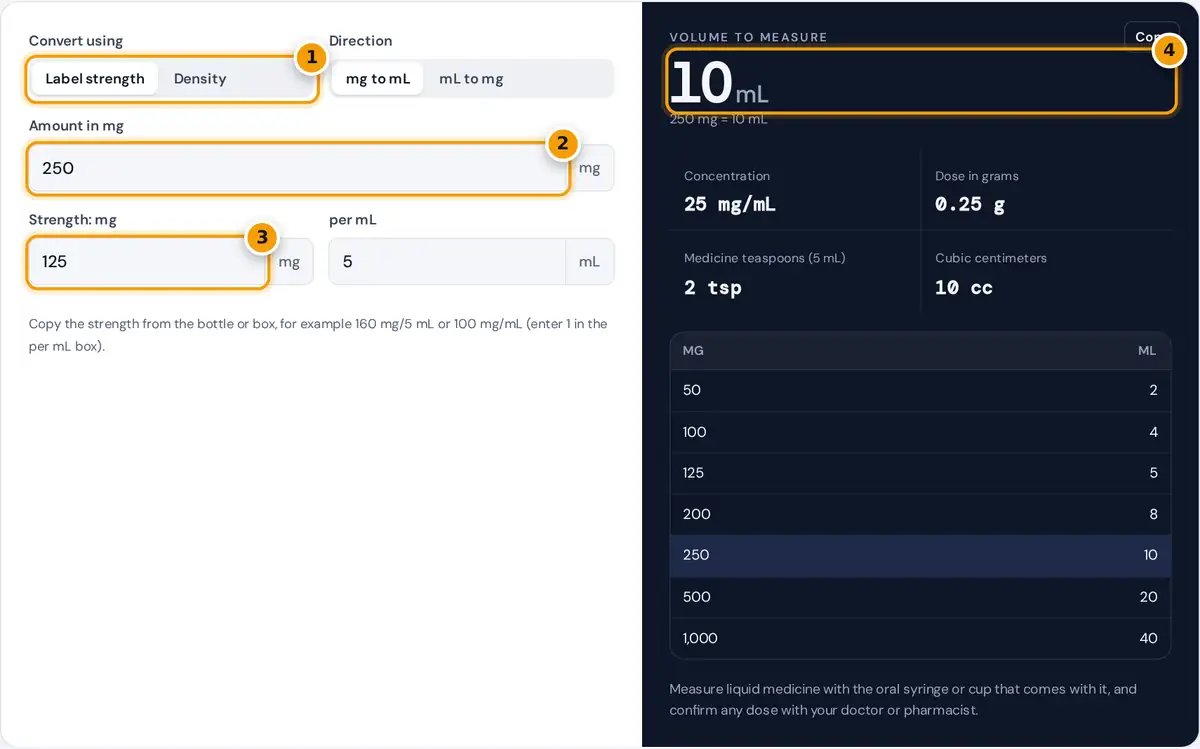
- Choose label strength for liquid medicines, or density for a pure substance such as water or oil.
- Enter the dose in mg, or switch direction to enter a volume in mL.
- Copy the strength from the label, for example 125 mg per 5 mL.
- Read the volume to measure in mL, with teaspoons and a table of nearby doses.
Choose how you want to convert. Label strength is for liquid medicines, supplements and lab solutions where the concentration is printed as milligrams per milliliter, such as 125 mg/5 mL or 100 mg/mL. Density is for a pure substance such as water, oil, honey or alcohol, where the mass of each milliliter is a physical property.
Then pick the direction. mg to mL tells you how much liquid holds a given dose. mL to mg tells you how many milligrams are in a volume you measured. The table under the result lists common amounts at the same strength so you can check nearby doses at a glance.
Why Mg and mL Cannot Be Converted Directly
A milligram is a unit of mass and a milliliter is a unit of volume. One milliliter of water has a mass of about 1,000 mg, but one milliliter of honey is about 1,420 mg and one milliliter of a children’s fever syrup might contain only 32 mg of the active drug. There is no single factor, so every correct mg to mL conversion uses either a concentration or a density.
The Formula
mL = dose in mg ÷ concentration
mg = mL × concentration
for a pure substance: concentration = density (g/mL) × 1,000
Worked Example
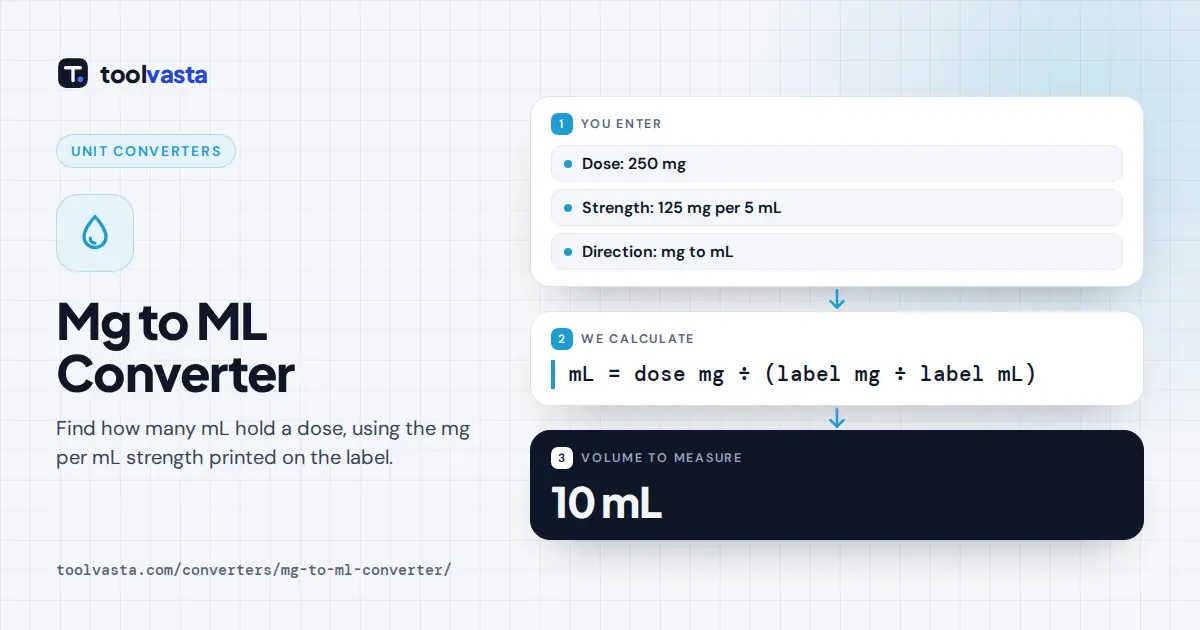
A prescription calls for a 250 mg dose of an antibiotic suspension labeled 125 mg/5 mL. The concentration is 125 ÷ 5 = 25 mg/mL, so the volume is 250 ÷ 25 = 10 mL, which is two 5 mL medicine teaspoons. If you instead measure 7.5 mL of the same suspension, it holds 7.5 × 25 = 187.5 mg.
For a pure substance, 500 mg of honey at 1.42 g/mL takes up 500 ÷ 1,420 = 0.352 mL, while 1,000 mg of water is exactly 1 mL at a density of 1 g/mL.
Mg to mL Table at Common Strengths
| Dose | At 100 mg/5 mL | At 125 mg/5 mL | At 250 mg/5 mL | At 100 mg/mL |
|---|---|---|---|---|
| 50 mg | 2.5 mL | 2 mL | 1 mL | 0.5 mL |
| 100 mg | 5 mL | 4 mL | 2 mL | 1 mL |
| 125 mg | 6.25 mL | 5 mL | 2.5 mL | 1.25 mL |
| 200 mg | 10 mL | 8 mL | 4 mL | 2 mL |
| 250 mg | 12.5 mL | 10 mL | 5 mL | 2.5 mL |
| 500 mg | 25 mL | 20 mL | 10 mL | 5 mL |
Typical Densities
The density option includes common substances at room temperature: water 1.00 g/mL, milk about 1.03 g/mL, vegetable oil about 0.92 g/mL, olive oil about 0.91 g/mL, honey about 1.42 g/mL, ethanol 0.789 g/mL and glycerin about 1.26 g/mL. Real densities shift slightly with temperature and composition, so choose Other and type a measured value when precision matters.
Measuring Liquid Medicine Safely
- Use the oral syringe or dosing cup supplied with the medicine. Kitchen teaspoons vary widely in size.
- Check the strength every time you buy a new bottle. Infant and children’s versions of the same drug often have different concentrations.
- A cc (cubic centimeter) is the same volume as a mL, so a 5 cc syringe holds 5 mL.
- This converter does arithmetic only. Your doctor or pharmacist decides the dose, and their instructions take priority over any calculator.
Reading Strengths Written in Other Ways
Labels do not always say mg/mL. A strength written as 160 mg/5 mL means 32 mg in each milliliter, so enter 160 and 5. A percentage strength for a liquid is usually weight per volume, where 1% means 1 g in 100 mL, or 10 mg/mL; a 2% solution is therefore 20 mg/mL, so enter 20 and 1. Some injectable and vitamin products list micrograms (mcg); divide by 1,000 to get mg first. When a strength is given per drop, the volume of a drop depends on the dropper, so use the dropper or syringe supplied and the volumes on the label rather than converting drops to mL yourself.
Frequently asked questions
How many mL is 250 mg?
It depends on the concentration. At 125 mg per 5 mL, 250 mg is 10 mL. At 250 mg per 5 mL it is 5 mL, and for pure water it is 0.25 mL. Enter the strength on the label to get the exact volume.
How do I convert mg to mL?
Divide the dose in mg by the concentration in mg per mL. If a label says 160 mg per 5 mL, the concentration is 32 mg/mL, so a 240 mg dose is 240 divided by 32, which equals 7.5 mL.
How many mg are in 1 mL of water?
About 1,000 mg. Water has a density of close to 1 gram per milliliter at room temperature, and one gram is 1,000 milligrams. Other liquids differ, for example 1 mL of honey is about 1,420 mg.
How many mg are in 5 mL?
Multiply 5 by the concentration in mg per mL. For a medicine labeled 125 mg/5 mL, 5 mL contains exactly 125 mg. For water, 5 mL weighs about 5,000 mg, which is 5 grams.
Is a cc the same as a mL?
Yes. One cubic centimeter is exactly one milliliter, so a syringe marked in cc measures the same volume as one marked in mL. Doses written as 2.5 cc and 2.5 mL are identical.
Can I use a kitchen spoon for a 5 mL dose?
It is not recommended. Kitchen spoons vary a lot in size, so the dose can be far off. Use the oral syringe or cup that comes with the medicine, and ask a pharmacist if one is missing.